China factory sourcing · Published · Reviewed
Barium Ferrite Magnet Factory Made in China
Estimate part mass and quoted tooling cost, then prepare an RFQ. Use the evidence guide below to check Ba chemistry, the actual manufacturing site and shipment terms.
Start the factory RFQ evaluator ↓Factory RFQ evaluator
Four decisions before accepting a factory quote
| Decision | Reason / evidence | Next step |
|---|---|---|
| Require explicit Ba chemistry | A magnetic grade is not a chemical composition certificate. IEC materials scope covers multiple material families. | Request a lot-linked BaFe12O19 declaration and substitution control. |
| Compare property limits, not grade names | IEC 60404-8-1 covers magnetic property specifications; no exact supplier Y-to-US/IEC mapping is established here. | Compare Br, Hcb, Hcj and (BH)max under the same test conditions. |
| Treat calculated output as a scenario | Geometry is calculable; density, loss, shrinkage and timing are unverified assumptions. | Confirm mass, DFM and schedule with the actual plant. |
| Verify export terms for each shipment | Tax rates, carrier acceptance and contractual delivery obligations require transaction details. | Use the official tax lookup, forwarder review and named Incoterms 2020 terms. |
Method: the quote checklist is editorial procurement guidance, not a factory ranking. Source: IEC 60404-8-1:2023 — Permanent magnet materials. Transaction details remain unconfirmed.
1. Verify the production site and manufacturing chain
A seller claiming “factory direct” should identify who presses, sinters, finishes and magnetizes the part. Ask which steps are subcontracted and which legal entity accepts quality responsibility. Location, registration and photographs are useful leads; none alone proves a working barium ferrite line.
- Identify the legal entity and exact production address.
- Verify which site presses, sinters and finishes your part.
- Link approved samples and production lots to that site.
- List the seller, sintering operator and subcontractors.
- Match audit evidence to the actual production site.
- Agree change notification before any site or process substitution.
| Check | Evidence to request | Hold point |
|---|---|---|
| Legal and production identity | Business registration, site address, named sintering operator and subcontracting list | Seller cannot link the quoted part to a real production site |
| Ba chemistry and traceability | Material declaration, powder batch and lot identifier; agreed composition test if critical | Only a generic “ferrite / Y30” datasheet is offered |
| Process and quality responsibility | Representative process records, approved inspection methods and change-notification terms | Unapproved site, material or process substitution |
| Commercial accountability | Tool ownership, maintenance, sample acceptance and nonconformance handling in writing | Tooling fees or responsibility for rejected lots remain unclear |
Direct sintering can simplify process access; a disclosed intermediary may help with consolidation and communication. Compare evidence, responsiveness and total cost rather than assuming either business model always wins.
2. Specify material, orientation and magnetic acceptance
The RFQ requests BaFe12O19; it does not verify supply. A Y designation alone does not prove Ba versus Sr chemistry. Ask the supplier to identify its formulation and any proposed substitution before samples are approved.
- Request the supplier datasheet and named standard edition.
- Compare Br, Hcb, Hcj and (BH)max at the same temperature.
- Approve composition and application B-H curves before substituting grades.
| Dimension | What must match | Evidence / limitation |
|---|---|---|
| Composition | Ba requirement, additives and approved deviations | Lot-linked declaration; independent method to be agreed if essential |
| Magnetic limits | Br, Hcb, Hcj and (BH)max, including minimum / typical distinction | Supplier datasheet and lot B-H report; no equivalence inferred here |
| Test conditions | Temperature, specimen, magnetization state and test method | Agree measurement under IEC 60404-5 where applicable |
| Application | Orientation, pole pattern, operating temperature and magnetic load line | Assembly and temperature-specific qualification; grade label alone is insufficient |
Source: SAMR: GB/T 12796.1-2012, Permanent ferrite magnets — Generic specification; Source: IEC 60404-8-1:2023 — Permanent magnet materials; Source: IEC 60404-5:2015 — Measurement of permanent magnet properties.
3. Understand the tool formulas and assumptions
The evaluator runs locally and updates immediately; it performs no supplier search. Ring volume is π(OD² − ID²)t / 4, disc volume is πD²t / 4, and block volume is LWt. Divide mm³ by 1,000 for cm³. Arc and custom volumes remain unknown until the complete geometry is supplied.
- Specify final dimensions plus finishing stock.
- Measure shrinkage along each axis on representative trials.
- Approve springback, clearances and cavity corrections before release.
| Output | Formula / scenario | Use boundary |
|---|---|---|
| Estimated net mass | Volume × 4.90 g/cm³ | Density is an unverified scenario constant; confirm actual material density |
| Material allowance | Net batch mass ÷ (1 − 0.06) | Assumes 6% loss of input mass; not precursor powder demand or a general yield claim |
| Illustrative green dimensions | Target dimension ÷ (1 − shrinkage); transverse 12.5%, axial 16.5% | Teaching constants only; assumes thickness is pressing axis; excludes grinding stock, springback and die clearances |
| Tooling allocation | Entered fee ÷ first-batch whole units | Only the entered fee; stock die does not imply no setup or modification charge |
| Illustrative schedule | Existing die: 0 + 5 + 18 days; new die: 18 + 7 + 18 days; production scenario 25 days above 50,000 pcs | Unverified planning example; excludes approvals, holidays, transport and capacity constraints |
| Energy, shielding weight and tax | Unknown — no reliable inputs or shipment-specific evidence | Request process records, final package measurement and dated tariff / tax confirmation |
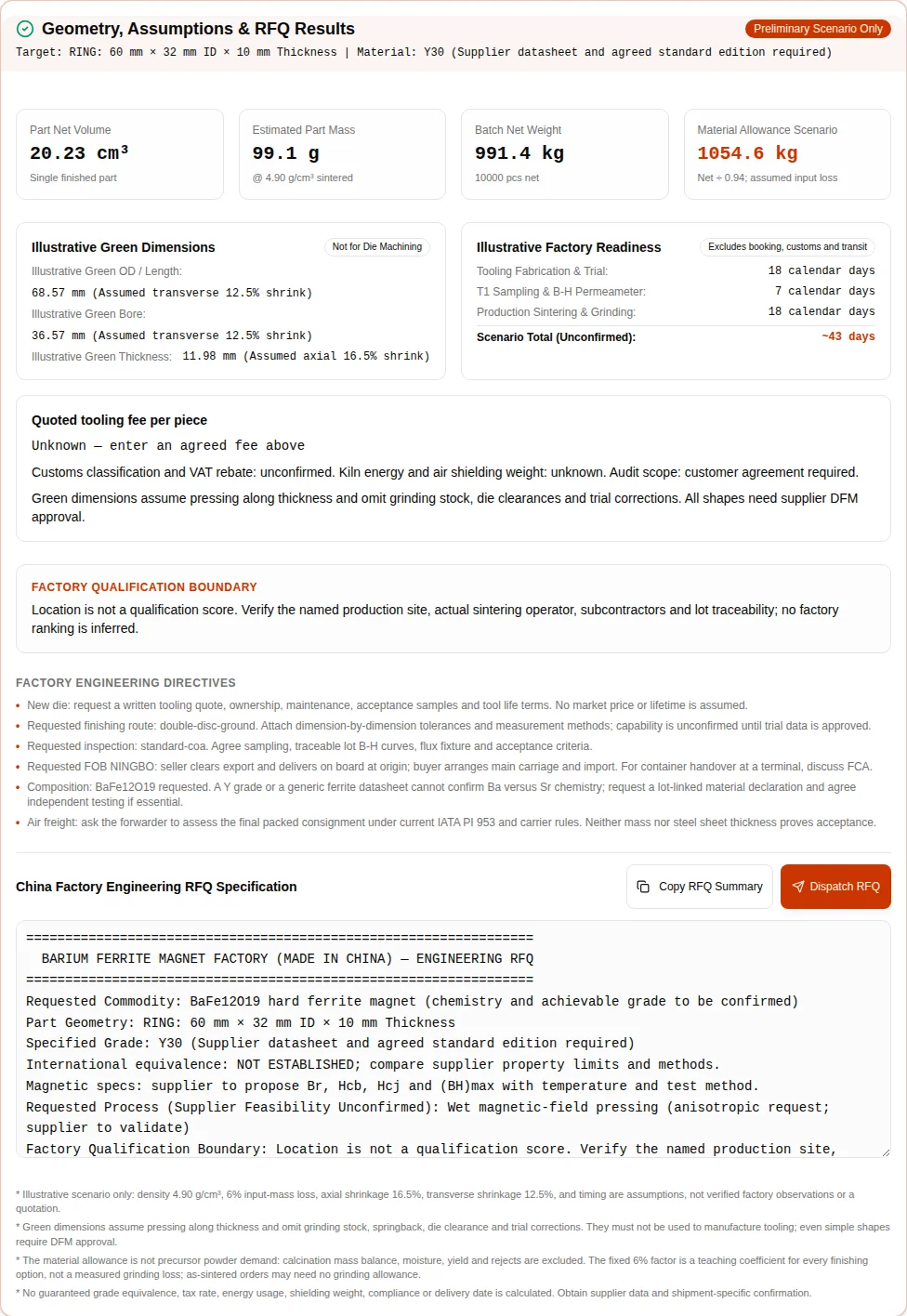
For the default 60 × 32 × 10 mm ring, volume is about 20.23 cm³ and estimated net mass is 99.14 g at the assumed density. A 10,000-piece batch is about 991.4 kg net; the loss scenario gives 1,054.6 kg of material allowance. Entering a USD 2,500 tooling fee allocates USD 0.25 per piece. These calculations demonstrate the method; they are not a price or procurement commitment.
4. Agree manufacturing and quality hold points
- Confirm Ba chemistry, powder batch and orientation.
- Approve pressing, sintering and finishing trials.
- Verify dimensions, B-H curves and magnetization against the order.
- Material batch → pressing and kiln records.
- Finishing inspection → magnetic test and approved fixture.
- Lot release → labeled packing list and retained records.
Before tooling release, approve a dimensioned drawing, pole direction, chamfers, dimensional tolerances and the measurement fixture. Before production release, compare representative samples and B-H reports against the agreed specification. Before dispatch, reconcile lot numbers, inspection records and packing labels.
Do not infer guaranteed ground tolerances from a process label. Request trial data for the actual geometry, inspection method and measurement-system capability. SPC or PPAP scope and acceptance criteria should be agreed with the customer.
- Identify the process and applicable customer requirements.
- Agree audit scope, calibration and survey acceptance limits.
- Review recorded trials and lot results; do not infer capability from grade.
CQI-9 is a heat-treatment assessment framework. This page cannot infer its applicability or a universal temperature-uniformity limit from the chosen grade, precision tier or PPAP option. Confirm the process scope, current edition and customer-specific requirement. Source: AIAG — Heat Treat System Assessment work group.
5. Compare complete quotes and alternatives
| Cost / route | Ask the supplier | Tradeoff to resolve |
|---|---|---|
| Stock tooling | Drawing match, availability, wear, setup fee and approved modifications | May shorten preparation; do not assume a zero fee |
| New tooling | One-time fee, ownership, maintenance, sample acceptance and tool-life terms | Additional commitment; amortization depends on actual accepted volume |
| As-sintered vs ground | Separate prices for each dimension and tolerance requirement | Avoid paying for finishing that the assembly does not need |
| Ba vs alternative ferrite | Composition, operating curves, assembly validation and change-control costs | Substitution requires approval even if nominal magnetic values look similar |
| Landed cost | Part price, tooling, inspection, packaging, freight, insurance, duties and destination charges | A low unit price can omit substantial shipment and acceptance costs |
Unknowns remain unknown until a written quote is returned: MOQ, die life, unit price, lead time, transport cost and any export-tax benefit. Ask for the same specification and commercial scope from each supplier to make the comparison useful.
6. Verify shipment terms, packaging and tax treatment
- Choose pole arrangement and protect brittle parts.
- Measure the final packed consignment under current PI 953.
- Obtain forwarder and carrier acceptance before dispatch.
- Give the broker composition, form, use and destination.
- Confirm the full tariff line and shipment-date tax treatment.
- Separate seller tax treatment from buyer landed cost.
Air acceptance depends on the final packed consignment and current IATA PI 953 plus carrier conditions. Classification screening and transport acceptance use different checks; do not apply one threshold at an interchangeable distance. This tool provides neither an acceptance certificate nor a shielding-weight calculation. Source: IATA — Dangerous Goods Regulations.
Protect brittle magnets against impact and rubbing, specify pole arrangement and confirm package mass and dimensions before booking. Ocean shipment still needs forwarder-approved stowage and protective packing.
| Requested term | Seller / buyer scope to confirm | Decision risk |
|---|---|---|
| FOB named loading port | Seller export-clears and delivers on board; buyer arranges main carriage and import | Risk transfers on board at origin; discuss FCA for container-terminal handover |
| CIF named destination port | Seller arranges sea freight and insurance; buyer handles import and agreed destination costs | Risk transfers on board at origin, not at destination; CIF is not door delivery |
| EXW named premises | Buyer organizes collection and export; explicitly agree loading responsibilities | Check whether the buyer can practically arrange export clearance; ask about FCA |
| Tariff and VAT rebate | Candidate heading 8505.19 only; broker must confirm full code and exporter must confirm date-specific treatment | No fixed 13% refund, export-duty exemption or blanket export-control exemption is established |
Source: ICC Academy — Incoterms 2020 C rules and D rules: risk transfer; Source: State Taxation Administration — Export VAT rebate lookup. Source review date: 2026-11-08; shipment-specific classification, rates and restrictions remain unconfirmed.
7. Manage misuse, cost and application risks
- Unknown chemistry: hold material approval.
- Unknown tooling fees: request a written itemized quote.
- Unknown packed field: hold the air-freight booking.
For cold-start motors, request low-temperature B-H curves and verify the operating load line; hard-ferrite coercivity can decrease in the cold. A room-temperature pass is insufficient. Source: Arnold Magnetic Technologies TN 0302 — Using permanent magnets at low temperature.
For toys, child-accessible magnets or drinking-water assemblies, obtain application-specific compliance review and agreed testing. Neither encapsulation nor a generic declaration proves final-product compliance. For exposed ceramic parts, define chip and crack acceptance and safe handling.
For cost control, use staged approval: material and drawing agreement → sample qualification → initial batch → repeat orders. A missing chemistry declaration, unapproved process change or unknown air-package status should hold the relevant release rather than be filled with an optimistic estimate.
8. Three RFQ scenarios and the next action
Speaker ring with an existing die
Use the default ring geometry and select stock tooling. Mass is a scenario estimate; tooling allocation stays unknown until a fee is entered.
Next: compare the stock cavity drawing, Ba declaration and quoted setup fee.
Custom motor arc
Select arc and enter valid inner and outer radii. Volume, mass and green dimensions are withheld because the arc angle and complete profile are missing.
Next: send CAD, magnetization direction, operating temperatures and required B-H data.
Industrial block with a quoted die
Set 50 × 25 × 10 mm: volume is 12.5 cm³ and scenario mass is 61.25 g. A USD 2,500 fee over 10,000 pieces is USD 0.25 per piece.
Next: approve dimension-specific tolerances and compare the full landed quote.
Reproduce the default software scenario
This is a software run captured on 2026-11-08, not a factory test or customer result. Reset the evaluator: ring, Y30 request, suggested route, OD 60 mm, ID 32 mm, thickness 10 mm, annual demand 120,000 pieces, first batch 10,000, new die, no quoted fee, double-disc ground, commercial CoA and FOB Ningbo. Volume is 20.232 cm³, scenario mass 99.14 g and fee allocation is unconfirmed.
View the captured software result
9. Sourcing questions
Factory & Material
Does a Y30 or Y35 label prove this is barium ferrite?
No. Treat the grade as a requested supplier identifier. Require a lot-linked BaFe12O19 composition declaration and agree how to verify Ba versus Sr if substitution is unacceptable.
How can I check whether the seller actually sinters magnets?
Ask for the legal entity, exact site, subcontracting list and evidence linking the pressing and sintering operations to that site. A registration record or sales video alone does not prove production capability.
Should I reject every trading company?
No. Compare traceability, disclosure, technical accountability and landed cost. A disclosed intermediary may be useful; an undisclosed manufacturing chain is the risk.
Which Chinese region guarantees the best factory?
None. Use location to plan site visits and freight, then qualify the actual plant. This guide does not rank regions by price or certify any supplier.
Can I accept strontium ferrite instead?
Only after engineering approval. If Ba chemistry is contractual, an Sr-based replacement is a deviation even when room-temperature magnetic values appear similar.
Can a generic compliance declaration cover toys or drinking-water equipment?
Do not assume so. Identify the final product, destination and exposure, and agree the applicable material or assembly tests with the responsible compliance specialist.
Engineering & Tool
Are Chinese, US Ceramic and IEC grades interchangeable?
No automatic mapping is used here. Compare guaranteed Br, Hcb, Hcj and (BH)max, temperature, orientation, composition and measurement method on the supplier datasheets.
Why does the tool withhold arc and custom mass?
Arc angle, detailed radii, chamfers and other geometry are not fully defined by an envelope. Send a dimensioned drawing or STEP file for a net-volume calculation.
Can I manufacture a die from the green dimensions?
No. They demonstrate a shrinkage formula using unverified scenario assumptions, without grinding stock, springback or die clearances. Use representative pressing and sintering trials for die release.
Does the material allowance equal raw precursor demand?
No. The teaching scenario divides finished mass by 0.94 for an assumed 6% input-mass loss. It excludes calcination mass balance, moisture and reject rates; the allowance may not apply to as-sintered orders.
Does the result prove motor or speaker suitability?
No. Request temperature-specific B-H curves and assembly-level flux tests. Low-temperature coercivity and the operating load line can govern demagnetization risk.
What if an input is invalid or clipboard permission is blocked?
Correct the highlighted field or reset the defaults. Invalid inputs suppress results and export. If copying is blocked, select the visible RFQ text manually or open the email link.
Commercial & Export
Does existing stock tooling mean a zero tooling bill?
No. Availability, wear, setup and modification fees must be confirmed. The tool allocates only an entered fee, including an explicitly agreed zero.
Are the displayed schedule and tooling allocation a quote?
No. The schedule is a teaching scenario. The per-piece allocation is the entered fee divided by initial batch units, excluding part price, freight, taxes and other charges.
Can I deduct a 13% rebate from my purchase price?
No fixed rate or buyer discount is assumed. Ask the exporter to verify the complete commodity code, export date and its eligibility using the official tax lookup. Compare the written sales price.
Does CIF include door delivery and destination risk?
CIF is a sea or inland-waterway term to a named port. The seller pays freight and insurance, while risk transfers on board at origin. Specify import clearance, destination charges and onward delivery separately.
Can the tool determine air-shielding weight?
No. Package arrangement and final measured stray field matter. Have the forwarder apply current PI 953, distinguishing classification screening from transport acceptance and carrier conditions.
Is CQI-9 mandatory for every high-grade ferrite magnet?
A grade, tolerance or PPAP selection does not establish CQI-9 applicability. Agree the customer-specific requirements, relevant process assessment and evidence before committing to audit limits.
10. Sources, review date and evidence limits
Reviewed 2026-11-08 by FerriteCustom Editorial Team. See our editorial policy and publisher information. Official abstracts and public records support scope statements; they do not verify a specific factory. No factory field-study dataset supports the calculator’s process constants. All commercial recommendations are an editorial checklist; technical and shipment approval remain with the responsible parties.
- SAMR: GB/T 12796.1-2012, Permanent ferrite magnets — Generic specification
The official record identifies Part 1 and its current status. It does not establish the US/IEC equivalence of a supplier Y grade.
- IEC 60404-8-1:2023 — Permanent magnet materials
The public abstract describes magnetic property minima and dimensional tolerances. It does not certify a particular factory or its Ba composition.
- IEC 60404-5:2015 — Measurement of permanent magnet properties
Reference for demagnetization-curve and recoil-line measurement. Agree the applicable specimen, method and acceptance limits.
- Arnold Magnetic Technologies TN 0302 — Using permanent magnets at low temperature
Explains low-temperature behavior and hard-ferrite coercivity risk. General behavior cannot replace grade-specific operating curves.
- IATA — Dangerous Goods Regulations
Current-edition and addenda entry point. Full PI 953 acceptance must be checked by the forwarder; this page does not certify a shipment.
- State Taxation Administration — Export VAT rebate lookup
Query by exact product code and name. No product-specific rebate rate was verified here; request a dated result from the exporter.
- AIAG — Heat Treat System Assessment work group
Identifies CQI-9 as a heat-treatment assessment. Applicability, edition and limits for a magnet process require customer agreement.
- ICC Academy — Incoterms 2020 C rules and D rules: risk transfer
Explains why seller-paid carriage under C terms does not mean risk transfers at destination.
Inquiry Email
Send your requirements to FerriteCustom for a drawing and supplier-capability review. Request written confirmation of material, tooling fees, inspection scope and delivery terms.