Factory RFQ tool + sourcing report

Barium Ferrite Magnet Factory: RFQ Evaluator

Check part geometry and tooling allocation, then prepare an evidence-led factory inquiry. Supplier capability and pricing require confirmation.

Factory RFQ evaluator

Check geometry, allocate a quoted tooling cost and prepare a factory RFQ. Runs locally; screening only.

3–300 mm

>0; at least 1 mm below OD

1–100 mm

Magnetic target, quantities & supplier requirements

1–50,000; 100 means 100,000 pcs

1–50,000,000 whole pcs

Blank = unknown; explicit 0 = no fee

All fields except quoted tooling cost are required. Prefilled values are an example ring. Input ranges are this tool’s screening limits; the supplier must confirm manufacturing capability.

Ready: enter your dimensions or evaluate the example ring.Have an incomplete drawing? Ask engineering for help

By FerriteCustom Editorial Team. First recorded . Reviewed . This is an editorial procurement guide, not a factory audit report or a quotation. Public source abstracts and a manufacturer technical note support the cited scope; drawing-specific capabilities remain unknown.

Four decisions before a factory order

Confirm chemistry before comparing grades

Specify BaFe₁₂O₁₉ composition and required magnetic minima. A familiar Y or Ceramic label alone does not establish barium chemistry or an interchangeable grade.

Basis and scope: IEC 60404-8-1:2023. Buyer actions are editorial recommendations.

Compare material tests on agreed conditions

Request lot-linked Br, Hcb, Hcj and (BH)max with method and temperature. A handheld surface-gauss reading alone is not a complete material specification.

Basis and scope: IEC 60404-5:2015. Buyer actions are editorial recommendations.

Check cold-start as well as hot operation

Request the actual grade’s temperature-dependent demagnetization curves and check reverse fields in the intended magnetic circuit.

Basis and scope: Arnold TN 0302: Using Permanent Magnets at Low Temperature. Buyer actions are editorial recommendations.

Approve the end use and assembly

For water-contact parts, establish applicable health-effects requirements and evidence for the final assembly. Neither a stable ceramic nor a substitute chemistry is automatic approval.

Basis and scope: NSF: Drinking Water System Components — Health Effects. Buyer actions are editorial recommendations.

Map the production and evidence chain

Use this editorial workflow to ask who controls each operation. A factory may purchase powder or subcontract finishing; document that chain rather than assuming every operation must be owned on-site.

Production evidence chain: powder to pressing, firing and lot release1. Powder & pressingConfirm Ba/Sr chemistryRecord aligned directionTrack green-part lot2. Firing & finishingIdentify actual kiln siteRecord shrinkage by axisName ground faces3. Release & traceLink test records to lotAgree acceptance limitsRetain reference samples

Swipe tables and diagrams horizontally on small screens.

Production audit questions — recommended evidence, not verified plant capabilities
OperationEvidence to requestQuestion to resolve
Powder sourcing / preparationChemical identity, powder supplier and batch recordWho makes the powder? If purchased, how is its lot retained?
Pressing and alignmentPart drawing, orientation and trial sampleWhich process and magnetization direction can this plant support?
SinteringNamed kiln site, lot log and trial dimensional reportWhich stages are subcontracted? What is the demonstrated lot capacity?
Grinding / finishingNamed ground faces, datums and inspection methodWhich dimensions need grinding, and what is its quoted yield allowance?
Magnetizing / testingAgreed pole pattern, material and assembly testsHow do sample measurements connect to the shipped lot?
Release / packagingLot CoA, retained sample and packing agreementWho approves release and owns corrective action?

Qualify the actual production site

Compare evidence and accountability across direct plants, distributors and trading firms. Request the actual production address and a lot-linked evidence pack before committing to a trial order.

Supplier audit gates require site evidence, lot records and trial acceptance1. Verify identityPlant address & scopeName subcontractorsConfirm die ownership2. Trace a sample lotKiln lot → test reportCalibration & methodReview defect handling3. Approve conditionallyTrial actual drawingAgree release criteriaMonitor repeat orders

Swipe tables and diagrams horizontally on small screens.

Suggested supplier review gates; each remains open until evidence is checked
GateRequestBoundary / next step
Site identityLegal entity, actual production address and certificate scopeIndependent verification against issuer records and a live/site audit
Process ownershipProcess map with in-house and outsourced stepsName each sub-tier; agree change notification and lot traceability
Kiln capacitySchedule, recent lot logs and constraints for the actual partA kiln photograph does not prove available production capacity
Tool ownershipDie number, matched drawing, maintenance and access termsAn existing die may still need modification or a setup charge
MeasurementLot-linked reports, calibration and agreed methodCorrelate buyer and factory measurement setups before acceptance
Quality responseDefect handling, containment and corrective action recordDefine responsibility across all subcontracted steps

Discuss the process after specifying the magnetic target

Choose a pressing discussion from the required magnetic orientation1. State the targetAligned or unoriented?Specify min Br and HcjInclude pole direction2. Compare routesWet aligned routeDry unoriented routeOther routes: ask plant3. Prove the choiceTest material & assemblyTrial geometry and finishCompare actual quotes

Swipe tables and diagrams horizontally on small screens.

Editorial route comparison; supplier validation and actual quotations required
RouteUse in the RFQ discussionLimit
Wet aligned routeDiscuss for a specified anisotropic targetConfirm orientation, achievable grade and actual cycle/quote on drawing
Dry unoriented routeDiscuss for a specified isotropic targetCannot promise an aligned target from an unoriented process
Other aligned routesAsk the plant about its supported equipmentWet/dry and isotropic/anisotropic are different dimensions; not an exhaustive process list
Unsure of targetSend assembly geometry, pole pattern and field needsKeep route unresolved until magnetic requirements are agreed

Keep linear shrinkage, volume loss and tolerances separate

Illustrative shrinkage mathematics, not a manufacturing recipe1. Define linear shrinks = (green − final)/green10% is an example onlyMeasure each axis2. Size an example dietarget = 100 mmcavity = 100/(1 − 0.10)cavity = 111.11 mm3. Keep volume separate10% loss on all 3 axes:Vfinal/Vgreen = 0.9³Volume loss = 27.1%

Define linear shrinkage for each measured axis as s = (Lgreen − Lfired) / Lgreen. Cavity scaling is Ltarget / (1 − s). For independent axes, volume loss is 1 − (1 − sx)(1 − sy)(1 − sz). These are geometric identities, not a firing recipe.

Swipe tables and diagrams horizontally on small screens.

Illustrative arithmetic only — no supplier-specific shrinkage coefficient is supplied
Input / calculationExample resultUse / boundary
Target 100 mm, linear shrinkage 10%Cavity = 100/0.9 = 111.11 mmExample only; obtain measured per-axis trial shrinkage
10% linear shrinkage in all three axesVolume loss = 1 − 0.9³ = 27.1%Cannot label 10% linear shrinkage as 10% volume loss
Actual anisotropic pressing and firingShrinkage by axis: not establishedPlant must validate process, powder, orientation and dimensions
Tolerance approval starts with functional dimensions and ends with measured capability1. Mark the drawingCritical fits & datumsState flatness separatelyAllow chamfers if suitable2. Select finishingAs-sintered if sufficientGround on named facesLapping: justify its cost3. Verify capabilityInspect actual trial partsAgree measurement setupRecord acceptance plan

Swipe tables and diagrams horizontally on small screens.

Finishing choices — numerical tolerances must be agreed for the actual drawing
Finish / featureSpecifyCost or misuse risk
As-sinteredAsk whether trial dimensions meet the functional fitAvoid finishing where proven unnecessary; do not assume universal percentages
Diamond groundName each face, tolerance and datum on the drawingAdd finishing cost only where it improves fit or assembly repeatability
Precision lappedSpecify flatness, parallelism and finish separatelyConfirm the extra operation and inspection justify the cost
Edge conditionAgree chamfer/radius and allowable chip sizeTest handling and assembly to reduce brittle-edge damage

Compare magnetic specifications without grade-name shortcuts

Use a material specification and an agreed measurement method. See IEC 60404-8-1:2023 and IEC 60404-5:2015 for their respective public scopes; the licensed standards and supplier data are needed for detailed contractual acceptance.

Swipe tables and diagrams horizontally on small screens.

RFQ magnetic data request; no universal BaFe / Y / Ceramic grade equivalence is asserted
Data itemWhat to requestDecision risk
Ba/Sr chemistryNamed composition / supplier declarationCommercial grade labels alone do not verify chemical identity
BrMinimum remanence in mT at stated temperatureNot the same measurement as air-gap or surface flux
Hcb and HcjSeparate minima in kA/m and demagnetization curvesAvoid treating normal and intrinsic coercivity as interchangeable
(BH)maxMinimum energy product in kJ/m³ with methodCompare like-for-like measurement conditions
Assembly testField/flux or functional result at agreed positionsValidate the intended circuit, clearances and pole pattern

Validate the operating circuit at hot and cold conditions

Thermal approval needs service conditions and grade-specific curves1. Define serviceMinimum & maximum TReverse field at stallMagnetic circuit geometry2. Review curvesFerrite Hcj falls in coldAsk for grade-specific dataNo universal safe Pc3. Validate assemblyCold-start and hot-soakCheck irreversible lossApprove application limits

Hard-ferrite intrinsic coercivity decreases as temperature falls. That makes cold-start reverse fields a relevant check; it does not establish a fixed failure temperature or a safe permeance coefficient for every part. The supplier’s grade-specific curves and an assembly test are the next step. Basis: Arnold TN 0302: Using Permanent Magnets at Low Temperature.

Separate quoted costs from calculated allocations

Separate piece cost, tooling allocation and landed costs without invented percentages1. Recurring piece costMaterial & processingFinishing & inspectionRequest a supplier quote2. Tooling allocationEntered tooling quote÷ first batch piecesExclude annual forecast3. Landed costAdd freight and dutiesName delivery term/placeRecord currency & date

Tooling allocation = buyer-entered tooling quote ÷ first-batch quantity. Annual demand remains a forecast. The tool does not infer a material-price benchmark, manufacturing margin, MOQ or lead time. Blank tooling cost means unknown; an explicit zero means the buyer entered a zero-fee quote.

Compare recurring part cost, tooling/setup, finishing, inspection, packaging, freight and duties separately using a named delivery term and place. Commodity background such as USGS Mineral Commodity Summaries 2026 cannot replace a magnet-grade supplier quote.

Prepare your factory RFQ with the evaluator

Three worked RFQ examples

Hypothetical examples show how the tool handles inputs. These are not customer case studies, measured plant yields or commercial quotations.

Example 1: ring RFQ

Premise: Illustrative ring: OD 60 mm, ID 32 mm, thickness 10 mm; annual forecast 100,000 pcs; first order 10,000 pcs.

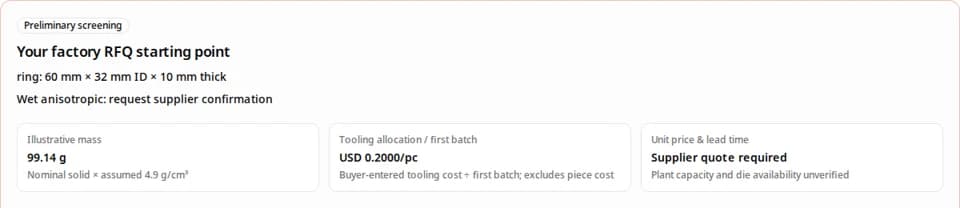
Method: Volume = pi × (60² − 32²) × 10 / 4000 = 20.232 cm³. At the tool’s assumed density of 4.9 g/cm³, estimated mass is 99.14 g.

Next decision: If the buyer enters a USD 2,000 tooling quote, first-batch allocation is USD 0.20/pc. This is tooling only; it is not a piece-price quote or plant approval.

Example 2: rectangular block

Premise: Illustrative block: 60 × 20 × 10 mm, with finishing requested only on mounting faces.

Method: Volume = 60 × 20 × 10 / 1000 = 12 cm³; estimated mass at 4.9 g/cm³ is 58.8 g. Doubling the width to 40 mm doubles volume and mass.

Next decision: Request a drawing-specific finishing quote and trial inspection. Actual width matters; treating the block as 60 × 60 mm would overstate its volume.

Example 3: motor arc

Premise: Only envelope length, width and thickness are available; radii, included angle and pole direction are not yet specified.

Method: The evaluator retains an RFQ checklist but withholds mass. Obtain the arc drawing and required temperature/reverse-field conditions.

Next decision: Use the full drawing and grade curves to agree the process, then request a supplier quote and trial plan. Envelope dimensions alone cannot establish weight or production capability.

Methods, evidence and source limits

Factory RFQ evaluator showing 99.14 g ring mass and USD 0.2000 tooling allocation per first-batch piece
Software capture, 2026-10-27: ring OD 60 mm, ID 32 mm, thickness 10 mm; annual demand 100,000 pcs; first batch 10,000 pcs; entered tooling quote USD 2,000. Output: assumed-density mass 99.14 g and tooling allocation USD 0.2000/pc. Reproduce by entering these values and choosing Evaluate & prepare RFQ. This documents software behavior, not a factory trial or customer outcome.
Local calculation method. Ring volume = pi × (OD² − ID²) × t/4000 cm³; disc = pi × D² × t/4000 cm³; block = Lwt/1000 cm³ when inputs are mm and pi = 3.14159265… . Mass = volume × assumed 4.9 g/cm³. Density is an illustrative model assumption, not a certified BaFe grade value. Arc/custom envelopes lack enough dimensions and return no mass. Process suggestions follow the requested orientation; no numerical feasibility score or performance approval is generated.

Sources checked 2026-10-27. Public summaries establish topic scope only. Commercial and audit actions on this page are editorial recommendations; the sources do not verify FerriteCustom’s plant ownership or certifications.

IEC 60404-8-1:2023

Publication / version: 2023-09-20

Publisher summary covers permanent-magnet property specifications and dimensional tolerances.

Limit: The public abstract does not verify this supplier, any Ba/Sr grade equivalence or specific part tolerance.

IEC 60404-5:2015

Publication / version: 2015-04-16

Publisher summary identifies methods for magnetic measurements, demagnetization curves and recoil lines.

Limit: Agree the test temperature, specimen and acceptance limits. No universal test uncertainty is asserted here.

Arnold TN 0302: Using Permanent Magnets at Low Temperature

Publication / version: rev.2015a

Manufacturer technical note explains that hard-ferrite intrinsic coercivity decreases in the cold.

Limit: General hard-ferrite behavior; obtain the chosen barium grade’s curves. It does not establish a universal safe load line.

NSF: Drinking Water System Components — Health Effects

Publication / version: 2024-02-18

Explains assessment of contaminants contributed by water-contact materials and components.

Limit: This overview is not a certification of a magnet or encapsulated assembly. Verify the applicable current edition and listing.

EU Toy Safety Regulation (EU) 2025/2509

Publication / version: 2025-11-26; application dates must be checked

Sets out toy-safety requirements, material-category migration limits and transition provisions.

Limit: Confirm the applicable legislation, transition dates and test method with the destination-market laboratory. Composition alone cannot establish conformity.

USGS Mineral Commodity Summaries 2026

Publication / version: 2026-02-06

Industry and mineral-supply context, including barite.

Limit: Not a quote for magnet-grade barium carbonate, finished magnets or a fixed savings percentage against strontium.

European Commission: Toy safety in the EU

Publication / version: Regulation 2025/2509; general application 2030-08-01

Explains the transition from Directive 2009/48/EC to Regulation (EU) 2025/2509, generally applicable from 1 August 2030.

Limit: The regulation entered into force on 1 January 2026; some provisions apply earlier. Confirm the applicable product and shipment requirements with the destination-market laboratory.

Known unknowns, misuse risks and alternatives

Unresolved engineering, commercial and compliance risks need separate evidence1. Engineering riskWrong magnetic targetThin walls or complex arcsMitigate with drawing trial2. Commercial riskUnknown tooling or yieldForecast ≠ first batchGet itemized dated quote3. Compliance riskFinal use & market matterChemistry ≠ approvalObtain applicable testing

Swipe tables and diagrams horizontally on small screens.

Open decisions as of 2026-10-27 — unknown does not mean compliant or feasible
Risk / missing informationCurrent evidenceMinimum next action
Plant capability / yieldUnknown until drawing trial and capacity reviewRun a representative lot; agree scrap, sampling and acceptance terms
Unit price / tooling / lead timeSupplier quote required; no live quote feedRequest dated currency, validity, die fee, finishing, minimum batch and delivery place
Ba versus Sr cost advantageNo verified fixed percentage or carbonate benchmarkCompare equivalent drawings and validated grades on contemporaneous quotes
Magnetic temperature limitsGrade, geometry and reverse-field dependentRequest hot/cold curves and assembly verification; no universal safe Pc or service temperature
Toy / water-contact complianceEnd use, accessibility, market and final assembly dependentObtain current applicable testing; substitution or overmolding needs its own evaluation
Freight and dutiesUnknown route, shipment date and destinationObtain a lane-specific quote; use a named delivery term and place

For toy or water-contact use, confirm the applicable market and final assembly requirements. Neither RoHS/REACH conformity, toy safety nor drinking-water suitability follows automatically from the ceramic formula. Substitution with strontium and encapsulation are design options to evaluate, not automatic approval. Scope references: EU Toy Safety Regulation (EU) 2025/2509; NSF: Drinking Water System Components — Health Effects.

For EU toys, Regulation (EU) 2025/2509 entered into force on 1 January 2026 and generally applies from 1 August 2030, with specified provisions applying earlier. Check the transition from Directive 2009/48/EC for the intended shipment. See the European Commission: Toy safety in the EU overview.

Factory sourcing FAQ

Supplier evidence

What should I request before ordering from a barium ferrite magnet factory?

Send a dimensioned drawing, pole direction, magnetic minima, operating temperatures and quantities. Ask the manufacturer to identify the production site, outsourced operations, lot-linked test records, tooling terms and a dated quote. Use the evaluator to prepare the geometry and tooling-allocation portion of that RFQ.

How should I verify a direct factory?

As an editorial procurement checklist, verify the entity, production address, process map, named subcontractors and a lot’s path from kiln to inspection report. Independently check any certificate scope. A photo alone cannot establish ownership, capacity or product quality.

Can a trader or a factory using purchased powder be qualified?

Potentially, if your purchasing policy allows it and responsibilities, actual producer identity, change control and lot evidence are clear. Evaluate demonstrated control; kiln or calciner ownership is not a universal quality guarantee.

Does this page verify ISO 9001 or IATF certification?

No. Request the supplier’s current certificate, verify the issuer, site and scope, and agree customer-specific documentation. A checklist or selected PPAP request is not evidence that the supplier is certified.

Engineering decisions

Can Y30, Ceramic 5 and a BaFe label be treated as equivalent?

Do not assume equivalence or barium chemistry from a label. Compare the actual supplier datasheets, composition and agreed magnetic minima. The tool asks for the required orientation rather than inventing a grade conversion.

When should I discuss wet or dry pressing?

Start with the magnetic target. The tool suggests a wet aligned route for anisotropic requests and a dry unoriented route for isotropic requests. This is a discussion aid; other aligned processes exist and the supplier must validate the drawing and grade.

How is sintering shrinkage calculated?

Linear shrinkage is (green dimension − fired dimension) / green dimension. A target fired dimension requires a green dimension of target/(1 − shrinkage). Determine each axis from trial data; linear and volumetric shrinkage are different quantities.

Is the Curie temperature the allowed service temperature?

No. Service approval depends on the grade, temperature-dependent demagnetization curve, magnetic circuit and opposing fields. Ask for application-specific hot and cold testing rather than treating a Curie point as a safe operating limit.

Commercial and compliance decisions

Does the evaluator give a real factory price or lead time?

No. It calculates nominal volume and illustrative mass for fully defined simple solids, plus tooling allocation from a quote you enter. Actual unit price, MOQ, die availability and lead time require a dated supplier response.

Why is tooling allocated over the first batch?

Annual demand is a forecast, not a committed order. Dividing a tooling fee by first-batch pieces shows an explicit allocation assumption. Change the batch to match your contract; separate recurring piece costs and other charges.

Is barium ferrite automatically RoHS, REACH or toy compliant?

No automatic conformity is established here. Request the material declaration and applicable current product/market evidence. Toy accessibility, material category and final assembly matter; substituting strontium or adding plastic does not alone establish safety.

What evidence is needed for a magnet in contact with drinking water?

Have the final product, materials and exposure conditions reviewed against the destination market’s applicable requirements. Request evidence for the actual assembly and any encapsulation. The NSF overview explains the health-effects scope; it does not certify this magnet or establish the current applicable edition.

Send a drawing and an evidence request

Include the full drawing, pole direction, magnetic minima, operating temperature range, first batch, annual forecast, destination and documentation needs. Request a dated quote and a plant evidence pack; capability, availability and certification must be confirmed in the response.

Inquiry Email

[email protected]

Copy the email, or open your default email app to start an inquiry.

Return to the RFQ evaluator