
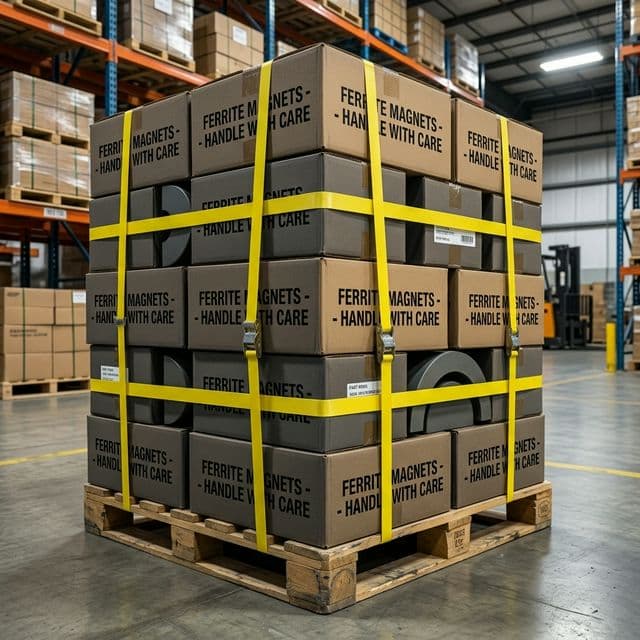
The Impact of Product Carbon Footprint (PCF) Regulations on Ferrite Magnet Sourcing in 2026
A comprehensive guide for procurement and engineering teams on navigating new PCF mandates, green-tariff risks, and ESG compliance when sourcing custom ferrite magnets.
For decades, the procurement of custom ferrite magnets was governed by three primary pillars: magnetic performance (grade), dimensional tolerance, and landed cost. However, as of 2026, a fourth pillar has become equally critical, and in some jurisdictions, mandatory: the Product Carbon Footprint (PCF).
With the enforcement of global frameworks like the EU’s Ecodesign for Sustainable Products Regulation (ESPR), the Critical Raw Materials Act (CRMA), and expanding Carbon Border Adjustment Mechanisms (CBAM), ESG compliance is no longer merely a marketing slide for corporate sustainability reports. It is a hard boundary that dictates whether your assembled motors, sensors, and acoustic devices will face border delays, "green-tariff" penalties, or outright market exclusion.
This comprehensive guide is designed for procurement professionals, supply chain managers, and engineers who must navigate this new reality. We will break down what drives the carbon footprint of a ferrite magnet, how to audit suppliers for verified ESG data, and how to protect your organization from compliance-related supply chain disruptions.
1. The Regulatory Landscape in 2026: Why PCF Matters Now
The transition from voluntary sustainability reporting to mandatory product-level carbon accounting has accelerated. For buyers of industrial components like hard ferrite magnets, the regulatory shift means that generic corporate-level emissions data is no longer sufficient.
Customs agencies and downstream OEM customers now demand cradle-to-gate PCF data, calculated in accordance with standards such as ISO 14067 or the GHG Protocol Product Standard. If your supplier cannot provide a verified Digital Product Passport (DPP) or equivalent lifecycle assessment (LCA) data, your imported components may be assigned a default "worst-case" carbon intensity by regulators, triggering heavy carbon taxes at the border.
The "Green Tariff" Risk
A green tariff is essentially a carbon border tax applied to imported goods based on their embedded emissions. If you source custom ferrite magnets from a region with a highly carbon-intensive electrical grid, and your supplier does not utilize green energy (like Power Purchase Agreements or green tariffs of their own), your final landed cost will skyrocket once these border adjustments are applied. Evaluating suppliers solely on their nominal piece price is now a severe financial risk.
2. Breaking Down the Carbon Footprint of a Ferrite Magnet
To effectively audit a supplier's PCF claims, buyers must understand where the carbon is generated during the production of a custom ferrite magnet. While ferrite magnets are inherently less carbon-intensive than rare-earth magnets (like Neodymium) due to the absence of complex, highly toxic mining and separation processes, they are not zero-emission components.
Raw Material Extraction and Pre-Processing (Scope 3 Upstream)
Ferrite magnets are primarily composed of iron oxide (~80-90%) combined with strontium or barium carbonate. The mining, milling, and chemical refinement of these base materials carry an embedded carbon cost. Suppliers must account for the emissions generated by their tier-2 and tier-3 raw material providers.
Specification Dimensions & Communication: When drafting RFQs, explicitly request the purity levels and the geographic origin of the iron oxide. Unverified spot-market powder not only introduces high variance in magnetic properties but also breaks the traceability chain required for compliance.
Calcination and Sintering (Scope 1 and 2)
This is the most critical phase for carbon accounting. The raw powder must be calcined, milled again, pressed (wet or dry), and then sintered in massive industrial kilns at temperatures exceeding 1,200°C.
- Energy Intensity: Sintering is highly energy-intensive. If a supplier's kiln is powered by coal-fired electricity grids, the PCF of the resulting magnet will be drastically higher than one produced using hydroelectric, solar, or wind power.
- Kiln Efficiency: Modern continuous roller kilns with waste-heat recovery systems significantly lower the energy consumed per kilogram of output compared to older batch kilns.
Machining, Grinding, and Coating (Scope 1 and 2)
Custom ferrite magnets often require precise grinding to meet tight engineering tolerances. Grinding requires industrial coolants, heavy machinery, and significant electricity. Additionally, if the magnets require coatings (e.g., epoxy or parylene for specialized environments), the chemical processing adds to the footprint.
Logistics and Packaging (Scope 3 Downstream)
Because ferrite magnets are heavy and have a relatively low value-to-weight ratio, transportation emissions are a significant factor. Sourcing heavy components via air freight exponentially increases the PCF. Sea freight is standard, but the specific shipping lanes and the efficiency of the vessels are now factored into advanced LCA models.
3. High-PCF vs Low-PCF Sourcing Strategies: A Structural Comparison
To illustrate the stark differences in procurement strategies under the new regulatory regime, consider the following structural comparison across key decision vectors.
| Sourcing Vector | High-PCF Strategy (Legacy/Risk-Prone) | Low-PCF Strategy (Modern/Compliant) | Impact on Total Cost of Ownership (TCO) | Supply Chain Resilience | Engineering Impact | Green Tariff Exposure | Typical Supplier Profile | Documentation Provided |
|---|---|---|---|---|---|---|---|---|
| Grid Energy Mix | 100% Coal/Fossil Fuel grid | >50% Renewable (PPA / Green Open Access) | High hidden costs via border taxes | Low (vulnerable to carbon tax hikes) | None directly, but limits future-proofing | Critical / High | Tier-3 / Unverified | Basic Material Safety Data Sheet (MSDS) only |
| Kiln Technology | Legacy batch kilns, no heat recovery | Continuous kilns with thermal recycling | Higher energy waste embedded in piece price | Medium | Wider thermal variances affecting magnetic uniformity | High | Older facilities avoiding CAPEX | None regarding energy |
| Scrap / Yield Rate | >15% scrap, landfilled | <5% scrap, internally recycled / re-milled | Scrap cost baked into unit price | Medium | Inconsistent dimensional CPK | Medium | Volume-focused, low-QC | Generic inspection reports |
| Raw Material Sourcing | Spot market buying, unknown origin | Verified regional supply, ESG-audited tier-2s | Price volatility passes to buyer | High (traceability protects against CRMA bans) | Consistent iron oxide purity improves Br | Low | Tier-1 / Audited | Full traceability certificates |
| Logistics | Air freight for delays, low packing density | Sea freight, optimized pallet density | Exorbitant freight carbon penalties | High (planned inventory buffers) | Standard packaging | High (if expedited often) | Reactive expeditors | Basic BOL |
| Carbon Reporting | Generic corporate ESG brochure | ISO 14067 verified cradle-to-gate LCA | Prevents default "worst-case" tax assessments | High (compliant with Digital Product Passports) | Design-for-environment feedback loop | Zero to Low | Strategic Partner | Digital Product Passport / 3rd Party LCA |
| Co-Engineering | "Build to print" only | Design optimization for thinner/lighter magnets | Material reduction directly lowers PCF | High | Tighter collaboration on minimum viable specs | Low | Engineering-led manufacturer | Simulation & Optimization reports |
| Water / Coolant Mgmt | Single-pass coolant, wastewater discharge | Closed-loop filtration and recycling | Lower environmental compliance risks | High | Cleaner grinding yields better surface finish | Low | Modern automated facilities | Environmental compliance certificates |
4. Engineering & Supply Chain Collaboration: Designing for Lower PCF
Procurement teams cannot solve the PCF challenge alone. Reducing the embedded carbon of a custom ferrite magnet requires upstream collaboration with engineering.
Optimize Tolerances: Over-specifying dimensional tolerances (e.g., demanding ±0.05mm when ±0.1mm is functionally acceptable) forces the supplier to engage in extensive grinding. Grinding is energy-intensive and produces yield loss. Designing for wider acceptable tolerances reduces grinding time, energy use, and the final PCF.
Grade Selection Trade-offs: Higher coercivity grades often require different chemical additives (like higher strontium content) and longer, hotter sintering profiles. Engineers should work with procurement to select the lowest adequate grade that meets the functional requirements, thereby avoiding the carbon penalty of over-engineering the magnetic circuit.
Miniaturization and Geometry: Sharp corners and complex geometries increase the likelihood of cracking during sintering, leading to higher scrap rates. Because scrapped magnets represent wasted energy, designing simpler geometries with appropriate radii directly improves yield and lowers the allocated carbon per shipped unit.
Procurement & Engineering Decision Matrix for Ferrite Sourcing
To facilitate cross-functional alignment, use the following matrix when evaluating a new magnet spec or supplier. This matrix highlights the trade-offs across key decision points:
| Decision Point | Engineering Priority | Procurement Priority | ESG / PCF Impact | Failure Risk / Trade-off |
|---|---|---|---|---|
| Tolerance Specs | Tighter is better for assembly | Looser reduces unit cost | Looser drastically lowers grinding energy (Scope 2) | Looser may cause fitment issues in the motor housing |
| Material Grade | Highest Br/Hcj possible | Cost-effective standard grade | Higher grades need longer sintering (higher Scope 1) | Over-specifying grade wastes money and carbon budget |
| Geometry/Shape | Complex shapes for integration | Simple blocks/rings | Complex shapes increase scrap rate and wasted carbon | Sharp corners may chip, leading to higher reject rates |
| Surface Coating | Epoxy for corrosion resistance | No coating (cheaper) | Coatings add chemical processing emissions | Skipping coating in humid environments causes rust/failure |
| Logistics Mode | Fast air freight for prototypes | Sea freight for bulk | Air freight ruins the product's carbon footprint | Sea freight delays prototype validation |
| Supplier Location | Close to final assembly | Low-cost labor regions | Local sourcing minimizes Scope 3 transport emissions | Single-sourcing locally increases geopolitical risk |
| Energy Source | Unconcerned (focus on spec) | Low overhead cost | 100% Renewable PPA is the biggest PCF reduction | Suppliers on green tariffs might pass premiums to buyers |
| Traceability Data | Material certs (RoHS/REACH) | Price stability | Cradle-to-gate LCA is mandatory for CBAM/DPP | Fake ESG data leads to customs delays and border fines |
| Packaging Density | Safe, bulky foam padding | High density per pallet | Dense packing lowers allocated transport emissions | Over-dense packing may cause chipping during transit |
5. Supplier Selection & RFQ Checklist for ESG/PCF Compliance
When auditing a new ferrite magnet supplier or issuing a Request for Quotation (RFQ), procurement teams must go beyond standard ISO 9001 checks. Use this actionable checklist to enforce compliance at the communication and acceptance stages:
Procurement & RFQ Communication Fields
- PCF Baseline Request: Does the RFQ explicitly mandate the submission of a baseline Product Carbon Footprint (PCF) estimate per 1,000 pieces?
- LCA Methodology: Demand ISO 14067 or GHG Protocol Product Standard compliance in the supplier agreement.
- Grid Mix Declaration: Require a formal declaration of the facility's electrical grid mix (coal vs. renewables) and any active Power Purchase Agreements (PPAs).
- Scrap Loop Verification: In the RFQ, ask for their internal green-scrap recycling percentage.
Acceptance & Validation Criteria
- Third-Party Verification: Is the PCF data verified by an accredited independent auditor (e.g., SGS, TÜV), or is it a self-declared marketing number?
- Scope 3 Traceability: Can the supplier trace tier-2 iron oxide back to the mine, fulfilling Digital Product Passport (DPP) prerequisites?
- Waste Heat Recovery: Site audit requirement: visually confirm the presence of waste-heat recovery systems on continuous sintering kilns.
6. Visualizing the Carbon Flow
Understanding the carbon lifecycle helps pinpoint where your supplier should be investing in efficiency.
7. Frequently Asked Questions (FAQ) from Buyers
Q: Our current supplier claims they can't provide ISO 14067 data because they buy raw powder from the spot market. How should we handle this?
A: This is a major red flag for 2026 compliance. Spot-market buying breaks the traceability chain required for Digital Product Passports (DPP) and accurate PCF calculations. You must transition to suppliers who have strategic, traceable partnerships with their tier-2 powder mills, even if it means a slight increase in raw material costs.
Q: We only buy small volumes of ferrite rings (under 1 ton/year) for sensors. Does CBAM still apply to our shipments?
A: Yes. While CBAM reporting initially targeted massive bulk imports like steel and cement, the expanded scope rules enforce compliance based on embedded carbon, not just gross tonnage. Failing to provide a verified PCF can trigger default "worst-case" tariff rates, wiping out the margin on your small-volume imports.
Q: How do tight tolerances directly increase the carbon footprint?
A: Hard ferrite is brittle and requires wet diamond grinding to achieve tight tolerances (e.g., ±0.05mm). This grinding process uses massive amounts of electricity for the CNC machines and the coolant filtration pumps. It also lowers the yield (more scrapped parts). Opening your tolerances where functionally possible directly reduces the Scope 2 energy consumed per shipped part.
Q: What specific data should we put in our supplier RFQ to filter out non-compliant factories early?
A: At a minimum, your RFQ must require: 1) Their total facility Scope 1 & 2 emissions, 2) The percentage of renewable energy powering their sintering kilns, and 3) A commitment to provide a component-level LCA (ISO 14067) before the first article inspection (FAI).
8. Conclusion & Next Steps
Treating the Product Carbon Footprint as a secondary "nice-to-have" metric is no longer viable in 2026. Buyers who fail to secure verifiable, ISO-compliant PCF data from their ferrite magnet suppliers expose their companies to unpredictable border tariffs, delayed shipments, and potential exclusion from major OEM supply chains that mandate Digital Product Passports.
The shift requires moving away from transactional sourcing based on spot piece-prices, toward strategic partnerships with suppliers who treat carbon accounting with the same rigor as dimensional metrology.
Are you ready to de-risk your magnet supply chain?
Our engineering and supply chain teams specialize in optimizing custom ferrite designs for both maximum magnetic performance and minimum embedded carbon. We provide full traceability and support for modern ESG reporting requirements.
Contact us today to request a carbon-optimized design review or to discuss our ISO-compliant manufacturing capabilities at [email protected].
9. Sources and References
| Source / Issuing Body | Why it matters for Buyers and Engineers | URL / Reference |
|---|---|---|
| European Commission (ESPR) | Official framework for the Ecodesign for Sustainable Products Regulation, defining mandatory performance and circularity requirements. | commission.europa.eu |
| European Commission (CBAM) | Official guidance on the Carbon Border Adjustment Mechanism and how importers must report embedded emissions. | taxation-customs.ec.europa.eu |
| ISO 14067:2018 | The definitive international standard for quantifying the carbon footprint of products, which suppliers must adhere to for verifiable claims. | iso.org |
| GHG Protocol Product Standard | Provides the standardized methodology for companies to measure the greenhouse gas emissions associated with a specific product's lifecycle. | ghgprotocol.org |
| European Commission (CRMA) | The Critical Raw Materials Act outlines the requirements for secure and sustainable supply chains, directly impacting how magnetic raw materials are sourced. | single-market-economy.ec.europa.eu |
Author

Categories
More Posts
Ferrite Cost Advantage and Average Price Calculator
Estimate the average ferrite magnet price and convert quote-line pricing into a landed cost model with tooling, yield, logistics, and risk reserves.
CEN/TS 18263:2026 Permanent Magnet Labeling: A Sourcing Guide for Ferrite Buyers
Learn how CEN/TS 18263:2026 affects custom ferrite magnet RFQs, supplier audits, labeling data, and EU DPP readiness before 2026 sourcing programs launch.

Anisotropic Ferrite vs Neodymium: 2026 Engineering Decision Guide
Compare anisotropic ferrite vs neodymium on force density, thermal limits, and supply risk. Use RFQ gates to request a project-specific engineering review.
Inquiry Email
Copy the email, or open your default email app to start an inquiry.