
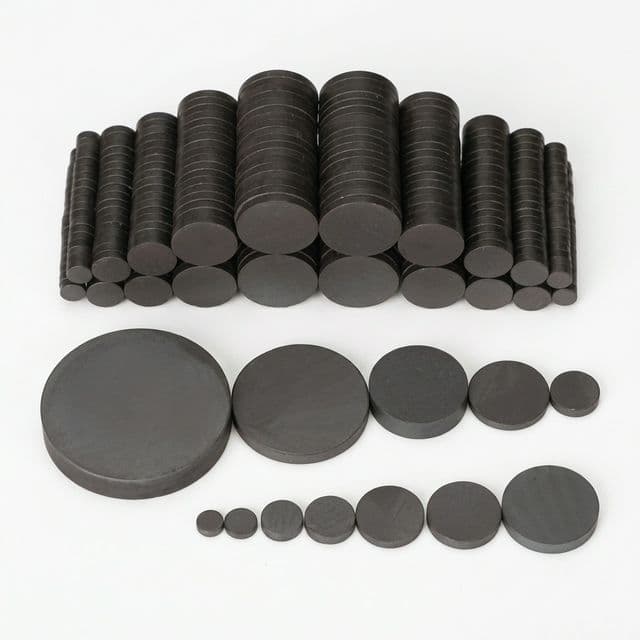
CEN/TS 18263:2026 Permanent Magnet Labeling: A Sourcing Guide for Ferrite Buyers
Learn how CEN/TS 18263:2026 affects custom ferrite magnet RFQs, supplier audits, labeling data, and EU DPP readiness before 2026 sourcing programs launch.
When the European Union began drafting the Critical Raw Materials Act (CRMA) and the broader Ecodesign for Sustainable Products Regulation (ESPR), much of the automotive and electronics industry breathed a sigh of relief regarding one specific component: Hard Ferrite (Ceramic) Magnets.
Because ferrite magnets are composed primarily of iron oxide and strontium/barium carbonate—materials not classified as "critical" or "strategic" supply risks like Neodymium, Dysprosium, or Terbium—many OEM procurement teams and engineers falsely assumed that their ferrite-based motors and sensors would be entirely exempt from the incoming wave of permanent magnet traceability regulations.
This assumption is dangerously incorrect.
In 2026, the European Committee for Standardization (CEN) published CEN/TS 18263:2026: Permanent magnet products - Procedure for declaring recycling-relevant information. This horizontal standard changes how permanent magnets, explicitly including ferrite, should be documented, labeled, and tracked when an OEM must provide recycling-relevant information downstream.
If your organization procures custom ferrite magnets for regulated products entering the European market, failing to prepare CEN/TS 18263:2026 data can result in border delays, inability to generate compliant Digital Product Passports (DPP), and exclusion from major OEM vendor lists.
This comprehensive guide breaks down exactly what CEN/TS 18263:2026 requires, how it specifically impacts ferrite magnet sourcing, and the exact steps procurement teams must take to update their RFQs and supplier audit frameworks.
Visual 1: Cross-section highlighting the necessity of proper labeling for end-of-life (EoL) disassembly.
0. Applicability Boundaries: When Does It Apply?
Before diving into the core requirements, it is essential to understand the Applicability Boundaries of this regulation. The ESPR and CRMA focus heavily on permanent magnets where their mass in a single product exceeds a defined threshold (commonly around 0.2 kg, but specifics vary by delegated acts).
- In-Scope Applications: Automotive traction motors, industrial pump impellers, wind turbine generators, HVAC compressors, and large consumer appliances (like washing machines). In these applications, the ferrite mass almost always triggers the reporting thresholds.
- Out-of-Scope (Typically): Small sensors, micro-motors for toys, tiny acoustic transducers, and low-mass consumer electronics where the magnet weight is negligible.
Use this guide as a procurement and engineering readiness checklist, not as a final legal determination. The controlling obligation still depends on the product category, the EU placing-on-market route, and the delegated or customer-specific rule set attached to that product.
However, even if your product falls below the mass threshold, many Tier-1 assemblers are adopting a "zero-exception" policy. They require the CEN/TS 18263 compliance data for all components to streamline their own automated compliance tracking systems. For global buyers, this means standardizing on compliance for all parts, regardless of destination, often proves more efficient than managing dual supply chains.
1. The Core Misconception: Why Ferrite is Regulated
To understand the procurement impact, we must separate the supply risk of a material from its end-of-life circularity.
The CRMA focuses heavily on securing the supply of rare earths. However, the EU's broader circular economy mandate dictates that all permanent magnets represent concentrated energy and material investments that should be recovered at the end of their lifecycle. Even though iron oxide is abundant, the energy required to calcine and sinter ferrite magnets (Scope 1 and 2 emissions) is significant. Regulators want to ensure these magnets are not simply shredded into mixed steel scrap.
CEN/TS 18263:2026 is a horizontal, chemistry-neutral standard. This means the declaration procedure is designed for use across product categories (from wind turbines to automotive wipers, to consumer HVAC systems) and across magnet chemistries (NdFeB, SmCo, AlNiCo, and Ferrite). Buyers still need to map the product-specific legal trigger before treating a part as mandatory-reporting scope.
If a product contains permanent magnets exceeding the regulated mass threshold (typically aggregated at 0.2 kg per product, though specific product-category rules apply), the OEM must provide standardized recycling information. The burden of generating this data falls directly on the tier-2 and tier-3 magnet manufacturers.
Furthermore, the scale of ferrite production globally means millions of tons of this material are circulated annually. The energy density required for processing (mixing, pressing, and sintering at temperatures often exceeding 1200°C) constitutes a significant carbon footprint. The EU's perspective is that this embedded carbon must be honored through proper circular lifecycle management, hence the strict labeling requirements.
2. Key Requirements of CEN/TS 18263:2026
The standard establishes a strict framework for what information must be passed downstream, how it must be formatted, and how it must be physically or digitally attached to the product.
A. The Data Carrier (Labeling)
The most visible aspect of the standard is the requirement for a "Data Carrier." This is typically a graphical symbol, such as a highly durable QR code or data matrix, that links directly to the product's recycling declaration.
- For Large Assemblies: The data carrier is applied to the motor housing or product chassis.
- For Bare Magnets: If the custom ferrite magnet is sold as a discrete component to an end-user, the packaging or the magnet itself (if large enough) must carry the data.
- Durability: The standard requires that the data carrier remains legible and scannable at the product's end-of-life, which could be 10 to 15 years in the future for automotive applications.
B. Composition and Location Declarations
Procurement teams can no longer simply order "Y30H-1 Ferrite." The supplier must provide a certified declaration of the magnet's composition.
- Base Chemistry: Exact percentage ranges of Iron Oxide, Strontium, and trace additives.
- Location: The OEM must declare exactly where the ferrite magnets are located within the assembly (e.g., "Rotor hub, inner diameter").
C. The "Adjacent Materials" Trap
This is where many custom ferrite magnet RFQs fail. CEN/TS 18263:2026 explicitly requires the declaration of "adjacent materials" that affect recyclability.
- Adhesives: If you specify an epoxy to bond the ferrite magnet to a steel rotor, the chemical family of that adhesive must be documented. Certain high-strength thermosetting adhesives make non-destructive disassembly impossible, which must be noted in the EoL instructions.
- Coatings: While ferrite is highly corrosion-resistant and rarely plated (unlike NdFeB), some medical or specialized marine applications require parylene or epoxy coatings. These must be declared.
- Overmolding: If the ferrite is injection-molded into a plastic hub (a common cost-saving practice), the polymer matrix (e.g., PA6, PPS) must be explicitly listed in the magnet declaration.
D. Disassembly Instructions
The magnet manufacturer must collaborate with the OEM to provide step-by-step disassembly instructions. This ensures that recyclers know how to safely extract the ferrite magnet without shattering it (ferrite is extremely brittle) or contaminating the surrounding copper windings.
E. Digital Product Passport (DPP) Integration
A critical factor of CEN/TS 18263:2026 is its synergy with the Digital Product Passport (DPP). The labeling must act as a gateway to cloud-hosted or decentralized data repositories where lifecycle data can be accessed instantly. This moves compliance from a static PDF attached to an email, into a dynamic, API-driven process. Sourcing teams must now assess if their ferrite manufacturers possess the IT infrastructure to maintain secure, highly-available databases of product characteristics for decades.
3. Structural Comparison: Pre-2026 vs. Post-2026 Ferrite Sourcing
To illustrate the magnitude of this shift, consider how standard procurement workflows must evolve. Below is a detailed structural comparison of how ferrite magnet sourcing changes under the CEN/TS 18263:2026 paradigm.
| Procurement Phase | Pre-2026 (Traditional Sourcing) | Post-2026 (CEN/TS 18263 Compliant) | Business Impact / Risk |
|---|---|---|---|
| RFQ Generation | Define Grade (e.g., Y33), Dimensions, Tolerances, and target price. | Must include requirement for CEN/TS 18263 data packet, adjacent material list, and DPP integration capability. | Non-compliant RFQs lead to sourcing delays when tier-1 customers demand traceability data prior to PPAP. |
| Supplier Auditing | Focus on ISO 9001, IATF 16949, defect rates, and dimensional capability. | Must audit the supplier's IT infrastructure for data carrier generation and long-term data retention (10+ years). | Suppliers lacking IT maturity will be disqualified, reducing the available supplier pool. |
| BOM Management | Magnets listed as single line items; adhesives/coatings often treated as generic consumables. | Adhesives, epoxies, and overmold plastics must be strictly managed and linked to the magnet's recycling profile. | Hidden engineering changes (e.g., swapping a Loctite adhesive) now trigger compliance violations. |
| Incoming QC | Check dimensions, B-H curve, visual defects (chips/cracks), and flux density. | Verify the scannability of the Data Carrier and cross-reference the digital composition declaration with the batch. | Increased QC overhead; requires integration of scanning hardware in the receiving dock. |
| Supplier Pricing | Priced per piece based on raw material weight, pressing time, and grinding complexity. | Priced per piece + overhead cost for maintaining lifecycle data and compliance portals. | Expect a slight premium (1-3%) for "compliance-ready" ferrite components from top-tier vendors. |
| End of Life (EoL) | OEM holds no liability for how the magnet is disposed of or shredded. | OEM must provide EoL instructions; failure to provide accessible data carriers can result in market penalties. | Requires cross-functional alignment between Procurement, Engineering, and Legal teams. |
| Packaging Specifications | Generic cardboard boxes with basic lot numbers. | Packaging must feature durable, scannable data carriers linked to the specific batch composition. | Without proper packaging, incoming QC cannot verify compliance before the magnet enters assembly. |
4. Visualizing the Compliance Data Flow
To understand why procurement must act now, look at the data dependency chain. The motor OEM cannot generate their final product label without the upstream data from the ferrite factory.
graph TD
    A[Raw Material Supplier] -->|Powder Composition Data| B(Ferrite Magnet Factory)
    B -->|Grinding & Testing| C{CEN/TS 18263 Data Packet}
    C -->|Coating / Adhesive Data| C
    C -->|Magnetic Grade Data| C
    C -->|Batch ID Data| C
    C -->|Digital Transfer| D[Motor / Sensor OEM]
    D -->|Generates Product Data Carrier| E[Final Assembly]
    E -->|Placed on EU Market| F((End of Life Recycler))
    F -.->|Scans Data Carrier to extract Disassembly Instructions| D
If your ferrite supplier is a low-cost, tier-3 factory with no capability to generate the "CEN/TS 18263 Data Packet," your entire assembly becomes non-compliant.
5. The Engineering-Procurement Disconnect
One of the largest pain points emerging in 2026 is the disconnect between engineering and procurement regarding assembly methods.
Engineers love to use aggressive, high-temperature adhesives to secure ferrite magnets into spoke-type (IPM) rotors. Because ferrite is heavy and brittle, a strong adhesive bond prevents the magnets from shifting under high torque or thermal cycling.
However, under CEN/TS 18263, if a magnet cannot be easily separated from the rotor steel at EoL, the product is deemed unrecyclable. Procurement teams are now being forced to push back on engineering, asking: "Can we use a mechanical retention system (like a plastic wedge or a specific slot geometry) instead of this epoxy? If we use the epoxy, our recycling rating drops, and our customer will reject the PPAP."
This is why procurement must be involved in the design-for-manufacturability (DFM) phase earlier than ever before. You are no longer just buying a magnet; you are buying a recyclable sub-assembly.
Specification Dimensions to Consider
When updating your RFQs, you must capture these Specification Dimensions:
- Adhesive Reversibility: Can the adhesive be thermally degraded at a temperature that doesn't damage the surrounding copper windings?
- Mechanical Retention: Can you replace adhesives entirely with snap-fits, overmolding, or mechanical wedges? Mechanical retention often yields a higher recyclability score.
- Trace Element Limits: Are there any trace elements in your specific ferrite grade (e.g., Cobalt additives for higher coercivity, or specific Barium ratios) that need special declaration?
- Coating Chemistry: If you are using Parylene or Nickel plating on ferrite (rare, but used in some cleanroom applications), exactly what chemicals are present and how do they interfere with the melting/shredding process?
5.5 Failure Risks in Compliance
Ignoring these requirements introduces severe Failure Risks into your supply chain. These are not just theoretical regulatory warnings; they are operational roadblocks.
- Border Confiscation Risk: EU customs authorities are increasing their technical capacity to scan shipments. Products lacking the required data carrier or DPP connection can be held at the border indefinitely, causing massive supply chain disruptions and line-down situations at the OEM level.
- Tier-1 Rejection: Major automotive and industrial OEMs will simply refuse to sign off on a Production Part Approval Process (PPAP) if the sub-assembly lacks the required recycling declarations. They cannot risk their final product's compliance status on a single non-compliant magnetic component.
- Brand Reputation: In an era where Environmental, Social, and Governance (ESG) reporting is heavily scrutinized by investors and public stakeholders, failing to meet circular economy standards can lead to negative PR, loss of green-fund investments, and lower ESG scores.
- Forced Redesign Costs: If a product is launched and later found non-compliant because the adhesive permanently binds the ferrite, preventing recycling, the cost to redesign the rotor and re-qualify the motor is astronomically higher than getting it right during the initial RFQ phase. The redesign cycle alone could halt production for 6-12 months.
6. Actionable RFQ Checklist for 2026 Ferrite Sourcing
If you are sourcing custom ferrite magnets today for production runs that will launch in late 2026 or 2027, update your standard RFQ templates immediately. Use this checklist:
- Data Carrier Capability (Supplier Communication Field): Explicitly ask: "Can you generate a digital product passport (DPP) or a digital data carrier compliant with CEN/TS 18263:2026 for this batch?"
- Adjacent Material Transparency: Require the supplier to list the exact chemical makeup of any surface treatments, coatings, or pre-applied adhesives. "Standard Epoxy" is no longer an acceptable answer.
- Data Retention Guarantee: Ensure your quality agreement mandates that the supplier will maintain the composition and EoL data on a secure server for a minimum of 10-15 years.
- Disassembly Feasibility: Request documentation on the recommended method for removing the magnet from its immediate housing (e.g., thermal shock to break adhesive bonds, mechanical pressing).
- Batch Traceability: Confirm that the QR code or data matrix on the packaging maps directly to the specific sintered batch, not just a generic catalog number.
- Buyer Decision Point - Cost vs. Compliance: Evaluate whether the supplier's compliance surcharge (usually 1-3%) is justified by a robust IT system. Do they have automated API integration for DPPs, or are they manually generating PDFs?
- Buyer Decision Point - Vendor Consolidation: Use this standard as an opportunity to consolidate your vendor list, dropping tier-3 suppliers who cannot meet the data requirements in favor of mature, digitally native manufacturing partners.
- Buyer Decision Point - Alternative Designs: If the supplier indicates disassembly is impossible with current adhesives, trigger an immediate engineering review to find mechanical alternatives.
Even simple custom ferrite geometries now require comprehensive digital traceability before entering the EU market.
7. FAQ: Sourcing Ferrite under CEN/TS 18263
Q1: Are small ferrite magnets exempt from this standard? Yes, there are mass thresholds. While the exact implementation details depend on the specific product category under the ESPR, generally, if the total permanent magnet mass in the final product is less than 0.2 kg, it may be exempt. However, for automotive drive motors or large industrial pumps, the ferrite mass easily exceeds this limit.
Q2: Ferrite is cheap. Why is the EU forcing us to recycle it? While iron oxide is cheap, the energy used to create a sintered ferrite magnet is not. The EU’s circular economy goals aim to recover the embedded carbon and energy, not just the raw chemical value. Furthermore, standardizing the labeling process across all magnets prevents loopholes where companies might misclassify NdFeB as Ferrite to avoid CRMA scrutiny.
Q3: Can we just put a sticker on the box? No. The standard dictates that the data carrier must be durable enough to survive the product's operational life. For industrial motors, a paper sticker will degrade. The data carrier is often laser-engraved on the motor housing or integrated into a permanent metal nameplate.
Q4: Will this increase the cost of my custom ferrite magnets? The piece price of the magnet itself (the material and machining) will not change. However, you should expect a slight increase in overhead costs as suppliers invest in the IT infrastructure, software, and compliance personnel required to manage the data packets.
Q5: What happens if my current supplier refuses to provide this data? If your final product is destined for the European market, you will likely need to re-source. Downstream OEMs (like Tier-1 automotive suppliers) are already rewriting their purchasing terms to push liability for non-compliance upstream. You cannot afford to carry the risk of a non-compliant supplier.
Q6: What specific fields do I need to add to our supplier onboarding questionnaire? You should add fields verifying their IT capability to generate Data Carriers, their process for testing and declaring trace elements (like Cobalt or Lead in ferrite), and their historical data retention policy. Ask for a sample CEN/TS 18263 declaration packet during onboarding.
Q7: How do dimensional tolerances affect recyclability declarations? Dimensional tolerances themselves don't change the chemical composition, but tighter tolerances often mean less adhesive is needed to secure the magnet. Less adhesive makes EoL disassembly much easier and cleaner, which improves the recyclability score in the DPP.
Q8: Are there software platforms that can help track this? Yes. Major PLM (Product Lifecycle Management) and supply chain tracking software suites are currently rolling out modules specifically designed for ESPR and CRMA compliance. Buyers should integrate these tools to automatically validate incoming data carriers against their BOMs.
8. Conclusion & Next Steps
The era of treating custom ferrite magnets as simple, low-risk commodity items is over. With the introduction of CEN/TS 18263:2026, data traceability is now just as critical as dimensional tolerance and magnetic coercivity.
Procurement teams must proactively audit their supply base to ensure their partners have the technical and IT maturity to support digital labeling and adjacent material declarations. Waiting until a European customs agency or a Tier-1 customer flags your assembly for non-compliance will result in costly redesigns and lost revenue.
At FerriteCustom, we specialize in high-precision, compliant magnetic solutions. If you are navigating the transition to rare-earth-free motors or need to ensure your next generation of ferrite-based products meets all 2026 EU traceability requirements, contact our engineering and compliance team today. We can provide the documentation, material declarations, and consistent quality required to keep your supply chain moving.
Sources & References
- BSI Knowledge - BS CEN/TS 18263:2026, Permanent magnet products - Procedure for declaring recycling-relevant information. https://knowledge.bsigroup.com/products/permanent-magnet-products-procedure-for-declaring-recycling-relevant-information/standard
- EUR-Lex - Regulation (EU) 2024/1781 establishing a framework for setting ecodesign requirements for sustainable products. https://eur-lex.europa.eu/eli/reg/2024/1781/oj/eng
- European Commission - European Critical Raw Materials Act. https://single-market-economy.ec.europa.eu/sectors/raw-materials/areas-specific-interest/critical-raw-materials/critical-raw-materials-act_en
- ERP-Recycling - Critical Raw Materials Act: Commission proposes new circularity rules for magnets in EEE. https://erp-recycling.org/news-and-events/2026/02/critical-raw-materials-act-commission-proposes-new-circularity-rules-for-magnets-in-eee/
Author

Categories
More Posts
Ferrite Market Update (2026-W20): HTS Revision 7, US Comment Window, and EU Raw Materials Mechanism Controls
Decision brief for ferrite magnet buyers on April-May 2026 trade-classification and raw-material sourcing signals that can change RFQ, landed-cost, and release controls.

Ferrite vs Neodymium Magnets: B2B Selection Guide
A procurement-focused comparison of ferrite and neodymium magnets across cost, thermal stability, supply risk, and lifecycle fit.
Mid-2026 OEM Magnet Sourcing: Impact of the Magnets Value Chain Support Act & Tariff Updates
Decision brief for OEM engineers and sourcing managers on the 2026 tariff updates and the newly introduced Magnets Value Chain Support Act, and what it means for custom ferrite magnet procurement.
Inquiry Email
Copy the email, or open your default email app to start an inquiry.