
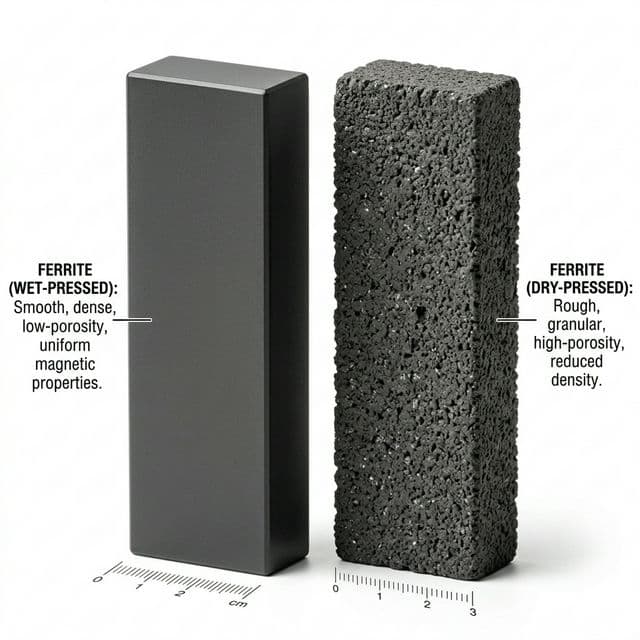
Wet Press vs Dry Press Ferrite: Process Selection for OEM Programs
How to choose wet-pressed or dry-pressed ferrite routes based on geometry, consistency targets, and total manufacturing economics.
For ferrite magnet sourcing, process route selection determines much more than piece price. It affects capability window, scrap exposure, lead-time stability, and long-run qualification risk.
This article helps procurement and engineering teams choose between wet press and dry press with a decision process that can be used before tooling commitment.
If the upstream decision is still material selection (anisotropic ferrite vs NdFeB) rather than ferrite process route, start with: Anisotropic Ferrite vs Neodymium: 2026 Engineering Decision Guide.
Fast Comparison
| Factor | Dry press (typical fit) | Wet press (typical fit) | Buyer impact |
|---|---|---|---|
| Standard geometry throughput | Strong | Moderate to strong | Dry press may scale faster in straightforward part families |
| Performance distribution control | Good | Often stronger where tighter magnetic distribution is needed | Wet press may reduce downstream sorting pressure |
| Tooling and process complexity | Usually lower | Usually higher | Wet press may require stricter process governance |
| Cost at high, stable volume | Often competitive | Depends on required consistency and spec tightness | Do not compare by piece price alone |
Selection by Buyer Priority
Priority A: Lowest Total Landed Cost
Start from dry press when geometry and performance tolerance are not highly restrictive. Then validate whether scrap, sorting, or warranty exposure erodes apparent cost advantage.
Priority B: Tight Performance Distribution
Start from wet press when your application is sensitive to variation and incoming distribution needs to be narrower.
Priority C: Fast Program Launch
Choose the path with the clearest supplier capability evidence for your exact geometry and tolerance map. A theoretically cheaper route is not cheaper if it triggers repeated validation loops.
Cost Model Buyers Should Use
Do not approve process route using only quoted unit price. Use a simple total-cost structure:
- quoted part cost by volume tier
- expected scrap and sorting cost
- qualification and revalidation cycle cost
- logistics variance and delay risk reserve
This model gives a better comparison between wet and dry routes across the full program lifecycle.
RFQ Inputs Required for Reliable Recommendation
- drawing revision with critical dimensions marked
- magnetization direction and magnetic target window
- tolerance classes by functional/non-functional dimensions
- annual demand and ramp schedule
- required quality documents at pilot and SOP
- destination route, Incoterm, and packing constraints
Pilot Plan Template (Recommended)
- Define technical acceptance criteria before sample build.
- Test at least two lots under the same method.
- Compare yield, variation band, and assembly impact.
- Lock route only after cross-functional sign-off (engineering + quality + procurement).
Red Flags During Supplier Review
- process recommendation without capability data
- unclear ownership for out-of-spec lots
- no traceable control plan for magnetic variation
- quote changes without technical change record
Bottom Line
Wet vs dry is not a generic winner/loser question. It is a program-fit decision. The right route is the one that minimizes combined technical and commercial risk at your target volume.
If you want a process-route RFQ checklist for ferrite rings, arcs, blocks, or discs, email [email protected].
Visual Decision Aids
Decision Snapshot
| Route choice | Best-fit condition | Procurement stance |
|---|---|---|
| Dry press first | Standard geometry, broader performance window | Validate whether yield and warranty cost stay controlled |
| Wet press first | Tighter distribution and variation control required | Confirm stronger capability evidence before tooling lock |
| Dual-path pilot | Boundary unclear at RFQ stage | Pilot both routes under one aligned method and compare |
Conclusion: Process route should be chosen by total program fit
Wet vs dry decisions are most reliable when technical, quality, and commercial risks are evaluated together.
Recommended Action
Run one standardized pilot framework and compare total-cost impact, not only quoted part price.
Caution
Avoid route commitment when supplier capability claims are not backed by lot-level evidence.
Evidence and Applicability Notes
Evidence and Applicability Notes
Last reviewed: 2026-04-24
Sources Used
- Supplier process-capability declarations and control-plan summaries
- Pilot lot yield and incoming-inspection records
- RFQ quote assumptions for wet and dry process routes
Method
- Compared wet and dry routes using identical drawing and tolerance scopes
- Separated piece-price impact from scrap, sorting, and revalidation cost
- Assessed process recommendation quality against documented capability evidence
Applicability Boundary
- Not intended for bonded ferrite or non-sintered material routes
- Actual route choice must be validated with pilot lots under your measurement method
- Commercial outcome depends on destination logistics and demand profile
External References
Author

Categories
More Posts

OEM Ferrite Supplier Audit Checklist
A buyer-side audit checklist covering process control, quality systems, and delivery reliability for ferrite magnet suppliers.

Ferrite Magnet Overmolding Design: Thermal and Stress Boundaries
Engineering guide for insert molding ferrite magnets into plastics. Covers thermal demagnetization limits, stress cracking, and tooling DFM rules.
Ferrite vs Neodymium Magnets: B2B Selection Guide
A procurement-focused comparison of ferrite and neodymium magnets across cost, thermal stability, supply risk, and lifecycle fit.
Inquiry Email
Copy the email, or open your default email app to start an inquiry.