
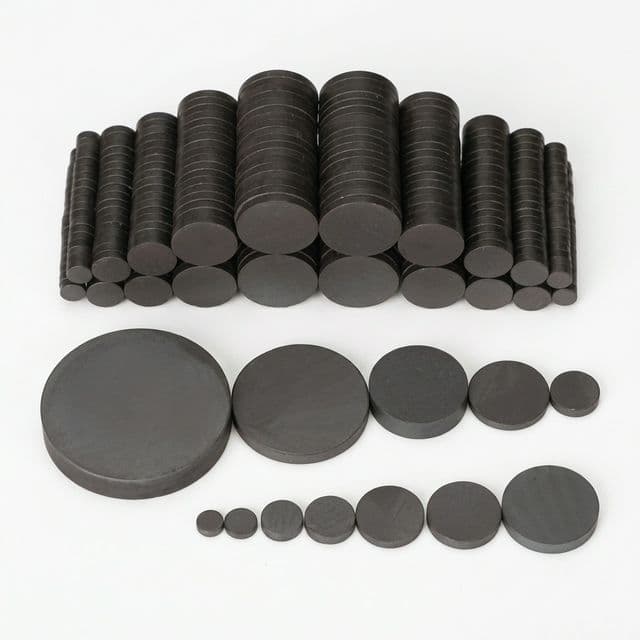
Ferrite Grade Selection (Y30, Y35, Y40): Procurement Playbook
A practical OEM guide to selecting ferrite grades by performance target, risk tolerance, and production repeatability.
Grade selection should be tied to application boundary conditions, not catalog labels alone. In sourcing practice, grade errors usually create hidden cost through sample reruns, delayed tooling decisions, and unstable incoming quality.
This playbook provides a buyer-friendly method to choose among Y30, Y35, and Y40 with fewer revalidation cycles.
If you are still deciding whether to stay in ferrite grades at all or keep NdFeB, review this side-by-side material-decision report first: Anisotropic Ferrite vs Neodymium: 2026 Engineering Decision Guide.
Typical Grade Positioning
| Grade family | Typical sourcing intent | Main tradeoff |
|---|---|---|
| Y30 | Cost-focused programs with moderate magnetic requirements | Lowest margin for high-demand performance windows |
| Y35 | Balanced option for many motor and speaker applications | Requires clear tolerance and test alignment |
| Y40 | Higher magnetic performance target programs | Narrower process window can increase control requirements |
Note: Final suitability must be confirmed with real samples under your duty cycle and test method.
5-Step Grade Selection Workflow
1. Freeze Functional Target First
Define force/torque/flux target at operating temperature range, not room-temperature nominal only.
2. Build Boundary Conditions
Include thermal range, duty profile, envelope limits, and assembly tolerances.
3. Shortlist Grade Candidates
Evaluate at least two grades with clear pass/fail criteria to avoid one-option lock-in.
4. Run Structured Pilot Validation
Use the same measurement method across lots and suppliers. Compare mean value and distribution, not only best sample.
5. Lock Grade With Quality Agreement
Grade decision is only complete when acceptance criteria, inspection method, and escalation process are documented.
Buyer Checklist: Inputs That Improve Recommendation Quality
- operating temperature and duty-cycle profile
- target magnetic performance window and measurement method
- geometry constraints and tolerance classes
- magnetization direction and polarity requirement
- annual demand, launch schedule, and ramp rate
- compliance documents needed for SOP release
Common Mistakes That Increase Program Cost
- selecting by nominal datasheet values without boundary validation
- changing grade after tooling without full impact review
- delaying test method alignment between buyer and supplier
- approving pilot samples without lot-to-lot consistency checks
Decision Scorecard Template
Use a weighted scorecard before final grade lock:
- performance fit under duty cycle
- process stability across pilot lots
- cost stability at target annual volume
- supplier capability and response speed
- quality risk and containment readiness
A scorecard prevents one-dimensional decisions based only on initial quote.
Final Recommendation
In most B2B programs, grade selection is a cross-functional decision. Procurement should require engineering and quality sign-off before PO release for mass production grade lock.
For a structured grade-selection review based on your drawing and duty cycle, contact [email protected].
Visual Decision Aids
Decision Snapshot
| Grade path | Typical fit | Decision trigger |
|---|---|---|
| Y30-first | Cost-led programs with wider performance margin | Keep if pilot distribution is stable and target is met |
| Y35-first | Balanced performance and cost requirement | Use as default baseline when boundary is uncertain |
| Y40-first | Higher output requirement with tighter control | Use only when process capability evidence is confirmed |
Conclusion: Grade lock is a cross-functional control point
Grade decisions should close only when performance, quality, and sourcing assumptions are aligned and documented.
Recommended Action
Run at least two grade candidates through the same test method, then finalize with engineering + quality + sourcing sign-off.
Caution
Avoid locking grade by catalog label alone without boundary-condition validation.
Evidence and Applicability Notes
Evidence and Applicability Notes
Last reviewed: 2026-04-24
Sources Used
- Grade evaluation matrices used in Y30/Y35/Y40 sourcing projects
- Pilot lot test summaries under aligned measurement methods
- Incoming quality and escalation records after grade lock
Method
- Mapped grade candidates to application boundary conditions before quotation
- Compared lot distribution consistency, not only best-sample values
- Used cross-functional sign-off criteria across engineering, quality, and sourcing
Applicability Boundary
- Not a substitute for system-level magnetic simulation and sample validation
- Grade choice must be reviewed whenever duty cycle or geometry changes
- Tolerance and inspection method assumptions must be frozen before mass PO release
External References
Author

Categories
More Posts

Ferrite vs Neodymium Magnets: B2B Selection Guide
A procurement-focused comparison of ferrite and neodymium magnets across cost, thermal stability, supply risk, and lifecycle fit.

Ferrite Magnet Overmolding Design: Thermal and Stress Boundaries
Engineering guide for insert molding ferrite magnets into plastics. Covers thermal demagnetization limits, stress cracking, and tooling DFM rules.

Ferrite RFQ Checklist for OEM Buyers
A practical RFQ checklist that helps purchasing and engineering teams get faster, comparable ferrite magnet quotations.
Inquiry Email
Copy the email, or open your default email app to start an inquiry.