
Advantages of Ferrites: Where They Win, Where They Do Not
Explore the advantages of ferrites with a fit checker, evidence tables on cost, supply risk, force density, and next steps to request an engineering review.
This page combines an executable tool layer (first-screen decision support) with a report layer (evidence, limits, risk, and alternatives) under one canonical URL.
Review cadence: quarterly evidence refresh. Next scheduled review: July 2026.
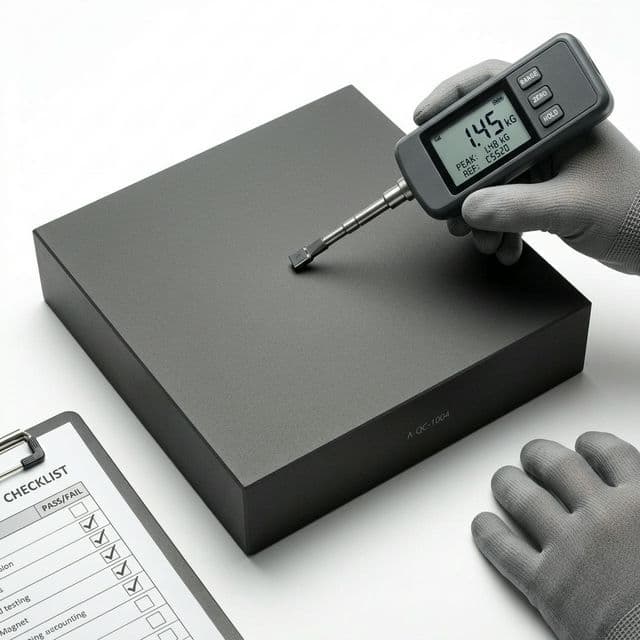
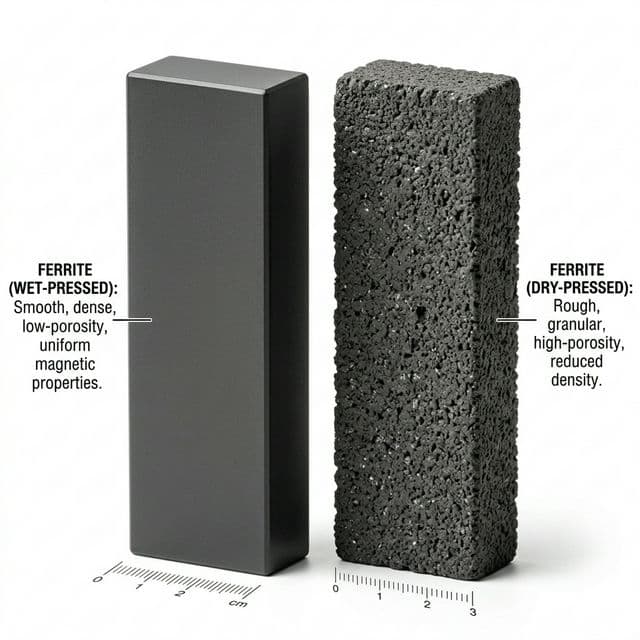
This tool gives a first-pass fit score. It is not a replacement for grade-level engineering validation.
Reference range: -60°C to 300°C. Boundary checks trigger guidance fallback.
Current score weights are heuristic and intentionally conservative. They are not trained on a public benchmark dataset.
As of April 24, 2026, no reliable open benchmark was found for a universal ferrite-fit scoring model across geometry, grade, and magnetic-circuit topologies.
Stage1c review and closure log
| Identified gap | Decision impact | Implemented fix | Status |
|---|---|---|---|
| Cost evidence relied too heavily on a 2015 benchmark. | Could create false confidence in BOM deltas during supplier negotiation. | Added USGS 2026 rare-earth price and import-dependency signals; legacy price points are now downgraded to directional-only context. | Closed (with date-stamped replacement evidence). |
| Hard ferrite vs soft ferrite boundaries were easy to mix. | Teams could misuse core-loss evidence for permanent-magnet pull-force decisions. | Added boundary map plus explicit misuse warnings tied to TDK/Fair-Rite and IEC scope language. | Closed (new boundary section + risk controls). |
| Supply-risk framing only covered rare earths. | Could understate upstream exposure in ferrite material chains. | Added USGS strontium 2026 facts (end-use share, disruption note, substitution caveat). | Closed (ferrite-side supply risk now explicit). |
| Mechanical limits were underrepresented. | Potential late-stage cracking/chipping issues in high-shock assembly. | Added MMPA brittle-material characteristics and mitigation actions to risk and scenario sections. | Closed (decision and mitigation path included). |
| No explicit disclosure of evidence not publicly available. | Readers may over-assume confidence where market data is thin. | Added a “Pending / no reliable public dataset” table with executable next steps. | Closed (uncertainty disclosure now visible). |
| Tool reset could race with in-flight calculation and show conflicting states. | Users could see stale score output alongside empty-state guidance, reducing decision trust. | Added run-token cancellation, disabled reset during loading, and made next-step action visible in the default result view. | Closed in stage1c self-heal (interaction race removed). |
Executive conclusions with key numbers
Each conclusion below includes source context, applicable users, and explicit non-applicable boundaries.
IEA 2026 tracking shows concentration intensifies downstream. Ferrite can lower rare-earth chain exposure where force-density demand is not extreme.
Suitable for: Programs with long contracts, geopolitical risk controls, or dual-source requirements.
Not suitable for: Projects where power density is the top KPI and supply-risk tolerance is high.
Source: IEA Rare Earth Elements (2026 report, 2024 supply-chain snapshot).
MMPA ceramic grades and DOE NdFeB report point to a large force-density gap. Ferrite usually needs more magnetic volume for equivalent pull force.
Suitable for: Space-relaxed assemblies where cost and robustness outrank miniaturization.
Not suitable for: Compact products with tight torque or pull-force envelopes.
Source: MMPA Standard 0100-00 + U.S. DOE NdFeB Supply Chain Report (2022).
Material chemistry changes exposure profile. Ferrite cuts Nd/Pr dependency but still depends on strontium/barium compounds and their regional supply conditions.
Suitable for: Cost-sensitive portfolios seeking lower rare-earth dependency.
Not suitable for: Teams assuming ferrite means zero upstream supply volatility.
Source: MMPA Standard 0100-00 + DOE NdFeB report + USGS Strontium 2026.
Thermal decisions need derating curves and magnetic-circuit context. A high Curie number alone is not a release criterion.
Suitable for: Projects that can run temperature qualification before tooling lock.
Not suitable for: Programs treating Curie data as a direct substitute for operating-temperature validation.
Source: MMPA Standard 0100-00 + IEC 60404-8-1:2023 boundary requirements.
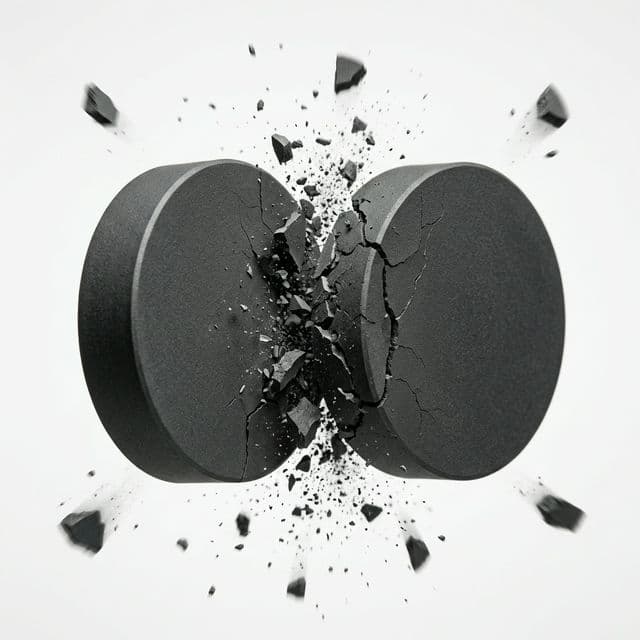
Ferrite can reduce coating dependency versus NdFeB oxidation risk, but chip/crack risk must be handled in mechanical design and assembly controls.
Suitable for: Humid environments where coating process complexity is a cost and reliability concern.
Not suitable for: High-shock or impact-loaded assemblies without brittle-material safeguards.
Source: U.S. DOE NdFeB report (2022) + MMPA mechanical property notes.
Soft ferrite resistivity supports lower eddy-current losses in high-frequency cores. This evidence does not directly prove permanent-magnet pull-force suitability.
Suitable for: EMI suppression, inductors, and transformer-core type scenarios.
Not suitable for: Assuming soft-ferrite core data applies directly to permanent magnet pull force.
Source: Fair-Rite 52 material data sheet (updated 2023-04-27) + TDK ferrite overview.
Ferrite lowers rare-earth dependence, but strontium carbonate disruptions were also reported in 2025. Teams still need supplier resilience checks.
Suitable for: Sourcing programs that plan dual-source and substitution checks early.
Not suitable for: Teams assuming ferrite automatically eliminates all material-supply risks.
Source: USGS Mineral Commodity Summaries 2026 (Strontium chapter).
Verified fact increments (2024-2026)
| Fact | Value | Date marker | Why this changes decisions | Source |
|---|---|---|---|---|
| U.S. rare-earth net import reliance | 67% | 2025 estimate (published in 2026) | Ferrite remains a strategic fallback when procurement policy penalizes rare-earth exposure. | USGS Rare Earths 2026 |
| U.S. rare-earth import source concentration | China 71%, Malaysia 13%, Japan 5%, Estonia 5% | 2025 estimate (published in 2026) | Exposure is not only price-driven; country concentration should be part of qualification reviews. | USGS Rare Earths 2026 |
| China downstream concentration in rare-earth chain | 60% mining, 91% refining, 94% sintered-magnet production | 2024 snapshot (reported in IEA 2026) | Downstream concentration can dominate risk even when mining appears diversified. | IEA Rare Earth Elements (Executive Summary) |
| NdFeB feedstock indicator prices | Nd oxide $73/kg, Pr oxide $64/kg (average 2025) | 2025 average (published in 2026) | Rare-earth magnet economics should be tracked with oxide indicators, not static historical benchmarks. | USGS Rare Earths 2026 |
| Ferrite-relevant strontium market signal | Ceramic ferrite magnets account for 14% of U.S. strontium end use | Published 2026 | Ferrite projects still require upstream monitoring of strontium compounds. | USGS Strontium 2026 |
| NdFeB corrosion handling requirement | Uncoated NdFeB corrodes with oxygen/water vapor exposure; coating is typical | Report published February 2022 | Corrosion-control process complexity should be costed in material-selection decisions. | U.S. DOE NdFeB Supply Chain Report |
Concept boundaries: hard ferrite vs soft ferrite vs NdFeB
| Decision question | Hard ferrite lane | Soft ferrite lane | NdFeB lane | Boundary note |
|---|---|---|---|---|
| What decision is this evidence valid for? | Permanent-magnet force/torque selection in low-to-medium energy-product lanes. | Core-loss, permeability, and EMI/high-frequency magnetic-path optimization. | High energy-product permanent-magnet selection for compact force density. | Do not transfer soft-ferrite core metrics directly into permanent-magnet force claims. |
| Typical property anchor used on this page | BHmax around 1.0-4.0 MGOe; brittle ceramic behavior. | NiZn example resistivity 1×10^9 ohm-cm (material-family specific). | Common sintered grades roughly 35-52 MGOe; higher force density in small envelopes. | Ranges are screening-level only; final decisions require grade datasheets and simulation. |
| Thermal interpretation | Curie and temperature coefficient are relevant, but still need demag-margin validation. | Temperature affects permeability and losses by frequency and bias conditions. | High-temperature service often depends on composition/doping and design margin. | Curie temperature is not a standalone release criterion for any magnet family. |
| Standards and tolerance boundary | IEC 60404-8-1:2023 defines minimum values and tolerances for magnetically hard ferrites. | Use material-family catalogs and core-specific standards for loss/permeability behavior. | Use grade-specific standards/specs and corrosion-protection requirements in RFQ. | If grade code and tolerance class are undefined, treat result as preliminary only. |
Applicability matrix: use and avoid scenarios
| Scenario | Ferrite fit | Why | Fallback path |
|---|---|---|---|
| High-volume commodity motor (space not ultra-tight) | High | Ferrite can reduce rare-earth exposure and often simplifies corrosion handling cost. | Validate torque margin with magnet/circuit simulation before tooling release. |
| Compact actuator with high force density target | Low | Energy-product gap versus NdFeB is typically order-of-magnitude. | Evaluate NdFeB early and quantify total cost including coating and qualification. |
| High-frequency EMI / core-related use | High | Soft-ferrite high resistivity supports lower eddy-current losses in many core applications. | Select by frequency, permeability, and temperature using core-material datasheets. |
| Humid deployment with strict maintenance budget | Medium-High | Ferrite can reduce dependence on anti-corrosion coating stacks used in NdFeB workflows. | Run enclosure-level corrosion validation and mechanical drop/shock checks. |
| High-impact or vibration-heavy mechanical assembly | Conditional | Ferrite brittleness can dominate reliability if mounting stress is high. | Use fixtures/adhesive design with chip-risk controls; consider alternative materials if impact loads are unavoidable. |
| Extreme miniaturization + premium performance | Low | Package volume often becomes the limiting factor. | SmCo/NdFeB path with lifecycle-cost model. |
Methodology and evidence boundary
Ferrite vs alternatives (decision table)
| Dimension | Ferrite | NdFeB | SmCo | Decision implication |
|---|---|---|---|---|
| Maximum energy product (MGOe) | Approx. 1.0-4.0 (ceramic grades) | Approx. 35-52 (sintered grades) | Approx. 16-30 | Ferrite generally needs substantially more magnetic volume for equivalent force. |
| Br range (Gauss, screening level) | ~2,300-4,100 | ~10,000-11,960 | ~8,300-11,600 | Flux density in compact geometries typically favors rare-earth magnets. |
| Material dependency | MO·6Fe2O3 (M=Sr/Ba), no rare-earth in base chemistry | Approx. 30 wt% rare-earth content in alloy | Rare-earth + cobalt alloy family | Upstream exposure profile changes with material family, not just with magnet grade. |
| Corrosion and mechanical handling | Lower oxidation concern, but brittle/chip-prone ceramic | Commonly coated (Ni-Cu-Ni typical) to control corrosion | Corrosion behavior can be favorable but verify grade-specific handling | Corrosion and mechanical reliability costs should be modeled together, not separately. |
| Thermal boundary interpretation | Curie around 450°C; Br temperature coefficient around -0.2%/°C | Higher-energy products often require temperature-specific grade choices | Often selected for high-temperature stability with higher material cost | Curie number alone is insufficient; use grade-specific derating and demag checks. |
| Standards / qualification baseline | IEC 60404-8-1:2023 defines minimum values and tolerances | Use grade standards + coating and environment qualification | Use supplier grade standards and thermal/corrosion validation | If standard class and tolerance are undefined, treat decisions as provisional. |
Need a material decision review before RFQ?
If your score is borderline, request a dual-material review so ferrite and NdFeB can be compared with the same boundary conditions before tooling lock.
Risk and tradeoff controls
| Risk | Probability | Impact | Mitigation |
|---|---|---|---|
| Force shortfall after packaging freeze | Medium | High | Run early magnetic-circuit simulation and compare ferrite vs NdFeB before tooling lock. |
| Wrong extrapolation from soft-ferrite core data | Medium | High | Separate permanent-magnet and core-material assumptions in requirements docs. |
| Treating Curie temperature as operating qualification | Medium | High | Require grade-level derating data, demag-margin checks, and thermal aging tests at worst-case duty. |
| Mechanical cracking/chipping in assembly or field impact | Medium | High | Add fixture stress review, drop/vibration validation, and handling controls for brittle ceramics. |
| Assuming ferrite has zero upstream supply risk | Medium | Medium | Track strontium/barium supply dependencies and include dual-source contingencies. |
| Over-trusting old or non-public cost benchmarks | High | Medium | Collect live quotes from at least two qualified suppliers and refresh assumptions per sourcing milestone. |
Scenario demonstrations (assumptions → outcome)
| Scenario | Assumptions | Outcome | Action |
|---|---|---|---|
| Automotive auxiliary DC motor (window-lift class) | Temp up to 140°C, moderate torque, high annual volume. | Ferrite-first path is often viable with cost and sourcing-risk benefits. | Proceed with ferrite pilot, keep NdFeB as backup only if torque margin fails. |
| Compact handheld actuator | Tight package, high pull force, user-facing size limit. | Ferrite volume penalty likely unacceptable. | Prioritize NdFeB/SmCo evaluation; ferrite stays as cost floor reference. |
| High-frequency EMI choke path | Loss/heat at switching frequency is main concern. | Ferrite core families often provide better loss behavior than metallic options. | Use ferrite core data sheet selection by permeability and frequency. |
| Outdoor actuator with high humidity and service constraints | Corrosion risk high, maintenance window limited, impact load moderate. | Ferrite can reduce coating dependency but mechanical brittleness still needs design margin. | Use ferrite candidate with shock-aware mounting and validate chip/crack risk in pilot. |
| Program with strict supply-resilience policy | Procurement penalizes concentrated rare-earth exposure, space envelope is moderate. | Ferrite is often acceptable if force targets are met with larger magnetic volume. | Run ferrite + NdFeB A/B with explicit supply-risk scoring before final award. |
Evidence table and SERP pattern audit
| Pattern | Finding | Why it matters |
|---|---|---|
| Top results are mostly listicles/vendor explainers | 8/10 sampled results | Users get generic claims but little execution guidance. |
| Interactive tool availability | 0/10 in sampled SERP snapshot | Tool-first section creates clear differentiation. |
| Evidence granularity | Most pages lack dated source tables | Date-stamped evidence layer improves decision trust. |
| Source | Date context | Signal used | Confidence / limit |
|---|---|---|---|
| USGS Mineral Commodity Summaries 2026 (Rare Earths) | Published 2026, statistics for 2025 estimate | U.S. rare-earth net import reliance 67%; import source shares: China 71%, Malaysia 13%, Japan 5%, Estonia 5%. | High for macro sourcing context. |
| USGS Mineral Commodity Summaries 2026 (Strontium) | Published 2026 | Strontium carbonate is used to make ceramic ferrite magnets; 14% of U.S. strontium end use goes to ceramic ferrite magnets and pyrotechnics. | High for ferrite upstream context; useful to avoid “ferrite has zero supply risk” assumptions. |
| IEA Rare Earth Elements (Executive Summary) | Report released 2026, with 2024 supply-chain shares | China concentration: 60% mining, 91% refining, 94% sintered magnet production; report also flags export-control and disruption context. | High for global concentration and policy-risk framing. |
| U.S. DOE Neodymium Magnets Supply Chain Report | Published February 2022 | NdFeB alloy composition and corrosion/coating handling notes; common sintered-grade energy-product range context. | Medium-High for NdFeB material behavior and process-risk framing. |
| IEC 60404-8-1:2023 standard metadata | Published 2023-03-24 | Defines specifications for magnetically hard ferrites including minimum values and tolerances (grade-level boundary control). | High for qualification boundary, but full numeric tables require standard access. |
| MMPA Standard Specifications for Permanent Magnet Materials | Edition year not explicit in accessible copy (legacy industry standard) | Provides ceramic magnet family formulas, magnetic ranges, and brittle-mechanical characteristics used for screening-level comparisons. | Medium for screening comparisons; verify final values with current supplier datasheets. |
| Fair-Rite 52 Material Data Sheet | Updated 2023-04-27 | NiZn ferrite example resistivity 1×10^9 ohm-cm, Curie >250°C. | Medium; applies to specific soft-ferrite family, not all ferrites. |
| TDK Ferrite World Vol.1 | Live page accessed 2026-04-24 | Explains ferrite high-resistivity behavior and practical high-frequency loss benefits; includes hard vs soft ferrite framing. | Medium; educational manufacturer source, useful for mechanism explanation. |
| Topic | Current status | Minimum executable next step |
|---|---|---|
| Real-time finished ferrite magnet spot price index (global, open) | No reliable public index found in this research round; available numbers are mostly vendor quote snapshots. | Use live RFQ quotes from at least two suppliers and refresh at each sourcing gate. |
| Universal maximum operating temperature for all ferrite grades | No single public value is valid across geometry, grade, and magnetic circuit. | Use grade-level BH/derating curves and define operating-temperature acceptance tests in RFQ. |
| One-size-fits-all conversion from core resistivity to pull-force outcome | Public data does not support direct conversion; physics differs by use case. | Split core-loss evidence and permanent-magnet force evidence into separate validation tracks. |
FAQ by decision intent
Adjacent decision pages
Use these pages when your decision is more about supplier execution than material tradeoff.
Inquiry Email
Copy the email, or open your default email app to start an inquiry.