
Anisotropic Barium Ferrite Magnets: Tool-First Fit Check, Then Decision Evidence
Run a 2-minute anisotropic barium ferrite fit check, then use evidence tables for remanence windows, process boundaries, supply tradeoffs, and RFQ action steps.
Evidence cadence: quarterly review. Latest source refresh completed April 24, 2026. Next scheduled update: July 2026.

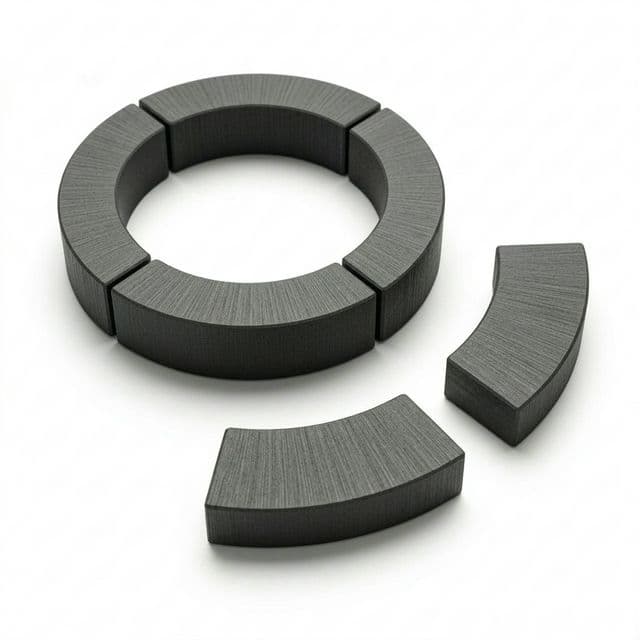
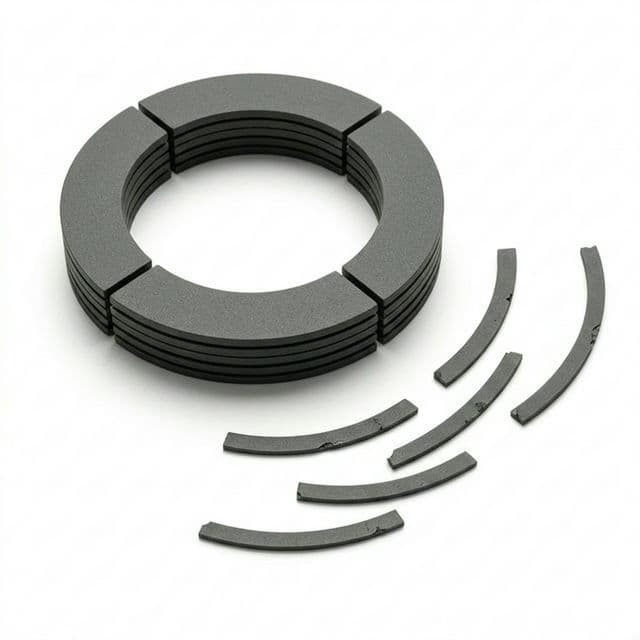
First-pass planning tool for anisotropic barium ferrite magnets. It is directional guidance, not a final engineering sign-off.
Planning window: anisotropic ferrite often targets roughly 300-400 mT; model absolute range is 100-600 mT.
Directional model range: -60°C to 300°C. Above this range, use grade-level demagnetization validation only.
| Model item | Implementation detail | Why it matters |
|---|---|---|
| Input range guardrails | Target Br (100-600 mT), temperature (-60°C to 300°C), and non-negative annual volume checks are validated before scoring. | Prevents false confidence from impossible or malformed inputs. |
| Directional score model | Score weights prioritize orientation control, geometry envelope, target Br pressure, and sourcing priority. | Aligns first-pass recommendation with anisotropic ferrite-specific tradeoffs. |
| Boundary fallback | Out-of-range inputs return a boundary state with an explicit next-step path to grade-level validation. | Keeps the tool actionable even when result confidence is intentionally low. |
| Deterministic behavior | Same inputs return the same score/result; inputs and reset are locked during loading to avoid race conditions and score/input mismatch. | Supports reproducible screening in buyer and engineering handoff workflows. |
Executive conclusions with key numbers
This section is optimized for quick decision alignment: each conclusion includes numeric signal, fit boundary, and source context.
For hard ferrite projects that can control orientation, anisotropic grades provide a major magnetic-performance uplift over isotropic baseline grades.
Best fit
Motor and speaker programs that can support directional orientation control and moderate package volume.
Not ideal when
Projects assuming isotropic and anisotropic ferrite can be swapped without geometry or process revalidation.
Source: MMPA Standard 0100-00 (Ceramic C1/C5/C8 table).
Anisotropic barium ferrite improves output versus isotropic ferrite, but compact high-force designs may still require NdFeB-class materials.
Best fit
Cost-sensitive assemblies with room for magnetic volume optimization.
Not ideal when
Ultra-compact envelopes where force density is the first KPI.
Source: MMPA 0100-00 (Ceramic + R5 NdFeB tables).
Without alignment and process control, anisotropic materials can miss expected Br consistency and lot-to-lot stability.
Best fit
Teams with fixture alignment controls, process SPC, and pilot transfer gates.
Not ideal when
Programs relying on nominal catalog data without orientation/process verification.
Source: KONA Powder and Particle Journal, “High Performance Ferrite Magnets:…”
Thermal decisions must still include reversible loss, demagnetization margin, and magnetic-circuit conditions at operating temperatures.
Best fit
Programs with explicit thermal derating and demag-margin validation plans.
Not ideal when
Projects using Curie numbers as direct substitute for operating qualification.
Source: MMPA 0100-00 Table III-5.
Room-temperature pass results are not enough for cold-start duty. Permeance-coefficient margin must keep the operating point above the knee at low temperature.
Best fit
Products that include explicit low-temperature demagnetization tests and operating-point margin checks.
Not ideal when
Projects qualified only with room-temperature pull-force tests.
Source: TDK FB Ferrite Product Guide (update May 2014, sections 2-2 and 2-3).
In humid duty cycles, anisotropic barium ferrite may simplify coating-related risk, but brittle handling risk must be controlled.
Best fit
Outdoor/humid designs where coating-process complexity is a schedule risk.
Not ideal when
High-impact assemblies without brittle-material safeguards.
Source: U.S. DOE NdFeB report + MMPA ferrite mechanical notes.
Electrical behavior can support EMI-related stability in some assemblies, but it should not be confused with pull-force capability gains.
Best fit
Design reviews that need both magnetic and electrical behavior context during material screening.
Not ideal when
Teams trying to use resistivity data as proof of higher permanent-magnet force output.
Source: MMPA 0100-00 ceramic ferrite physical-property table.
Switching to ferrite can reduce rare-earth chain dependence, but buyers still need upstream monitoring for ferrite-relevant mineral inputs.
Best fit
Sourcing teams pursuing dual-source resilience and material-risk diversification.
Not ideal when
Teams expecting ferrite selection to eliminate all upstream exposure risk.
Source: IEA Rare Earth Elements (2026) + USGS MCS 2026 Rare Earths.
Key facts table
| Fact | Value | Date context | Decision implication | Source |
|---|---|---|---|---|
| Isotropic vs anisotropic ferrite baseline (MMPA) | C1 BHmax 1.0 MGOe vs C5 3.5 MGOe vs C8 3.7 MGOe | MMPA 0100-00 (accessed April 24, 2026) | Anisotropic selection can materially improve magnetic output before changing to rare-earth systems. | MMPA 0100-00 |
| Remanence floor by grade (MMPA) | C1 Br 2.25 kG; C5 Br 3.80 kG; C8 Br 3.85 kG | MMPA 0100-00 | Target Br expectations should map to anisotropic grade family, not isotropic assumptions. | MMPA 0100-00 |
| Thermal boundary: Curie vs service limit | MMPA ceramic typicals: Curie about 460°C, max service about 250°C, Br coefficient around -0.20%/°C, Hci coefficient around +0.30%/°C | MMPA 0100-00 Table III-5 (accessed April 24, 2026) | Curie values describe phase behavior, not release criteria. Operating-point and demag-margin tests are still required. | MMPA 0100-00 |
| Low-temperature irreversible demag trigger | TDK FB guide documents that ferrite Hcj decreases when temperature drops; if operating point crosses the knee at low temperature, irreversible loss can occur | TDK FB Ferrite Product Guide, updated May 2014 | Cold-start validation must include permeance-coefficient margin and irreversible-loss checks, not just room-temperature tests. | TDK FB Ferrite Product Guide |
| Acceptance method boundary | MMPA section 9.1 recommends specifying minimum flux at one or more load lines and agreeing a reference magnet, instead of accepting by Br/Hc alone | MMPA 0100-00 section 9.1 | RFQ and PPAP gates should include load-line acceptance tests to avoid false passes. | MMPA 0100-00 |
| NdFeB composition signal | Approx. 30 wt% rare earth, 69 wt% Fe, 1 wt% B | DOE report published 2022 | Material-selection strategy should include composition-driven supply exposure. | DOE NdFeB Supply Chain Report |
| Rare-earth downstream concentration | IEA 2026: 91% refining and 94% sintered magnet production in China (2024 snapshot) | IEA Rare Earth Elements 2026 | Ferrite remains a practical hedge in programs sensitive to geopolitical and concentration risk. | IEA Rare Earth Elements 2026 |
| Potential disruption scale under full export controls | IEA 2026 estimates up to USD 6.5 trillion per year downstream production value at risk outside China | IEA Rare Earth Elements executive summary 2026 | Material choices should be linked to business-continuity planning, not only piece-price comparison. | IEA Rare Earth Elements 2026 |
| U.S. rare-earth import concentration and policy events | USGS 2026: U.S. rare-earth compounds/metals imports were 71% from China (2021-24); export controls were tightened in April and October 2025, then partially suspended in November 2025 | USGS Mineral Commodity Summaries 2026 | Ferrite migration can reduce some NdFeB exposure but does not remove sourcing-policy shock risk. | USGS Rare Earths chapter 2026 |
| Strontium end-use relevance | USGS 2026 U.S. end-use estimate: drilling fluids 65%, ceramic ferrite magnets 14%, pyrotechnics/signals 14%, other 7%; net import reliance 100% | USGS MCS 2026 | Ferrite supply reviews should also watch strontium-chain stability, not only rare-earth headlines. | USGS Strontium chapter 2026 |
| Ceramic ferrite physical baseline | MMPA ceramic baseline: density about 4.8-5.0 g/cm³, relative permeability around 1.05, resistivity around 10^6 ohm-cm | MMPA 0100-00 | Magnetic-circuit and mechanical packaging assumptions can be initialized from a defensible baseline. | MMPA 0100-00 |
Applicability boundaries by scenario
| Scenario | Fit | Why | Fallback path |
|---|---|---|---|
| Automotive auxiliary motor with moderate envelope | Likely fit | Directional ferrite gain plus cost/supply priorities align with anisotropic grades. | Validate with pilot BH and thermal demag test before locking tooling. |
| Compact handheld actuator with strict force density target | Conditional to low fit | Tight geometry and high Br requirement can exceed ferrite practicality. | Run NdFeB comparison and evaluate hybrid architecture options. |
| Outdoor fixture magnet with humidity exposure | Likely fit | Corrosion robustness and cost stability often favor ferrite in this context. | Add mechanical anti-chipping constraints in fixture and packaging. |
| Prototype with no orientation process control | Conditional | Without controlled alignment, anisotropic benefit can collapse to inconsistent output. | Use isotropic pilot baseline or enforce alignment fixture controls first. |
| High-temperature niche design near upper operating window | Conditional | Ceramic ferrite service-temperature headroom is useful, but operating-point margin still controls real release limits. | Use temperature-coefficient derating plus load-line verification at max operating temperature. |
| Cold-start duty with low permeance coefficient | Conditional to low fit | At low temperature, ferrite Hcj can decrease and push the operating point closer to the knee. | Run low-temperature irreversible-demag checks and increase permeance margin through geometry or grade updates. |
Thermal and demagnetization boundary gates
| Boundary condition | Verified evidence | Failure risk if ignored | Minimum executable action |
|---|---|---|---|
| Using Curie temperature as operating limit | MMPA ceramic typicals show Curie around 460°C and max service around 250°C, with explicit Br/Hci temperature coefficients. | Designs can pass paper review but fail in thermal demag margin when released. | Use service-temperature and load-line validation gates, not Curie-only gates. |
| Low-temperature duty below roughly -20°C | TDK FB guide documents low-temperature irreversible demag risk when operating point crosses the knee. | One-way flux loss after cold exposure and torque/force drift in field. | Run cold-start cycle tests and verify operating point remains above knee with margin. |
| Counter magnetic field events in motor duty | TDK guidance shows external opposing field can create irreversible loss depending on magnetic circuit and operating point. | Transient events cause hidden demag that appears later as performance complaints. | Specify opposing-field stress test and maximum irreversible loss threshold in validation plan. |
Comparison table: anisotropic barium ferrite vs alternatives
| Dimension | Anisotropic barium ferrite | Isotropic ferrite | NdFeB | Decision implication |
|---|---|---|---|---|
| Magnetic energy product (typical planning band) | Approx. 3.5-3.7 MGOe (C5/C8 range) | Approx. 1.0 MGOe (C1 baseline) | MMPA R5 class up to about 50 MGOe | Anisotropic ferrite is a major step above isotropic, but still far below NdFeB compact-force capability. |
| Remanence floor (Br) | Around 3.8 kG class in anisotropic grades | Around 2.25 kG class | Higher Br class for compact-force designs | Package size and required pull force determine whether anisotropic ferrite is enough. |
| Orientation/process dependency | High dependency on alignment and process control | Lower dependency on directional alignment | High grade/process discipline still required | Anisotropic value capture depends on manufacturing execution, not only material choice. |
| Corrosion and coating process load | Generally robust oxide behavior | Similar oxide behavior | Often requires protective coating controls | In humid duty cycles, ferrite may reduce coating-process complexity and cost. |
| Temperature behavior and release boundary | MMPA ceramic typicals: Br coefficient around -0.20%/°C, max service around 250°C | Similar ferrite-family trend and thermal behavior | MMPA NdFeB typical: Br coefficient around -0.09%/°C, max service around 150°C | Ferrite generally offers wider service-temperature headroom, but larger reversible Br drift per °C must still be derated in design. |
| Low-temperature irreversible demag sensitivity | TDK guidance: low-temperature knee crossing can cause irreversible loss if permeance margin is thin | Same ferrite-family mechanism can appear | Different demag mechanism profile; low-temperature Hci trend differs from ferrite | Do not rely on room-temperature-only pass criteria when the duty cycle includes cold starts or opposing fields. |
| Supply exposure profile | Lower rare-earth exposure, still mineral-input monitoring needed | Similar ferrite-chain profile | High rare-earth chain concentration sensitivity | Material strategy should combine magnetic fit with procurement risk policy. |
| Best-fit business objective | Balanced cost + directional performance + resilience | Lowest complexity and lower magnetic target | Maximum force density and miniaturization | Select by dominant KPI, then validate with pilot data instead of catalog-only assumptions. |
Method and evidence construction
- Collect input constraints from the buyer-side use case.
- Run deterministic screening model with explicit boundary guardrails.
- Map output to evidence tables (MMPA/KONA/TDK/DOE/IEA/USGS) and disclose uncertainty where public data is thin.
- Convert recommendation into executable next step (RFQ, pilot validation, or alternative material path).
| Pattern | Finding | Decision impact |
|---|---|---|
| Most top results are product listings or supplier pages | Users expect immediate specification guidance and sourcing action, not only textbook definitions. | Tool-first experience is required to satisfy do-intent quickly. |
| Research pages emphasize anisotropy mechanisms and processing | Know-intent users need process and boundary explanation before committing to RFQ. | Report layer must explain how anisotropic value is achieved and where it fails. |
| Comparison queries with NdFeB appear frequently in adjacent SERP | Decision quality depends on tradeoff framing, not isolated ferrite claims. | Comparison and risk sections are mandatory for conversion-ready decisions. |
| Public data depth is uneven across grade/vendor contexts | Some values are clear, while lot-level yield and reliability data remain non-public. | Visible uncertainty disclosure prevents false precision and improves trust. |
RFQ and validation checklist (actionable baseline)
| Checklist item | Minimum requirement | Why this matters | Source anchor |
|---|---|---|---|
| Load-line acceptance target | Specify minimum flux at one or more operating load lines, not Br/Hc table values only. | MMPA section 9.1 states unit properties alone are not a reliable acceptance basis for finished magnets. | MMPA 0100-00 section 9.1 |
| Reference sample and same test method | Buyer and supplier agree one reference magnet and identical test setup before volume release. | Reduces cross-lab variation and prevents acceptance disputes in pilot and mass production. | MMPA 0100-00 section 9.1 |
| Low/high temperature irreversible-loss gate | Include cold-start and max-temperature dwell tests with irreversible flux-loss limits. | TDK shows low-temperature knee crossing can create irreversible demag despite room-temperature pass results. | TDK FB Ferrite Product Guide (sections 2-2 and 2-3) |
| Handling brittleness control | Define anti-chipping packaging, fixture constraints, and incoming inspection criteria in RFQ. | Ferrite brittleness can convert logistics or assembly shocks into field failures. | MMPA + TDK handling cautions |
Risk matrix and mitigation plan
| Risk | Probability | Impact | Mitigation |
|---|---|---|---|
| Overestimating anisotropic uplift without orientation control | Medium | High | Require alignment-process evidence, magnetic SPC trend, and pilot acceptance limits. |
| Using Curie temperature as direct operating limit | Medium | High | Add derating validation with thermal cycling and demag margin criteria. |
| Low-temperature irreversible demagnetization is missed in qualification | Medium | High | Add cold-start irreversible-loss gate with explicit permeance-coefficient margin and knee-point checks. |
| Geometry squeeze forces unrealistic ferrite performance expectations | High | High | Run early A/B architecture study against NdFeB and adjust package or force target. |
| Procurement assumes ferrite removes all supply risk | Medium | Medium | Track ferrite-relevant upstream indicators and plan dual-source alternatives. |
| Export-control shock is not reflected in sourcing strategy | Medium | High | Map critical components to April/October 2025 export-control exposure and pre-qualify substitute routes before RFQ lock. |
| Brittle handling defects in assembly or shipping | Medium | Medium | Define anti-chipping fixture design, packaging drop limits, and incoming inspection gates. |
Scenario demonstrations
| Scenario | Assumptions | Outcome | Action |
|---|---|---|---|
| HVAC motor platform refresh with cost-down target | Medium force density requirement, moderate package envelope, annual volume >100k. | Anisotropic ferrite can be viable with strong cost-resilience profile after pilot validation. | Proceed with C5/C8-oriented screening and thermal derating test plan. |
| Small portable actuator redesign for size reduction | Tight geometry and high flux-density KPI dominate the design. | Anisotropic barium ferrite likely underperforms unless package size is relaxed. | Use ferrite as baseline and prioritize NdFeB path for final architecture. |
| Outdoor speaker magnet assembly with humidity concern | Corrosion durability and lifecycle cost are top priorities. | Anisotropic ferrite can offer balanced performance and lower coating dependency risk. | Add impact/brittleness safeguards and execute pilot-to-mass handoff checklist. |
| Multi-region sourcing policy update | Procurement must reduce single-chain concentration exposure. | Ferrite migration can support resilience goals for suitable force-density envelopes. | Map material strategy to supply-risk policy and dual-source qualification cadence. |
Evidence sources and uncertainty disclosure
| Source | Date context | Signal used | Confidence / limit |
|---|---|---|---|
| MMPA Standard 0100-00 Permanent Magnet Material Specifications | Public PDF revision (accessed April 24, 2026) | Ceramic C1/C5/C8 Br, coercivity, BHmax, density, Curie, and baseline property ranges. | High for standard baseline values; not a substitute for vendor-lot qualification. |
| KONA Review: High Performance Ferrite Magnets (perspective paper) | 1998 review (accessed April 24, 2026) | Anisotropic ferrite processing routes, orientation dependence, and BaM property context. | Medium-high for process principles; technology progress since publication must be considered. |
| TDK Ferrite Magnets FB Series Product Guide | Updated May 2014 (accessed April 24, 2026) | Temperature coefficients, low-temperature irreversible demag mechanism, and counter-field demag guidance for ferrite magnets. | High for ferrite behavior mechanisms and practical design cautions; grade-specific values still require supplier-lot validation. |
| U.S. DOE NdFeB Supply Chain Deep Dive Assessment | Published February 2022 | NdFeB composition context and supply-chain exposure framing for comparison decisions. | High for policy-level and composition-level comparison context; update with current market pricing separately. |
| IEA Rare Earth Elements (Executive Summary) | Published 2026 (2024 chain snapshot and 2025 policy events) | Downstream concentration, export-control timeline, and disruption-value indicators used in sourcing risk framing. | High for macro concentration signal; not project-specific procurement advice. |
| USGS Mineral Commodity Summaries 2026 - Rare Earths | Published February 2026 | U.S. import-source concentration, 2025 policy events, and production/import statistics for rare earths. | High for U.S. market and policy context; not a direct substitute for contract-level supplier audits. |
| USGS Mineral Commodity Summaries 2026 - Strontium | Published February 2026 | U.S. net import reliance and end-use distribution including ceramic ferrite magnets. | High for macro end-use context; does not provide supplier-level risk scoring. |
| Topic | Current status | Minimum executable next step |
|---|---|---|
| Public lot-yield benchmarks for anisotropic barium ferrite by geometry class | No consistent open dataset with cross-vendor comparability | Request pilot Cp/Cpk and lot-yield evidence directly in RFQ technical package. |
| Real-time global price index for anisotropic ferrite finished magnets | No unified transparent benchmark across grades, Incoterms, and magnetization states | Use normalized RFQ templates and compare landed-cost structure across candidate suppliers. |
| Universal mapping from catalog Br to system-level pull force | Public formulas are incomplete without geometry and circuit context | Run magnetic simulation + pilot fixture testing before committing tooling volumes. |
| Public dataset linking low-temperature irreversible-loss behavior to permeance coefficient by geometry | No standardized cross-vendor publication with comparable test setup | Require supplier low-temperature demag reports with explicit test fixture, operating point, and irreversible-loss criteria. |
| Cross-industry failure-rate benchmark for brittle chipping in ferrite assemblies | Insufficient open, standardized reliability dataset | Add incoming inspection criteria and handling FMEA in NPI stage-gate documentation. |
FAQ by decision intent
Related decision pages
Use these when your next question is supplier execution and RFQ implementation detail.
Inquiry Email
Copy the email, or open your default email app to start an inquiry.
Boundary reminder
This page is decision support, not a final design release. Always complete grade-level validation before tooling lock or mass production launch.