

Ferrite vs Neodymium Magnets: B2B Selection Guide
A procurement-focused comparison of ferrite and neodymium magnets across cost, thermal stability, supply risk, and lifecycle fit.
When engineering and sourcing teams compare ferrite and neodymium magnets, the right choice is almost never a one-line material preference. It is a program-level decision across envelope constraints, lifecycle cost, and supply risk.
This guide is for buyers who need to decide whether to keep neodymium, fully migrate to ferrite, or run a mixed strategy by SKU.
If your project specifically needs anisotropic ferrite vs neodymium engineering thresholds (MMPA table ranges, 2025-2026 supply policy signals, and RFQ test gates), use this focused report: Anisotropic Ferrite vs Neodymium: 2026 Engineering Decision Guide.
If the sourcing question is price-first, including the misspelled query average price of ferrit, use the ferrite cost calculator before comparing ferrite against neodymium on lifecycle cost.
Executive Decision Matrix
| Dimension | Ferrite | Neodymium | Buyer implication |
|---|---|---|---|
| Cost stability | Usually stronger in high-volume planning | More exposed to price swings | Ferrite often improves annual budget predictability |
| Magnetic energy density | Lower | Higher | Neodymium is favored when installation space is constrained |
| Thermal robustness in many industrial use cases | Often strong with proper margin design | Can be sensitive in high-heat scenarios if derating is ignored | Validate both against actual duty cycle and heat profile |
| Supply continuity planning | Often easier to stabilize | Can face higher volatility risk | Multi-year contracts benefit from ferrite continuity |
| Geometry flexibility | Works well when more magnet volume is available | Helps where compact designs are mandatory | Envelope is usually the first hard gate |
When Ferrite Is Usually the Better Business Choice
Ferrite is often the better choice when these conditions are true:
- your product has sufficient magnet envelope volume
- annual demand is high and cost stability matters more than maximum flux density
- your program is sensitive to procurement volatility and quote variance
- your quality team can control performance through process consistency and sorting rules
When Neodymium Should Stay
Keep neodymium as the primary path when:
- installation envelope is tightly constrained and cannot be redesigned
- performance target has no practical ferrite margin after simulation and sample tests
- the cost of redesigning housing, tooling, and certification exceeds expected material savings
Migration Framework: Neodymium to Ferrite
Use a gated approach instead of a direct material swap.
Gate 1: Envelope and Performance Feasibility
Confirm that available magnet volume can support target force/torque with ferrite under worst-case temperature and duty cycle.
Gate 2: Process and Tolerance Feasibility
Align supplier on tolerance map, magnetization direction, and acceptance window before tooling release.
Gate 3: Pilot Validation
Run pilot lots with defined pass/fail criteria for magnetic output, assembly yield, and field return risk indicators.
Gate 4: Commercial and Supply Validation
Compare landed cost, lead time stability, and disruption response plans across at least two approved sources.
Buyer Checklist Before Issuing RFQ
- target performance window at operating temperature
- space envelope and assembly constraints
- annual demand and ramp profile
- allowed tolerance stack and critical dimensions
- compliance and documentation package required at SOP
- approved trade terms and destination routes
Common Decision Mistakes
- choosing by nominal datasheet values only
- ignoring thermal and duty-cycle boundary conditions
- evaluating piece price without yield and downtime cost
- launching migration without pilot lot acceptance criteria
Practical Recommendation
For most industrial OEM programs, the best first step is not “replace neodymium immediately,” but run a structured ferrite feasibility RFQ using a fixed technical template.
If you want a ferrite migration review template (technical + commercial), send your drawing set and duty-cycle boundary to [email protected].
Visual Decision Aids
Decision Snapshot
| Decision path | Program condition | Recommendation |
|---|---|---|
| Keep neodymium | Envelope is fixed and ferrite margin fails pilot | Retain neodymium and optimize continuity terms |
| Partial migration | Mixed SKU portfolio with varying envelope constraints | Split by SKU and run controlled migration batches |
| Full ferrite migration | Envelope and performance can be achieved with ferrite | Launch gated migration with pilot acceptance criteria |
Conclusion: Material choice is a program architecture decision
Ferrite vs neodymium should be evaluated across envelope, lifecycle cost, and supply continuity rather than isolated material preference.
Recommended Action
Use a gate-based migration plan and compare options using normalized technical and commercial assumptions.
Caution
Avoid direct material swaps without pilot validation under real duty-cycle and temperature boundaries.
Evidence and Applicability Notes
Evidence and Applicability Notes
Last reviewed: 2026-04-24
Sources Used
- Ferrite and neodymium RFQ comparison sheets from industrial OEM programs
- Pilot lot magnetic output and thermal test records
- Supplier lead-time variance and disruption-response logs
Method
- Normalized commercial and technical assumptions before quote comparison
- Compared options under identical envelope and duty-cycle constraints
- Evaluated total cost including yield, logistics, and schedule-risk impact
Applicability Boundary
- Not intended for applications where installation envelope cannot be adjusted
- All conclusions require validation under your temperature and load profile
- Program-level decisions should include engineering and quality sign-off
External References
Author

Categories
More Posts

OEM Ferrite Supplier Audit Checklist
A buyer-side audit checklist covering process control, quality systems, and delivery reliability for ferrite magnet suppliers.
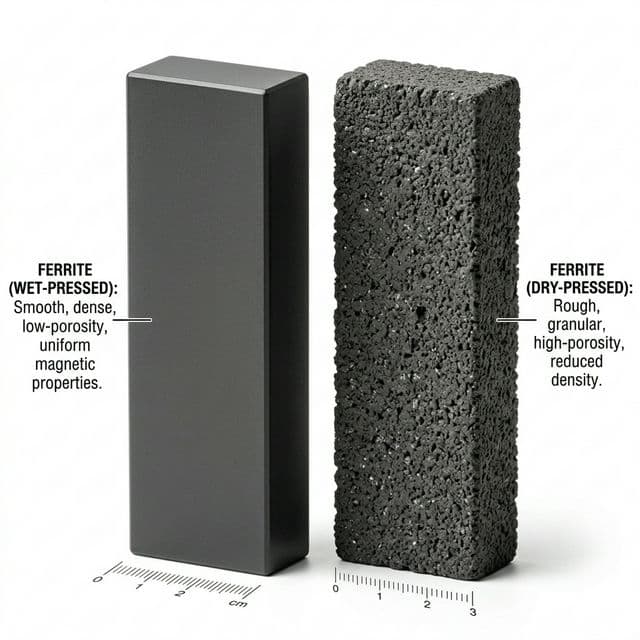
Wet Press vs Dry Press Ferrite: Process Selection for OEM Programs
How to choose wet-pressed or dry-pressed ferrite routes based on geometry, consistency targets, and total manufacturing economics.
Injection Molded vs Sintered Ferrite Magnets: An OEM Buyer's Guide
Compare injection-molded vs sintered ferrite magnets for OEM sourcing: tooling cost, tolerances, heat limits, assembly yield, and RFQ review support now.
Inquiry Email
Copy the email, or open your default email app to start an inquiry.