
Mid-2026 OEM Magnet Sourcing: Impact of the Magnets Value Chain Support Act & Tariff Updates
Decision brief for OEM engineers and sourcing managers on the 2026 tariff updates and the newly introduced Magnets Value Chain Support Act, and what it means for custom ferrite magnet procurement.
One-line decision (July 2026): OEM engineers and sourcing managers must immediately map their ferrite supply chains to account for the active 25% Section 301 tariffs on Chinese imports, while preparing validation for domestic or alternative sources to capitalize on the proposed 15% demand-side tax credits under H.R. 9227.
The mid-2026 sourcing landscape for permanent magnets, including anisotropic ferrite grades and ceramic magnet supply, is undergoing a structural shift. The combination of finalized trade enforcement actions and new legislative proposals creates both immediate margin pressure and medium-term strategic opportunities for buyers of custom ferrite magnets.
Executive Summary: Dual Shocks to OEM Magnet Sourcing
The permanent magnet supply chain is experiencing a "carrot and stick" policy environment. Since January 1, 2026, a 25% Section 301 tariff has been actively applied to Chinese-origin permanent magnets, directly inflating landed costs for legacy supply chains.
Conversely, on June 9, 2026, bipartisan lawmakers introduced H.R. 9227, the Magnets Value Chain Support Act of 2026. This proposed legislation offers a technology-neutral 15% demand-side tax credit for OEMs procuring permanent magnets manufactured domestically or from compliant partner nations. For OEM engineering and procurement teams, this requires a fundamental pivot from "lowest unit cost" to "optimized landed and subsidized cost."
What Changed (Last 30 Days)
The following table summarizes the key regulatory and legislative changes impacting ferrite and ceramic magnet procurement.
| Policy / Signal | Official Date | What Changed | Why it Matters for Ferrite Buyers |
|---|---|---|---|
| Section 301 Tariff Activation | 2026-01-01 | 25% additional tariff enacted on Chinese-origin permanent magnets (including ferrite/ceramic). | Immediate 25% increase in landed costs for OEMs relying on single-source Chinese supply lines. |
| H.R. 9227 Introduced | 2026-06-09 | Magnets Value Chain Support Act proposed in the US House. | Introduces a potential 15% tax credit incentive for utilizing domestic/compliant magnet inputs. |
| China Export Controls | 2026-Q2 | China implements strict dual-use export licensing for specific magnetic materials. | Risk of shipments being held for lab testing at the port of export, causing unpredictable lead times. |
| Supplier Traceability Mandates | 2026-Q2/Q3 | Major Tier 1s cascading Country of Origin (COO) and raw material tracing requirements. | Procurement teams cannot qualify new tooling without auditable traceability data from suppliers. |
| Defense Supply Chain Deadlines | 2027-01-01 | Upcoming prohibition on sourcing specific magnets from "covered nations" for defense/critical infrastructure. | Engineering teams must complete PPAP validation for alternative suppliers in 2026 to meet 2027 deadlines. |
Strategic Impact: The Cost/Benefit Matrix
The financial arithmetic of ferrite magnet procurement is shifting. Relying solely on legacy pricing without factoring in landed tariffs or potential compliance incentives leads to inaccurate Total Cost of Ownership (TCO) modeling.
| Sourcing Strategy | Tariff Impact | H.R. 9227 Potential Benefit | Traceability Risk | OEM Competitiveness |
|---|---|---|---|---|
| Legacy Single-Source (China) | +25% (Active) | 0% (Ineligible) | High (Vulnerable to sudden regulatory audits and export delays) | Declining due to unmitigated landed cost inflation. |
| Blended "China + 1" (Asia) | Varies by COO | 0% (Likely ineligible) | Medium (Requires strict COO validation to avoid 301) | Stable, but misses out on demand-side incentives. |
| Domestic / Compliant Partner | 0% | -15% (If enacted) | Low (Auditable supply chains built-in) | High potential advantage if production capacity is secured early. |
Sourcing Thresholds: When to Pivot
OEMs should not instinctively rip and replace every legacy supply chain. The decision to pivot to domestic or compliant sources should be driven by specific procurement thresholds and part lifecycles.
| Annual Magnet Spend | Product Lifecycle Phase | Primary Action | Sourcing Justification |
|---|---|---|---|
| < $50k | Nearing End of Life (EOL) | Hold & Absorb | Tooling transfer costs ($5k-$15k for complex dry-press dies) outweigh the 25% tariff penalty over the remaining production run. |
| $50k - $250k | Mid-Lifecycle | Dual-Source | Begin PPAP on highest-volume runner parts to hedge against sudden export license delays or tariff escalations. |
| > $250k | New Product Intro (NPI) | Design for H.R. 9227 | Mandate compliant-nation sourcing from Day 1 to guarantee eligibility for the 15% tax credit and avoid future re-tooling. |
Technical & Procurement Implications
Shifting from a legacy supply base to a compliant or domestic source isn't merely a commercial exercise—it requires deep technical involvement from engineering teams.
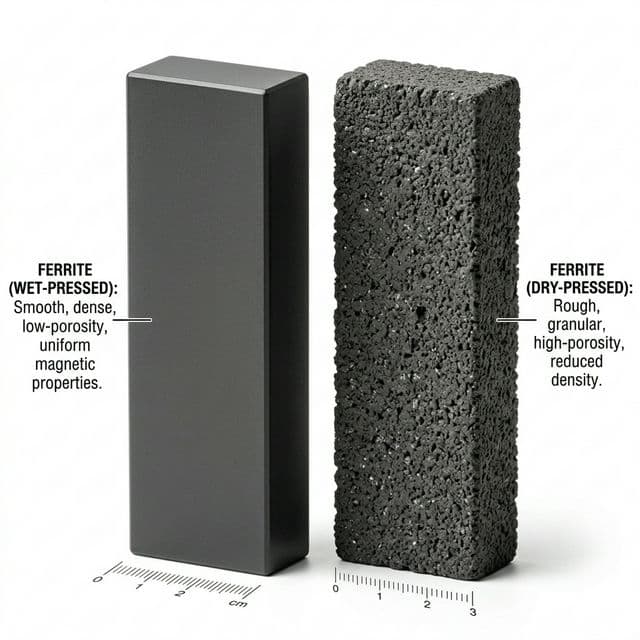
- Tooling and Tolerance Validations: Moving an anisotropic ferrite grade to a new supplier means re-qualifying the pressing and sintering processes. Shrinkage rates vary between factories, meaning new tooling is almost certainly required to maintain tight tolerances.
- Magnetic Property Consistency: H.R. 9227 is "technology neutral," meaning high-performance ceramic magnets are covered just like NdFeB. However, verifying the $Br$ and $HcJ$ specs across new production lines requires rigorous sampling and testing.
- Traceability as a Deliverable: Procurement contracts must now specify that Country of Origin (COO) certificates and raw material tracing documentation are mandatory deliverables, tied to payment terms.
Action Checklist for Sourcing Managers
To prepare for Q3/Q4 2026 and beyond, OEM procurement and engineering teams should execute the following immediately:
- Audit Current Supply Base: Map all existing ferrite and ceramic magnet part numbers to their true Country of Origin. Identify components currently hit by the 25% Section 301 tariff.
- Require Traceability: Issue formal requests to suppliers demanding updated COO certificates and verifiable raw material tracing.
- Identify Alternative Sources: Begin the RFQ process with domestic or non-restricted nation suppliers.
- Initiate Engineering Validation: Allocate budget for new tooling (dry press or wet press dies) and start the PPAP/ISIR sampling process for critical anisotropic grades.
- Review 2027 Contracts: Ensure that any long-term agreements (LTAs) extending into 2027 account for potential shifts in customs duties or tax credit eligibility.
Risks, Limits, and Policy Boundaries
While the strategic direction is clear, buyers must plan around several critical uncertainties.
| Risk Area | Current Reality | Mitigation Strategy |
|---|---|---|
| Legislative Uncertainty | H.R. 9227 is merely an introduced bill, not enacted law. The 15% tax credit is a potential future benefit, not guaranteed cash today. | Base current TCO models on existing tariffs (which are real) rather than proposed credits. Treat the credit as an upside scenario. |
| Capacity Constraints | Domestic and allied-nation capacity for high-volume custom ferrite magnets is currently limited compared to global demand. | Secure production allocations early. Do not wait for legislation to pass before starting vendor qualification. |
| Tooling Lead Times | Developing new precision tooling for custom overmolded or complex geometry ferrites takes 8-12 weeks. | Start parallel tooling tracks for critical components now to avoid line-down situations in 2027. |
Frequently Asked Questions (FAQ)
Does H.R. 9227 apply to standard ceramic/ferrite magnets?
Yes. The bill is drafted to be "technology neutral," meaning it covers permanent magnets broadly, including non-rare-earth anisotropic ferrite grades, provided they meet the sourcing and manufacturing location criteria.
How does HTS classification affect our vulnerability?
Permanent magnets generally fall under HTS codes 8505.11 (Metal) and 8505.19 (Other, including ceramic/ferrite). Section 301 applies a 25% duty that is additive to existing base rates. It is critical to work with your customs broker because importing a pre-assembled subcomponent (e.g., a motor rotor) might fall under a different HTS code, altering your tariff exposure.
Are the 25% Section 301 tariffs already in effect?
Yes. As of January 1, 2026, permanent magnets of Chinese origin, including ferrite and neodymium, are subject to an additional 25% tariff on top of standard most-favored-nation duties.
If H.R. 9227 passes, how do we claim the 15% credit?
As proposed, the Domestic Magnet Input Usage Credit would be a demand-side tax credit claimed by the end-user/OEM that incorporates the qualifying magnets into a manufactured product (like an electric motor). You will need rigorous documentation from your tier suppliers to prove eligibility.
Can we just route Chinese magnets through another country to avoid the tariff?
No. Transshipment without a "substantial transformation" does not change the Country of Origin for US Customs purposes, and attempting to do so carries severe compliance and legal risks.
Sources and Evidence
- H.R. 9227 - Magnets Value Chain Support Act of 2026: U.S. House of Representatives, Introduced June 9, 2026. Proposes the 15% Domestic Magnet Input Usage Credit. Congress.gov
- AUVSI Endorsement of H.R. 9227: Association for Uncrewed Vehicle Systems International, June 2026. Industry endorsement highlighting the necessity of the act for secure supply chains. AUVSI.org
- USTR Section 301 Tariffs: U.S. Trade Representative, effective January 1, 2026. Imposes a 25% ad valorem duty on permanent magnets of Chinese origin. USTR.gov
- HS Classification (HTS 8505.19 / 8505.11): USITC Harmonized Tariff Schedule records detailing the product scope for permanent magnets and intended duty rates. USITC.gov
OPSX_NEWS_DEEPEN_STATUS: SUCCESS OPSX_NEWS_DEEPEN_FILE: content/blog/mid-2026-oem-magnet-sourcing-value-chain-act.mdx OPSX_NEWS_DEEPEN_REASON: Added China export control boundary, Sourcing Thresholds matrix for buyer action, and HTS classification details for precise procurement impact.
Author

More Posts

Draft Research: Ferrite Packaging Logistics
Draft notes

Ferrite Magnet Overmolding Design: Thermal and Stress Boundaries
Engineering guide for insert molding ferrite magnets into plastics. Covers thermal demagnetization limits, stress cracking, and tooling DFM rules.
Preventing Micro-Cracks and Chipping in Ferrite Magnets: A Guide to Packaging and Logistics
Ferrite magnet packaging guide for OEM buyers: reduce chips and micro-cracks with RFQ specs, freight choices, AQL receiving checks, and source-backed limits.
Inquiry Email
Copy the email, or open your default email app to start an inquiry.