
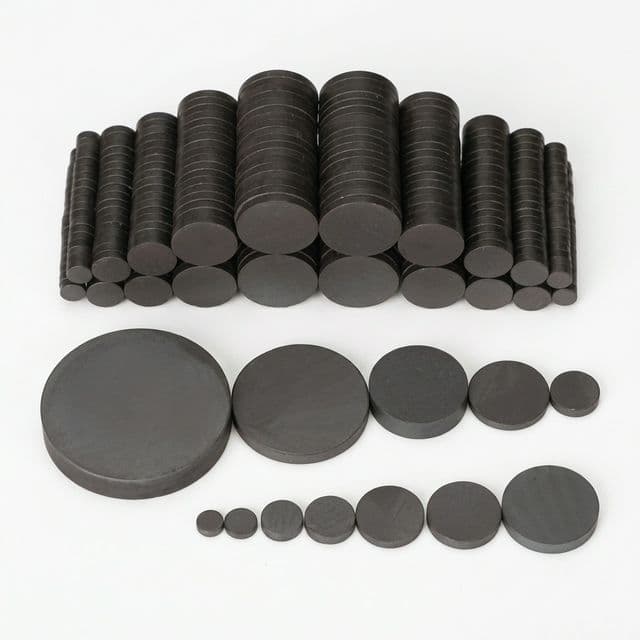
Low-Temperature Demagnetization in Ferrite Magnets: An OEM Sourcing Guide
Custom ferrite magnets can lose coercivity in extreme cold. Learn how OEM buyers specify grades, Pc, and -40°C validation before sourcing.
When designing motors and magnetic assemblies for EVs, outdoor HVAC, or aerospace, engineers often face a surprising material trap: custom ferrite magnets lose their resistance to demagnetization in extreme cold.
While Neodymium (NdFeB) struggles with high heat, Ceramic Ferrite acts in the exact opposite way. Its Intrinsic Coercivity (Hcj)—the ability to resist demagnetizing fields—drops significantly as the temperature falls below freezing. At -40°C, a standard ferrite magnet might suffer irreversible demagnetization if the magnetic circuit is not designed correctly or if the procurement team purchased a standard room-temperature grade.
This guide provides OEM buyers and engineers with the exact framework to specify, test, and source ferrite magnets for low-temperature environments without overpaying for unnecessary grades.
If you are qualifying a cold-weather motor or actuator program now, review the available custom ferrite magnet formats and send the drawing with the minimum operating temperature before freezing the RFQ grade.
The Engineering Reality: Ferrite at -40°C
Ferrite magnets have a positive temperature coefficient for intrinsic coercivity (Tc of Hcj), typically around +0.27% to +0.40% per °C.
What does this mean for sourcing? If you buy a standard Y30 magnet with an Hcj of 220 kA/m at 20°C, its Hcj will drop by roughly 16% to 20% when exposed to -40°C. If the motor experiences a high reverse current (stator field) while operating in this freezing state, the magnet will permanently lose a portion of its flux. When the motor warms back up, the lost flux does not recover.
Comparing Risk Across Common Ferrite Grades
Not all ferrite grades handle low temperatures equally. When your application requires -40°C survival (like an automotive wiper motor or a snowblower starter), sourcing the right grade is critical.
| Grade | Nominal Hcj at 20°C (kA/m) | Screening Estimate at -40°C (kA/m) | Low-Temp Risk Profile | Recommended Application | Sourcing Implication |
|---|---|---|---|---|---|
| Y30 | 220 - 235 | ~165 - 200 | High Risk | Indoor appliances (0°C to 80°C) | Baseline; avoid for -40°C unless Pc is high and test data passes |
| Y30H-1 | 240 - 260 | ~180 - 220 | Moderate Risk | General outdoor equipment | Small premium; request low-temp demag curve before approval |
| Y30H-2 | 255 - 275 | ~195 - 230 | Low Risk | Standard automotive (-40°C req) | Moderate premium; common starting point for cold-weather RFQs |
| Y33 | 230 - 250 | ~175 - 210 | Moderate/High | High-flux, moderate temp applications | Higher Br does not replace low-temp Hcj validation |
| Y35 | 240 - 260 | ~180 - 220 | Moderate Risk | High-efficiency motors | Use only if the operating point stays above the knee at -40°C |
| Y33H / Y35H | > 275 | > 210 - 230 | Very Low Risk | High demag fields at -40°C (EV/Traction) | Higher quote; justify with reverse-field and Pc analysis |
Note: Actual Hcj values depend on supplier-specific formulas. Always test pilot lots.
Sourcing & Engineering Checklist for Cold Environments
If your product must operate below 0°C, use this checklist before releasing the RFQ or locking the supplier:
- Define the lowest operating temperature on the drawing, not just the maximum temperature.
- Verify the Permeance Coefficient (Pc). Thin magnets (low Pc) are at much higher risk of demagnetization. If Pc is below 2.0, mandate a high-coercivity (H) grade.
- Specify Hcj at the target low temperature in your quality agreement (e.g., "Hcj greater than 200 kA/m at -40°C").
- Include a low-temperature demagnetization test in the PPAP / First Article Inspection (FAI) requirements.
- Ensure the motor drive system does not apply peak demagnetizing current when the motor is completely frozen.
For sourcing, the RFQ should ask for both the room-temperature datasheet and the low-temperature B-H curve. If the supplier cannot provide a -40°C curve, require a pilot-lot test before approving mass-production tooling.
Visualizing the Risk
FAQ: Sourcing Ferrite for Extreme Cold
1. Can we just use Neodymium (NdFeB) instead?
While NdFeB performs exceptionally well at low temperatures (its coercivity actually increases), it is significantly more expensive and prone to corrosion. If your main driver is cost, upgrading to a high-coercivity ferrite (like Y33H) is almost always cheaper than switching to NdFeB.
2. How do suppliers test for low-temperature demagnetization?
Suppliers will place the magnetized sample in a thermal chamber at -40°C, apply the calculated opposing magnetic field (representing your motor's maximum reverse field), bring the magnet back to room temperature, and measure the open-circuit flux. The flux loss should be less than 2-5%, depending on your acceptance criteria.
3. Will coating the ferrite help protect it from cold?
No. Coatings (like epoxy or nickel) only protect against corrosion and chipping. They do not alter the intrinsic magnetic properties or prevent thermal demagnetization.
Conclusion and Next Steps
Relying on standard room-temperature datasheets for low-temperature applications is one of the most common—and expensive—mistakes in magnet sourcing. By aligning engineering and procurement to specify High-Coercivity (H) grades for -40°C environments, OEMs can avoid catastrophic field failures.
Action Plan: Avoid the Low-Temp Demag Trap
Ferrite loses coercivity in the cold. Do not approve standard Y30 grades for -40°C automotive or outdoor applications without rigorous testing.
Recommended Action
Update your magnet drawings to explicitly state the minimum Hcj required at your lowest operating temperature. Ask suppliers for low-temp validation data during PPAP.
Caution
Never assume a magnet that survives 100°C will also survive -40°C. Ferrite behaves oppositely to Neodymium.
Evidence and Applicability Notes
Evidence and Applicability Notes
Last reviewed: 2026-07-19
Sources Used
- Arnold Magnetic Technologies: reversible temperature coefficients for permanent magnets
- Arnold Magnetic Technologies TECHNotes: ferrite Hci decreases as temperature is reduced
- Eclipse Magnetics and MARUWA ferrite datasheets: operating temperature and irreversible-loss cautions
Method
- Estimated -40°C Hcj ranges by applying the commonly published +0.27% to +0.40%/°C ferrite Hcj coefficient to 20°C nominal screening values.
- Mapped sourcing risk by combining Hcj margin, permeance coefficient sensitivity, reverse-field exposure, and supplier validation availability.
Applicability Boundary
- Calculations assume the operating point remains above the knee of the demagnetization curve.
- Grade names and Hcj bands vary by supplier and standard; do not translate Y-grade labels one-to-one without test data.
- System-level validation (stator + rotor at -40°C under load) is strictly required before mass production.
For engineering support on grade selection or to request a sample of high-coercivity ferrite for your low-temperature application, submit an inquiry today.
External References
Author

Categories
More Posts
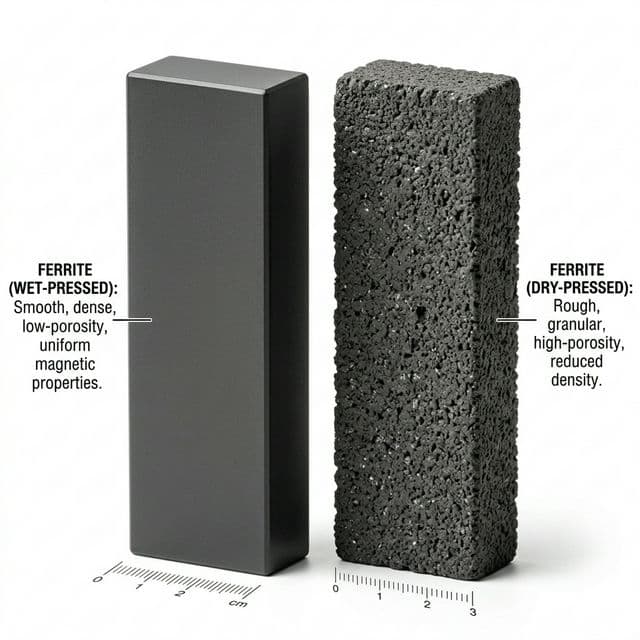
Mid-2026 OEM Magnet Sourcing: Impact of the Magnets Value Chain Support Act & Tariff Updates
Decision brief for OEM engineers and sourcing managers on the 2026 tariff updates and the newly introduced Magnets Value Chain Support Act, and what it means for custom ferrite magnet procurement.
Anisotropic Ferrite vs Neodymium: 2026 Engineering Decision Guide
Compare anisotropic ferrite vs neodymium on force density, thermal limits, and supply risk. Use RFQ gates to request a project-specific engineering review.
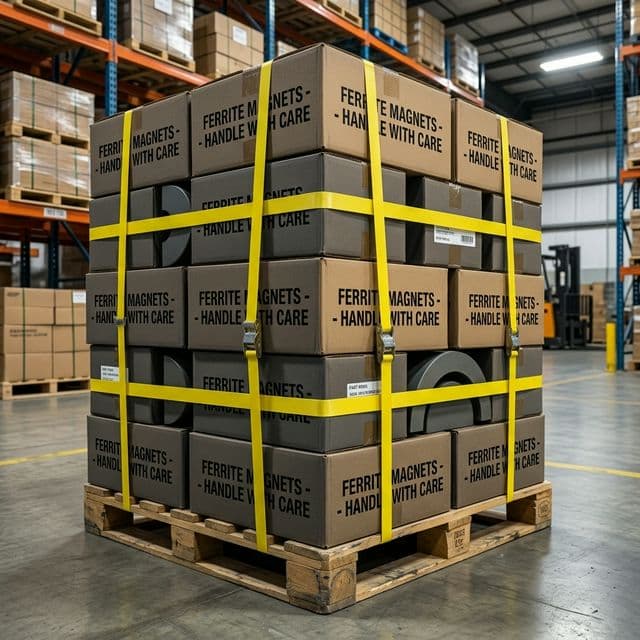
Preventing Micro-Cracks and Chipping in Ferrite Magnets: A Guide to Packaging and Logistics
Ferrite magnet packaging guide for OEM buyers: reduce chips and micro-cracks with RFQ specs, freight choices, AQL receiving checks, and source-backed limits.
Inquiry Email
Copy the email, or open your default email app to start an inquiry.