
LogoFerriteCustom
[email protected]
Hybrid page · tool + report

Arc Ferrite Magnets Company: Tool-First Screening and Due-Diligence RFQ Decision Report

Run a 2-minute arc ferrite magnets company fit check, then use quantified evidence, risk controls, and comparison tables to choose and start a safer RFQ path.

Published: 2026-05-25. Last updated: 2026-05-25.

Run fit checker nowOpen RFQ inquiry templateJump to evidence tables

1) Tool layer first: run the company fit checker

This section satisfies immediate do-intent. Input core constraints, get a deterministic result state, and move to a concrete next action.

Arc Ferrite Magnets Company Fit Checker

Tool scope: company-screening layer for arc ferrite sourcing. This checker does not replace drawing review, geometry/tolerance sign-off, pilot testing, or contract risk allocation.

Planning range: 10-10000k pcs.

Planning range: 180-500 mT.

Planning range: -20°C to 220°C.

Planning range: 2-20 weeks.

Geometry complexity and tolerance sign-off are mandatory manual gates in the report layer below; this quick score models company-operating fit only.

Empty state
Start with baseline values, then change one high-impact variable at a time to see what drives company-level risk.

Alias intents covered on this canonical page: "arc ferrite magnets company", "arc ferrite magnet company", and "arc ferrite magnet manufacturer".

Review cadence: quarterly evidence refresh plus policy-trigger refresh. SERP and source snapshot refreshed on May 25, 2026 (including FAA transport and EU/DFARS applicability checks). Next scheduled refresh: August 2026.

2) Report summary for fast decision alignment

Before deep reading, align on a few non-negotiables: tolerance, thermal boundaries, evidence depth, and continuity controls.

RFQ inputboundary checkfactory screenpilot releaseTool output should end with a concrete next action
Who this page is for

Suitable for procurement + engineering teams evaluating arc ferrite factories for pilot or mass production.

Not suitable as a final award authority without pilot validation, audit closure, and signed commercial risk terms.

Palletized ferrite shipments prepared for industrial procurement lanes.
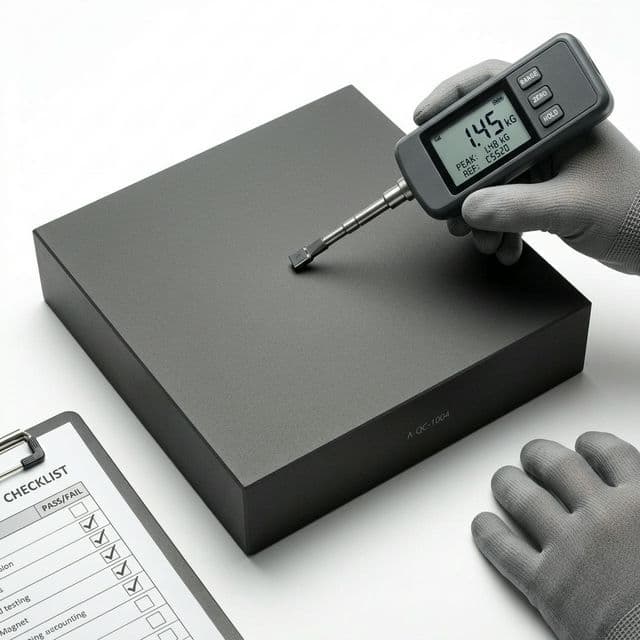
Quality engineer validating ferrite magnetic consistency with a gauss meter.
Ferrite manufacturing line used as a reference for company due-diligence audits.

3) Core conclusions and key numbers

Each conclusion includes metric, applicability boundary, and source trace.

RFQ inputboundary checkfactory screenpilot releaseTool output should end with a concrete next action
Intent is tool-first: buyers want immediate company screening
SERP snapshot (May 25, 2026) is dominated by supplier catalogs, marketplace listings, and B2B directories for "arc ferrite magnets company" intent.

First-screen interaction must let users run a fit check immediately, then branch into evidence and risk controls.

Suitable for

Teams shortlisting companies under timeline pressure before pilot RFQ.

Not suitable for

Readers expecting glossary-only content without execution guidance.

Source: SERP sampling (retrieved May 25, 2026): Thomasnet directory + supplier listings around arc ferrite company queries.

o.r. ref +0.006ini.r. ref -0.006intable III-3 gage window
Arc tolerance is a primary company-screening gate
MMPA Table III-3 references arc-radius gage windows around +0.006 in and -0.006 in.

Without explicit tolerance and gaging logic, company comparisons collapse into price-only decisions and late-stage rejects.

Suitable for

Programs with explicit OD/ID/arc-angle acceptance criteria before tooling release.

Not suitable for

Programs awarding companies only by grade label and unit price.

Source: MMPA Standard 0100-00, Table III-3.

ambient150C+Br reversible coeff. about -0.2%/C
Thermal derating matters more than Curie headline claims
MMPA thermal table lists reversible Br coefficient around -0.2%/°C and Curie around 450°C.

Company approval should include duty-cycle thermal validation; Curie number alone is not an operating approval criterion.

Suitable for

Motor and actuator projects with thermal verification plans before mass PO.

Not suitable for

Projects using Curie headline values as direct field-usage approvals.

Source: MMPA Standard 0100-00, Table III-5.

directtraderdual
Upstream material dependency remains a hidden risk
USGS 2026 lists U.S. strontium net import reliance at 100% (2025 estimate); ceramic ferrite magnets are ~14% of strontium end use.

Company capability checks must include raw-material continuity and substitution planning, not only process evidence.

Suitable for

Teams building dual-source or buffer strategies into supplier agreements.

Not suitable for

Single-source programs assuming ferrite automatically removes supply risk.

Source: USGS Mineral Commodity Summaries 2026, strontium chapter.

document depth should increase with program risk
Trade depth is high, but HS rows are not arc-specific
WITS 2024 world exports: HS 850511 top exporter China at $1,939,838.74K; HS 850519 top exporter China at $502,689.89K.

Macro liquidity supports supplier discovery, but HS-level data does not prove arc-segment-specific company repeatability.

Suitable for

Teams using macro trade signals as context before supplier-level audits.

Not suitable for

Teams treating macro export volume as proof of company-level process control.

Source: WITS country-product tables (UN Comtrade source), accessed May 25, 2026.

CoA → Cpk/PPAP depth by project risk
Regulatory fit is market-specific, not one-size-fits-all
EU SCIP uses >0.1% w/w SVHC trigger, air freight uses 0.00525 gauss at 4.5 m gate, and DFARS 225.7018 covered magnets list SmCo/NdFeB (not ferrite).

One compliance packet cannot be copied across EU commercial, air-expedite, and defense-adjacent paths without scope checks.

Suitable for

Cross-region teams running one RFQ across multiple logistics and contract channels.

Not suitable for

Programs assuming one market declaration automatically closes all regulatory risk.

Source: EU SCIP guidance + FAA PackSafe + Acquisition.gov DFARS 225.7018 references, accessed May 25, 2026.

SERP intent pattern table

Observed patternEvidenceDecision impactPage response
Directory + catalog dominanceTop results route to B2B directory pages (for company discovery) and supplier catalog inventory pages.Users need a first-screen fit decision before reading long explanations.Hero starts with input tool, deterministic output, and immediate next-step CTA.
Company claims with weak boundary disclosureMany company pages state grade and temperature claims without tolerance windows, evidence depth, or ownership accountability.Price-first RFQs can fail at pilot when tolerance and process assumptions surface late.Boundary table and risk matrix define where tool output is valid vs invalid.
Custom-size promise with thin governance proofFrequent custom claims still omit named process line, owner, and dated compliance packet references.Governance uncertainty shifts risk from quote stage to mass-production stage.Report layer adds company due-diligence checkpoints, evidence depth tiers, and fallback paths.
Few decision-grade company frameworksMost results do not compare trading-only, integrated-manufacturer, and multi-site-company paths.Teams overfocus on unit cost and underweight continuity and quality stability.Comparison table maps company model choice to tradeoff and operational fallback.

4) Evidence layer and methodology

The report layer is built to strengthen trust, not distract from completion. Every high-impact claim is source-backed or explicitly marked as uncertain.

Method flow
Tool result → boundary check → evidence pull → RFQ action.
score inputverify boundariescollect evidencelaunch RFQ
Factory path split
Direct, trader-mediated, and dual-company routes need different evidence depth.
directtraderdual
Stage1b gap closure
Gap foundWhy high-impactStage1b actionStatus
Initial outline lacked quantifiable public evidence for factory risk boundaries.Without numeric anchors, users cannot judge whether recommendations are credible or generic.Added MMPA property/tolerance/thermal rows and explicit evidence-state columns.Closed
Trade depth was previously qualitative only.Users could not separate market liquidity from factory-level capability confidence.Added WITS 2024 HS 850511/850519 values plus boundary notes on non-arc specificity.Closed
Compliance section had weak update cadence disclosure.Outdated compliance assumptions drive audit failures and RFQ churn.Added RoHS framework and review-cadence references from the EU standards page.Closed
Open-data limitations for arc-only customs and supplier Cpk remain.Users may overtrust public data and underinvest in supplier-side qualification evidence.Marked unavailable datasets as open gaps and attached minimum executable fallback paths.Partially closed
Logistics section lacked a hard air-shipment magnetic threshold for go/no-go decisions.Teams can commit unrealistic expedite plans without a transport-level magnetic field gate.Added 49 CFR 173.21(d) / FAA threshold facts and execution rules across source, compliance, and boundary tables.Closed
Regulatory scope boundaries (EU SCIP/REACH and DFARS material scope) were under-specified.Mis-scoped compliance assumptions cause late-stage blockers in EU and defense-adjacent programs.Added regulatory applicability matrix with explicit trigger conditions, non-applicable boundaries, and execution actions.Closed
Source facts table
FactValueDate/contextDecision implicationSourceStatus
Ferrite class reference row for decision baselineBr 410 mT, Hcb 225 kA/m, Hcj 230 kA/m, BHmax 4.00 MGOe (31.8 kJ/m3).MMPA 0100-00 public PDF (retrieved May 25, 2026).Factory promises should be judged against realistic ferrite-class windows, not marketing maxima.MMPA Table III-1Verified
Arc gaging tolerance referenceArc-radius gaging references include approximately +0.006 in and -0.006 in windows.MMPA 0100-00 (retrieved May 25, 2026).Tolerance language must be explicit in RFQ packs to avoid sample-pass / mass-fail drift.MMPA Table III-3Verified
Thermal derating contextReversible Br coefficient around -0.2%/°C; Curie around 450°C.MMPA 0100-00 thermal table (retrieved May 25, 2026).Factory qualification needs operating-temperature validation, not Curie headline reliance.MMPA Table III-5Verified
Strontium dependency and end-use contextU.S. net import reliance: 100% (2025e). Ceramic ferrite magnets: ~14% of strontium end use.USGS Mineral Commodity Summaries 2026.Supplier resilience and inventory buffers should be part of company-selection criteria.USGS Strontium chapterVerified
Global trade depth signal (HS 850511)China exports: $1,939,838.74K and 129,208,000 Kg in 2024.WITS country-product table, page refreshed May 14, 2026 ET.Discovery liquidity is high, but capability proof still requires factory-level evidence.WITS/UN Comtrade HS 850511Verified with boundary note
Global trade depth signal (HS 850519)China exports: $502,689.89K and 177,503,000 Kg in 2024.WITS country-product table, page refreshed May 14, 2026 ET.High aggregate volume should not be treated as arc-specific process capability proof.WITS/UN Comtrade HS 850519Verified with boundary note
RoHS governance cadenceRoHS framework anchored on Directive 2011/65/EU with periodic review requirement under Article 26.European Commission RoHS standards page (accessed May 25, 2026).Factory compliance evidence should be versioned and date-tagged, not static attachments reused indefinitely.European Commission RoHS pageVerified
Air-shipment magnetic-field gateA package is forbidden on aircraft if magnetic field strength exceeds 0.00525 gauss at 4.5 m (15 ft) from any package surface.49 CFR 173.21(d) + FAA PackSafe (FAA page last updated March 15, 2023; accessed May 25, 2026).Expedite promises using air freight require pre-shipment field checks, not only lead-time declarations.49 CFR 173.21(d) + FAA PackSafe magnetsVerified
EU SCIP disclosure triggerArticles placed on the EU market with Candidate List SVHC above 0.1% w/w require information submission to ECHA (obligation active since January 5, 2021).EU Publications Office SCIP article (published October 2020).EU-bound ferrite programs should request part-level SVHC and SCIP readiness evidence during supplier screening.EU SCIP guidance (WFD Article 9(1)(i))Verified
REACH registration threshold boundaryIn EU/EEA scope, registration generally applies when a substance is manufactured or imported at more than 1 tonne per year.Your Europe REACH page (last checked May 29, 2024; accessed May 25, 2026).Registration scope and legal entity responsibilities should be checked before assuming substance compliance is already covered.Your Europe REACH registration thresholdVerified with boundary note
US defense covered-material scope boundaryDFARS 225.7018-1 lists samarium-cobalt and neodymium-iron-boron magnets as covered materials; ferrite magnets are not named in this definition.Acquisition.gov DFARS 225.7018-1 (change 01/17/2025, viewed May 25, 2026).Do not assume this DFARS material rule automatically governs ferrite awards; check contract flowdowns and program-specific clauses.DFARS 225.7018-1 definitionsVerified with boundary note
Trade depth table
HS rowDescriptionExport valueQuantitySignalBoundary noteSourceStatus
850511Permanent magnets and articles intended to become permanent magnets$1,939,838.74K (China, 2024 exports to world)129,208,000 KgMacro liquidity strong for permanent magnet supply lanesHS row mixes products and does not isolate arc ferrite geometry or process quality depth.WITS/UN Comtrade HS 850511Verified with boundary note
850519Other permanent magnets and related articles$502,689.89K (China, 2024 exports to world)177,503,000 KgVolume indicates broad market activity and multi-segment participationCannot infer reject-rate, tolerance stability, or PPAP readiness from HS-level exports alone.WITS/UN Comtrade HS 850519Verified with boundary note
Arc-segment-only datasetPublic customs rows at this scope do not isolate arc ferrite magnet segments as a standalone codeN/AN/ASupplier-level audit evidence remains mandatoryUse macro trade rows only as context, and combine with drawing-level factory qualification records.WITS HS taxonomy + page scopeVerified with boundary note
Compliance signal table
CoA → Cpk/PPAP depth by project risk
Control pointCurrent ruleWhy it mattersExecution ruleSourceStatus
RoHS framework alignmentDirective 2011/65/EU is referenced as the legislative basis for restricted hazardous substances in EEE.Buyer audits often fail when supplier declarations are reused without scope/version checks.Request current substance declarations tied to the exact part number and shipment lot.European Commission RoHS standards pageVerified
RoHS review cadence awarenessArticle 26 periodic review is highlighted on the Commission guidance page.Static compliance packets become stale when regulatory assumptions evolve.Add evidence-refresh timestamps in supplier quality agreements and RFQ checklists.European Commission RoHS pageVerified
Material continuity watchUSGS 2026 lists 100% U.S. net import reliance for strontium (2025 estimate).Upstream disruptions can break lead-time commitments even when factory conversion capacity is available.Require supplier contingency notes for raw-material substitution and buffer policies.USGS Strontium chapter 2026Verified with boundary note
Thermal claim validationMMPA thermal table provides ferrite class context; Curie values are material-level references, not application approval gates.Overreliance on nominal Curie values leads to field failures under duty-cycle heat load.Attach duty-cycle thermal test plans to supplier award gates for high-temperature use cases.MMPA Table III-5Verified
Air-shipment feasibility gateFor aircraft carriage, packages above 0.00525 gauss at 4.5 m (15 ft) from any surface are forbidden.Urgent delivery plans fail when magnetic-field checks are skipped until dispatch.Require magnetic-field test records and packaging method before approving air-lane lead times.49 CFR 173.21(d) + FAA PackSafeVerified
EU SCIP disclosure triggerArticles on the EU market containing Candidate List SVHC above 0.1% w/w require SCIP submission to ECHA (effective January 5, 2021).Missing SCIP readiness can block release into EU customer programs even if magnetic performance is acceptable.For EU-bound SKUs, collect SCIP-related declarations and owner accountability during supplier onboarding.EU SCIP guidance (WFD Article 9(1)(i))Verified
US defense scope boundary (material-specific)DFARS 225.7018-1 covered-magnet definition names samarium-cobalt and neodymium-iron-boron magnets.Teams can misapply defense material restrictions to ferrite without checking contract-specific flowdowns.If contract references DFARS 225.7018, confirm exact material scope and applicable clause year before RFQ commitments.Acquisition.gov DFARS 225.7018-1Verified with boundary note
Regulatory applicability matrix
Use this to prevent over-generalizing one regulation across all company decisions.
FrameworkExplicit ruleApplicability boundaryExecution ruleSourceStatus
49 CFR 173.21(d) / FAA PackSafe (air transport)Package is forbidden on aircraft when magnetic field exceeds 0.00525 gauss at 4.5 m (15 ft).This rule governs transport safety only; it does not validate magnetic performance or process capability.Add pre-shipment field-test checkpoint for any quote relying on air freight escalation.FAA PackSafe magnetsVerified
EU SCIP / WFD Article 9(1)(i)EU-market articles with Candidate List SVHC above 0.1% w/w require SCIP information submission to ECHA.SCIP disclosure confirms information duty, not automatic product fitness, lot quality, or route capability.Ask each bidder for part-level SVHC mapping and who owns SCIP dossier maintenance.EU Publications SCIP guidanceVerified
REACH registration threshold (EU/EEA)Substances manufactured or imported above 1 tonne/year generally trigger registration duty.Threshold logic is substance- and legal-entity-specific; it cannot be inferred solely from magnet part demand.Map substance ownership and annual tonnage assumptions before concluding REACH scope is already closed.Your Europe REACH pageVerified with boundary note
DFARS 225.7018 material restrictions (US defense)Covered magnets in 225.7018-1 are samarium-cobalt and neodymium-iron-boron; 225.7018-2 defines acquisition restrictions for covered materials.Ferrite is not named in the covered-magnet definition, but contracts may still impose separate material controls.Treat clause-year and flowdown text as mandatory review items before award recommendation.Acquisition.gov DFARS 225.7018-1/-2Verified with boundary note

5) Tool boundaries and execution assumptions

Numeric score covers company-operating fit. Geometry and tolerance remain mandatory manual gates before pilot or award decisions.

Lead-time decision visual
toolingsamplemass rununder 6 weeks usually needs compromise
Input boundary table
Input fieldPlanning windowWhy it mattersFailure mode
Annual demand (k pcs)10-10,000Very low or very high volume programs follow different process economics and control plans.Score confidence drops when volume assumptions do not match real production cadence.
Arc geometry + tolerance gate (manual checkpoint)Verify on drawing + RFQ checklist (not directly scored in quick checker)Geometry complexity drives tooling risk and grinding stability.Late-stage dimensional rejects despite acceptable nominal grade data.
Flux target + max operating temperature180-500 mT and -20°C to 220°CMagnetic and thermal constraints must be assessed together, not independently.Pilot pass but field drift under thermal duty cycle.
Lead-time target2-20 weeksAggressive schedules often eliminate evidence depth and raise quality escape probability.Awarded supplier cannot sustain both speed and repeatability in mass production.
QC evidence depthCoA / Cpk1.33 / PPAP-like packageEvidence depth determines how early process variability is detected.Hidden process instability discovered only after tooling lock.
Factory access pathTrader-mediated / integrated-manufacturer / dual-companyAccess model determines visibility into actual process controls and corrective loops.Commercial alignment without process transparency and recovery options.

6) Comparison and tradeoff layer

Factory pathway map
Path choice changes evidence depth requirements and fallback design.
document depth should increase with program risk
Option comparison table
OptionFactory signalWhen to useMain tradeoffFallback path
Direct factory pathHigher process visibility and faster corrective loopsMedium-to-high annual volume with tight tolerance accountabilityRequires stronger audit discipline and engineering coordinationAdd dual-company contingency for demand spikes
Trader-mediated pathFaster commercial handling but lower direct process transparencyLow-complexity or low-volume programs with flexible timingHigher risk of evidence gaps and delayed root-cause closureRequire named factory records and lot-level traceability in PO terms
Air-expedite heavy schedule pathFast escalation possible only when magnetic-field transport checks are operationalizedProgram has validated air-lane compliance records and accepts premium freight costHigher logistics cost and risk of shipment hold if field-threshold evidence is missingPre-approve sea/rail fallback lanes and keep pilot inventory for demand spikes
Dual-factory pathBest continuity resilience for supply and quality incidentsPrograms with strict uptime or contractual continuity penaltiesOnboarding overhead and cross-factory calibration effortUse one primary + one validated reserve for phased adoption
High-grade ferrite push (Y40-like target)Higher performance window but tighter process-control sensitivityApplications constrained by flux density and size envelopeMay require longer validation loops and stronger QC depthRe-evaluate geometry and thermal limits before grade escalation
Cost-first baseline (Y30/Y35-like window)Broader availability and more predictable process baselineCost-stable, moderate-flux applications with realistic tolerance targetsMay not satisfy compact or high-flux architecturesShift selective SKUs to higher-grade or redesign path only where needed

7) Mid-flow action checkpoint

If your current result is conditional or low, do not jump to mass PO. Run a two-step path: pilot evidence gate first, then commercial lock.

Open RFQ template nowReview risk matrix

8) Risk and boundary disclosure

Risk matrix visual
prioritize high-impact + high-probability first
Risk register
RiskProbabilityImpactTriggerMitigation
Tolerance mismatch between quote and production controlMedium-highHighRFQ omits clear gage logic and acceptance limitsAttach arc gaging references and incoming inspection protocol at RFQ stage
Thermal performance overclaimMediumHighCurie headline used as operating proof without duty-cycle testsDemand thermal derating test evidence before mass-production award
Compliance packet stalenessMediumMedium-highSupplier submits reused declarations without date-scoped traceabilityDefine evidence validity windows and lot/part mapping in quality agreements
Raw-material continuity shockMediumMedium-highUpstream disruption in strontium feed or logistics laneQualify fallback material routes and safety-stock rules with suppliers
Timeline compression removes validation stagesHighHighLead-time target undercuts sample and corrective-loop windowsRun two-step RFQ (pilot then mass) with explicit gate criteria
Single-path commercial dependencyMediumMedium-highOnly one mediated channel with no direct factory contingencyBuild dual-path escalation and reserve supplier onboarding plan
Air shipment blocked by magnetic-field non-complianceMediumHighExpedite lane planned without package-level field test evidence at dispatch.Add pre-shipment field test checkpoints and fallback logistics lanes in RFQ and SOP.
Regulatory scope misclassification across regionsMediumHighTeams assume one compliance framework automatically covers EU, US defense, and commercial channels.Maintain market-by-market applicability matrix and clause-year verification before award.
Boundary conditions table
TopicBoundary conditionRisk if ignoredExecution ruleSource
HS trade data usageHS 850511/850519 are aggregate classes and do not isolate arc ferrite factory quality outcomes.False confidence in supplier capability based on macro volume aloneUse trade data as context only; require supplier-level process evidence for award decisionsWITS/UN Comtrade tables (2024, accessed May 25, 2026)
Tolerance interpretationMMPA tolerance references guide gaging logic but do not replace project-specific drawings and acceptance agreements.Quote-stage alignment but production-stage reject escalationLock drawing rev + gage method + incoming criteria in RFQ attachmentsMMPA Table III-3
Thermal claim usageCurie and reversible coefficients are material-level context, not plug-in operational guarantees.Field demagnetization or performance drift under real duty cyclesRequire duty-cycle thermal test plan before volume releaseMMPA Table III-5
Compliance scopeRoHS governance references must be mapped to exact part, market, and declaration date.Audit findings from stale or mismatched documentationTrack compliance evidence by lot and update cycle in supplier portal or QMSEuropean Commission RoHS page
Material continuityUSGS import-reliance context is region-level and not a direct predictor of individual supplier disruption timing.No contingency when upstream shock reaches awarded supplierRequire supplier contingency matrices and inventory assumptions before PO lockUSGS MCS 2026 strontium
Air transport assumptionsAircraft transport depends on magnetic-field thresholds (0.00525 gauss at 4.5 m) and cannot be inferred from promised lead time.Expedite plan collapse, shipment holds, and customer schedule missesRequire package-level field-test records before booking air freight lanes.49 CFR 173.21(d) / FAA PackSafe magnets
EU chemical disclosure triggersSCIP obligations are triggered when Candidate List SVHC concentration in articles exceeds 0.1% w/w.Late-stage compliance blockers for EU deliveries and avoidable re-documentation loopsFor EU-bound parts, collect SVHC concentration statements and SCIP responsibility owner during RFQ.EU SCIP guidance (WFD Article 9(1)(i))
US defense material-scope interpretationDFARS 225.7018 covered-magnet definition is material-specific and does not list ferrite magnets.Wrong legal assumptions or missed contract-specific flowdowns in defense-adjacent bidsVerify clause year and full contract flowdown text before final sourcing decisions.Acquisition.gov DFARS 225.7018-1/-2
Tool model confidenceTool output is a screening layer; out-of-range inputs should trigger human review and deeper validation.Automated score misused as final sourcing decisionTreat boundary results as mandatory escalation, not approvalThis page tool definition and boundary-state logic

9) Scenario examples

Example scenarios show how tool outcomes map to actionable RFQ paths.

High-volume motor program with tight tolerance

Setup: Annual demand 1,200k, Y35-Y40 target, tight tolerance, lead time 8 weeks, PPAP depth available.

Tool outcome: Conditional to strong (depends on factory access and audit depth).

Recommended action: Run direct-factory pilot with dual-source contingency and explicit thermal/tolerance gates.

Cost-first replacement project under short deadline

Setup: Annual demand 150k, baseline grade, lead time 4 weeks, CoA-only evidence.

Tool outcome: Low to conditional due to timeline and evidence-depth conflict.

Recommended action: Split RFQ into pilot + mass phases and upgrade evidence depth before award.

Compliance-sensitive export product

Setup: RoHS/market compliance critical, mixed shipment lanes, medium volume, moderate thermal load.

Tool outcome: Conditional with compliance and documentation concentration.

Recommended action: Add declaration refresh cadence and lot-level traceability in supplier contracts.

Prototype path with uncertain geometry and thermal profile

Setup: Arc dimensions evolving, operating temperature uncertain, no finalized test protocol.

Tool outcome: Boundary or low confidence by design.

Recommended action: Freeze draft design ranges first, then rerun tool and start pilot qualification loop.

10) Open-data gaps and minimum executable paths

QuestionCurrent statusDecision impactMinimum executable path
Public dataset isolating arc ferrite segment exports and reject-rate outcomes?Not found in open HS-level trade datasets used in this page scope.Macro trade data cannot replace supplier-level process reliability evidence.Collect supplier-side Ppk/Cpk and lot reject history under NDA during RFQ.
Comparable public Cpk/PPAP benchmark by ferrite company tier?No robust open benchmark with consistent methodology discovered.Cross-supplier comparisons can become subjective or sales-led.Use a normalized audit checklist and require the same evidence fields from every bidder.
Unified cross-region compliance freshness index for ferrite parts?No single public source combines scope, lot mapping, and revision history.Documentation age risk may be underestimated in global sourcing programs.Track document age, market scope, and part mapping in internal compliance dashboards.
Public linkage between tolerance tier and mass-run scrap probability by geometry class?Not available as a reproducible open dataset in this topic scope.Teams may misprice quality risk during commercial negotiation.Pilot-run measurement plans should capture reject causes by geometry and process step.
Public supplier-level dataset linking SCIP/REACH status to ferrite part numbers by company?No reliable open dataset found that directly maps ferrite suppliers to validated part-level SCIP/REACH evidence quality.Compliance confidence can be overestimated when relying on high-level declarations only.Track per-part evidence ownership, last update date, and market scope in an internal supplier compliance matrix.

11) Evidence source registry

SourceWhat it supportsLast updated/publicationURL
Brave SERP snapshot (query cluster: arc ferrite magnets company)Intent diagnosis: tool-first interaction is required before long-form report content.Retrieved May 25, 2026https://search.brave.com/search?q=arc+ferrite+magnets+company
MMPA Standard 0100-00 permanent magnet specificationsMaterial class windows, tolerance gaging references, and thermal boundary interpretation.Public PDF referenced in page, retrieved May 25, 2026https://www.magneticsgroup.com/wp-content/uploads/2019/09/mmpa-0100-00-pm-specifications-FOR-WEB.pdf
USGS Mineral Commodity Summaries 2026 - StrontiumImport-reliance context and ferrite-related end-use share for upstream risk reasoning.January 2026 release (retrieved May 25, 2026)https://pubs.usgs.gov/periodicals/mcs2026/mcs2026-strontium.pdf
WITS/UN Comtrade HS 850511 exports by country (2024)Macro market-depth signal and non-arc-specific boundary disclosure.Page refreshed May 25, 2026 EThttps://wits.worldbank.org/trade/comtrade/en/country/ALL/year/2024/tradeflow/Exports/partner/WLD/product/850511
WITS/UN Comtrade HS 850519 exports by country (2024)Additional market-depth context and boundary notes for mixed permanent-magnet rows.Page refreshed May 25, 2026 EThttps://wits.worldbank.org/trade/comtrade/en/country/ALL/year/2024/tradeflow/Exports/partner/WLD/product/850519
European Commission RoHS standards pageDirective anchor and periodic-review cadence for compliance evidence governance.Accessed May 25, 2026https://single-market-economy.ec.europa.eu/single-market/goods/european-standards/harmonised-standards/restriction-use-certain-hazardous-substances-rohs_en
FAA PackSafe magnets + 49 CFR referenceAir-shipment go/no-go threshold for magnetic field strength and its logistics boundary impact.FAA page updated March 15, 2023 (accessed May 25, 2026)https://www.faa.gov/hazmat/packsafe/magnets
EU Publications Office SCIP article (WFD context)SCIP trigger condition (>0.1% w/w SVHC in articles) and effective timeline context.Published October 6, 2020 (accessed May 25, 2026)https://op.europa.eu/en/publication-detail/-/publication/887091cb-0938-11ec-b5d3-01aa75ed71a1
Your Europe REACH registration guide1 tonne/year registration threshold boundary for EU/EEA substance obligations.Last checked May 29, 2024 (accessed May 25, 2026)https://europa.eu/youreurope/business/product-requirements/chemicals/registering-chemicals-reach/index_en.htm
Acquisition.gov DFARS 225.7018-1 and 225.7018-2Material-scope boundary (SmCo/NdFeB covered magnets) and clause-timeline context through Dec 31, 2026.Change 01/17/2025 (viewed May 25, 2026)https://www.acquisition.gov/node/35509/printable/print

12) FAQ by decision intent

13) Conversion layer: move from score to RFQ action

Use the tool score + boundary tables as your negotiation baseline, then launch pilot RFQ with explicit evidence gates.

Start RFQ discussionRe-run checker with updated assumptions
Related: arc ferrite magnets suppliers shortlist tool + reportRelated: China arc ferrite manufacturer shortlist checkerRelated: arc ferrite in China tool + reportRelated: arc fan ferrite magnet Y35 fit tool + reportRelated: ceramic ring magnets factory evaluation guideRelated: ferrite magnetic properties and application fit

Inquiry Email

[email protected]

Copy the email, or open your default email app to start an inquiry.

Open email appStart inquiry (opens email app)
WhatsApp
LogoFerriteCustom

Factory-direct ferrite magnet manufacturing with OEM customization and stable global supply.

Inquiry Email

[email protected]

Copy the email, or open your default email app to start an inquiry.

Open email appStart inquiry (opens email app)
Products
  • Ferrite Discs
  • Ferrite Rings
  • Ferrite Arcs & Segments
  • Ferrite Blocks
  • Multipole Rings
  • Pot Magnets
  • Injection Molded
  • Custom Machined
Solutions / Applications
  • DC Motors
  • Speakers and Audio
  • Education and Crafts
  • Home Appliances
OEM Capabilities
  • Factory Profile
  • OEM Inquiry
Resources
  • About
  • Contact
  • Blog
  • Editorial Policy
  • Privacy Policy
  • Terms of Service
  • Cookie Policy
© 2026 FerriteCustom. All Rights Reserved. | Backed by Linkup Ai Co., Ltd. Manufacturing delivered by the Advanced Manufacturing Division of Linkup Precision.