
Anisotropic Ferrite Magnet Manufacturers: Run the Checker, Then Validate the Evidence
Screen anisotropic ferrite magnet manufacturers with a shortlist checker, then validate capability, risk, and sourcing evidence before RFQ award. Contact sales.
Evidence cadence: quarterly review. Latest source refresh completed April 24, 2026. Next scheduled refresh: July 2026.
Tool-first screening model for buyer-side supplier shortlisting. Use this for triage, then move to evidence-backed RFQ validation.
Boundary model: 5-6000k pieces/year.
Smaller tolerance values require stronger process capability.
Boundary model: 2-20 weeks.
| Model item | Implementation detail | Why it matters |
|---|---|---|
| Input guardrails | Volume (5-6000k), tolerance (0.03-1.2 mm), lead time (2-20 weeks) boundaries are validated before scoring. | Prevents overconfident outputs from unrealistic planning inputs. |
| Capability weighting | Process ownership and evidence depth carry the highest weight in score contribution. | Supplier execution quality matters more than brochure-level product claims. |
| Boundary fallback | Out-of-range inputs return a boundary state with an explicit manual-audit path. | Keeps the tool actionable when a numeric score would be misleading. |
| Deterministic output | Same inputs produce the same result; loading state locks inputs to avoid race conditions. | Improves reproducibility for cross-functional buyer-engineer review. |
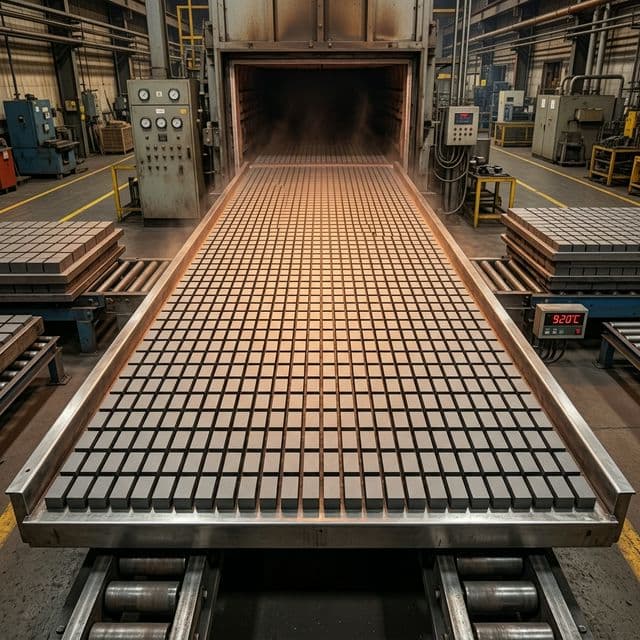
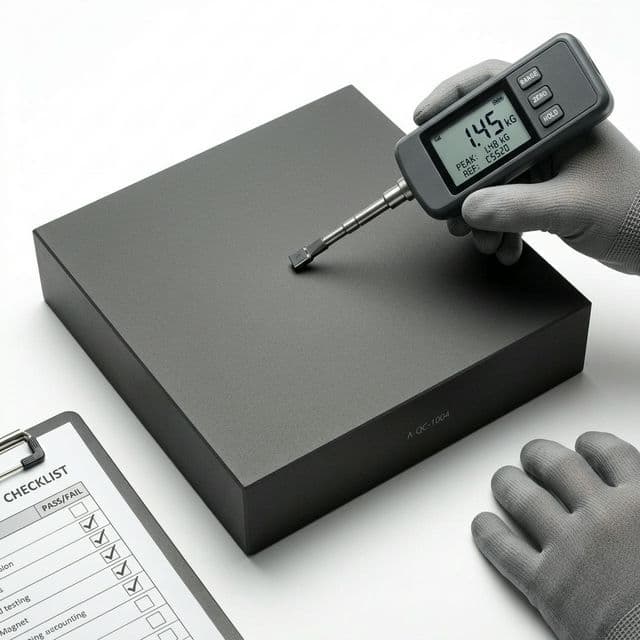
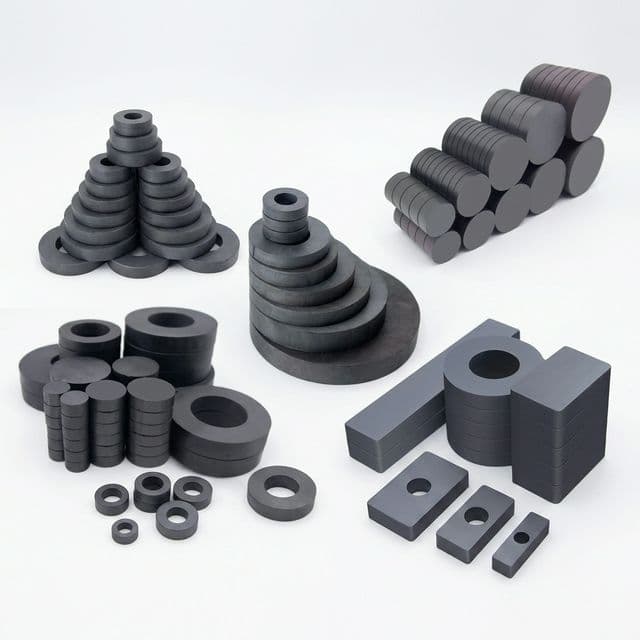
Core conclusions for supplier decision
Each conclusion includes metric signal, use boundary, and source anchor so buyers can act without losing audit traceability.
Teams should prioritize suppliers with traceable in-house process control when sourcing anisotropic ferrite magnets.
Suitable for
Programs with repeat lots, dimensional consistency targets, and PPAP-style validation gates.
Not suitable for
Projects selecting suppliers from unit-price comparison only.
Source: Tool transparency model + MMPA acceptance guidance (section 9.1).
If two suppliers use different measurement assumptions, datasheet values can look similar but still be non-comparable in your circuit.
Suitable for
Teams requiring cross-supplier technical comparability before RFQ award.
Not suitable for
Programs accepting catalog property tables without method declaration.
Source: MMPA 0100-00 + IEC 60404-5:2015 + IEC 60404-18:2025.
Tight tolerance quotes need matching grinding and magnetization capability evidence, not only grade labels.
Suitable for
Programs with strict dimensional and magnetic consistency criteria.
Not suitable for
Programs treating ferrite parts as generic high-ductility structural components.
Source: MMPA 0100-00 section I + section III table notes.
Schedule commitments are credible only when supplier buffering and substitution plans are visible in RFQ.
Suitable for
Teams balancing launch speed with material continuity risk.
Not suitable for
Programs accepting rush commitments without upstream risk evidence.
Source: USGS Mineral Commodity Summaries 2026 - Strontium.
Supplier shortlists for EU-bound products should include declaration format, threshold logic, and update cadence checks.
Suitable for
Programs shipping EEE or article-containing assemblies into EU-regulated supply chains.
Not suitable for
Award decisions that rely on generic “compliant” statements without threshold evidence.
Source: Directive 2011/65/EU (consolidated 01/01/2025) + ECHA pages.
Dual-source only works when both routes pass identical evidence gates and your substitution triggers are pre-defined.
Suitable for
Teams designing continuity plans across ferrite base case and rare-earth fallback scenarios.
Not suitable for
Programs that add supplier count without harmonized qualification and substitution criteria.
Source: USGS MCS 2026 (Strontium + Rare Earths) + IEA 2026.
Stage1b gap audit and closure log
| Audited gap | Decision risk if unchanged | Stage1b closure applied |
|---|---|---|
| Supply-risk evidence was too rare-earth centric for a ferrite page | Readers could over-focus on NdFeB concentration and underweight ferrite-chain constraints. | Added USGS 2026 strontium-chain facts: 14% ferrite end use in U.S. estimate, 100% U.S. net import reliance, and 2025 disruption events. |
| Compliance wording lacked numeric acceptance thresholds | Supplier declarations could pass narrative checks but still fail downstream compliance review. | Added RoHS Annex II concentration limits, ECHA Candidate List count (253), immediate REACH article references, and SCIP >0.1% w/w threshold. |
| Cross-supplier test comparability boundary was under-specified | Datasheet values might be compared despite mismatched measurement method assumptions. | Added IEC 60404-5 / 60404-8-1 / 60404-18 standard gates and explicit method declaration requirements. |
| Failure-mode explanation was light on concrete counterexamples | Teams could treat a high tool score as sufficient despite hidden failure paths. | Added counterexample table with failure mechanism, minimum recovery path, and evidence anchor per case. |
Key numbers and date context
| Fact | Value | Date context | Decision implication | Source |
|---|---|---|---|---|
| Anisotropic vs isotropic ferrite baseline | MMPA C1 BHmax 1.0 MGOe vs C5/C8 BHmax 3.5-3.7 MGOe | MMPA 0100-00 (accessed April 24, 2026) | Supplier screening should focus on anisotropic process capability, not isotropic assumptions. | MMPA Standard 0100-00 |
| Acceptance-method warning | MMPA section 9.1 recommends minimum flux/load-line acceptance, not Br/Hc table values alone | MMPA 0100-00 section 9.1 | RFQ should include agreed test method and reference sample for award decisions. | MMPA Standard 0100-00 |
| Magnetization saturation requirement | MMPA note: achieving table properties typically needs 10,000-15,000 Oe saturation magnetization field (grade-dependent). | MMPA 0100-00 table note (accessed April 24, 2026) | RFQ should request magnetization fixture capability and saturation evidence for the target grade. | MMPA Standard 0100-00 |
| Closed-circuit vs open-circuit method boundary | IEC 60404-5 (2015) defines closed-circuit measurements; IEC 60404-18 (2025) defines SCM open-circuit method with self-demag correction. | IEC publications dated 2015-04-16 and 2025-02-20 | Supplier data should declare method family before cross-vendor comparison. | IEC 60404-5 + IEC 60404-18 |
| RoHS Annex II thresholds | Cd 0.01%; Pb/Hg/Cr(VI)/PBB/PBDE 0.1% by weight in homogeneous material. | Directive 2011/65/EU, consolidated version 01/01/2025 | Compliance declaration must include material-level threshold mapping, not generic pass/fail wording. | EUR-Lex (Directive 2011/65/EU) |
| REACH Candidate List scale and legal trigger | ECHA Candidate List page shows 253 entries and notes immediate obligations under REACH Articles 7, 31, and 33 after listing. | ECHA Candidate List table (accessed April 24, 2026) | Supplier change-management cadence should track list updates and downstream communication duty. | ECHA Candidate List table |
| SCIP concentration threshold | SCIP support states notifications concern articles containing Candidate List substances above 0.1% w/w. | ECHA SCIP support page (accessed April 24, 2026) | EU article suppliers need data structures that can support SCIP dossier preparation when threshold is exceeded. | ECHA SCIP support |
| Strontium end-use relevance | USGS 2026 U.S. estimate: ceramic ferrite magnets account for about 14% of strontium end use | USGS Strontium chapter 2026 | Ferrite supply monitoring should include strontium-chain visibility. | USGS MCS 2026 - Strontium |
| U.S. strontium dependency | USGS 2026 reports 100% U.S. net import reliance for strontium in 2025. | USGS Strontium chapter 2026 | Continuity planning should include import-route and buffer-stock assumptions. | USGS MCS 2026 - Strontium |
| Global strontium-chain volatility signal | USGS: world celestite output 400,000 tons (2024) to 450,000 tons (2025), while 2025 strontium carbonate supply was disrupted by multiple events. | USGS Strontium chapter 2026 | Lead-time promises should be checked against upstream disruption-response plans. | USGS MCS 2026 - Strontium |
| Rare-earth fallback concentration (boundary context) | USGS 2026: U.S. rare-earth compounds/metals imports were 71% from China (2021-2024); IEA 2026: China share in sintered permanent magnets reached 94% in 2024. | USGS Rare Earths 2026 + IEA Rare Earth Elements 2026 | If ferrite programs define NdFeB fallback routes, fallback concentration risk should be disclosed explicitly. | USGS MCS 2026 - Rare Earths + IEA 2026 |
| Ferrite thermal behavior boundary | MMPA ceramic typicals: Curie ~460°C, max service ~250°C, Br coefficient around -0.20%/°C | MMPA 0100-00 Table III-5 | Suppliers should be evaluated on thermal-derating and demag validation ability. | MMPA Standard 0100-00 |
Standards and compliance gate (added in stage1b)
| Gate | Minimum requirement | Applicable condition | If missing | Source |
|---|---|---|---|---|
| Magnetic measurement route declaration | Supplier data package should declare whether results follow IEC 60404-5 closed-circuit method or IEC 60404-18 open-circuit SCM method (with correction approach). | Any cross-supplier magnetic curve comparison or final technical ranking. | Curves may be compared as if equivalent while measurement assumptions differ. | IEC 60404-5:2015 + IEC 60404-18:2025 |
| Material-grade baseline mapping | RFQ should map supplier grade naming to recognized baseline specification (IEC 60404-8-1 and/or MMPA tables) before comparing BHmax/Br claims. | Multi-vendor grade comparison or substitution decisions. | “Same grade” language can hide non-equivalent material baselines. | IEC 60404-8-1:2023 + MMPA 0100-00 |
| RoHS homogeneous-material threshold file | Declaration should provide substance-level evidence for Cd 0.01% and Pb/Hg/Cr(VI)/PBB/PBDE 0.1% thresholds. | EU EEE shipment or downstream compliance review. | Supplier can pass narrative compliance check but fail customer audit evidence review. | Directive 2011/65/EU Annex II (consolidated 01/01/2025) |
| REACH / SCIP article disclosure readiness | For EU article supply, require Candidate List review cadence, REACH Article 33 communication path, and SCIP dossier readiness when >0.1% w/w threshold is exceeded. | EU article-containing assemblies in scope of REACH/WFD workflows. | Late-stage legal communication gaps can delay customer approval and shipment. | ECHA Candidate List table + ECHA SCIP support |
| Strontium-chain continuity evidence | Supplier should disclose strontium feedstock route, buffer strategy, and disruption-response plan. | Programs with strict launch windows or low interruption tolerance. | Lead-time commitment is weak against upstream disruption shocks. | USGS MCS 2026 - Strontium |
Applicable and non-applicable audience boundaries
| Audience profile | Fit level | Why this page helps | Where this page is not enough |
|---|---|---|---|
| OEM buyer with volume >100k and formal quality gate | Strong fit | Tool supports rapid shortlist plus evidence-based RFQ handoff for anisotropic ferrite sourcing. | Not for final supplier award without sample-lot verification and acceptance tests. |
| Engineering manager comparing process-capable suppliers | Strong fit | Combines tolerance, lead-time, and evidence-depth logic with explicit boundary disclosures. | Not sufficient for geometry-specific magnetic-circuit sign-off. |
| Price-only sourcing flow under rush schedule | Conditional to low fit | Page highlights why quote speed alone can hide capability and quality-system risk. | Not suitable if the team refuses to collect lot evidence before award. |
| Prototype team with no audit bandwidth | Conditional | Can still use the boundary and fallback guidance to avoid high-risk supplier lock-in. | Not a replacement for minimum supplier due diligence in production programs. |
Supplier class comparison for anisotropic ferrite programs
| Dimension | Integrated manufacturer | Hybrid subcontract model | Trading profile | Decision implication |
|---|---|---|---|---|
| Process ownership | Pressing + sintering + grinding + magnetization in one system | Core process in-house, critical steps subcontracted | Mostly outsourced manufacturing and QC | Integrated ownership usually supports stronger repeatability and faster root-cause response. |
| Evidence depth at RFQ stage | Lot reports, Cpk trend, acceptance method alignment | Partial reports, sample-level evidence | Catalog data with limited lot traceability | Evidence depth should determine shortlist rank before quote comparison. |
| Tolerance capability confidence | Higher confidence for tight tolerance programs | Depends on subcontract grinding control | Often uncertain until pilot failure appears | Tolerance risk should be priced into supplier ranking, not deferred. |
| Schedule resilience | Better control when plan changes or defect correction is needed | Moderate resilience with coordination overhead | High delay risk when upstream changes occur | Lead-time promises are only credible with process control evidence. |
| Best-fit procurement objective | Long program stability and quality consistency | Balanced cost with moderate technical risk | Low-complexity, non-critical orders only | Supplier class should match risk tolerance and quality criticality. |
Methodology and scoring evidence chain
This page keeps one URL so do-intent and know-intent do not compete. The tool gives immediate direction; the report section validates whether the direction is defensible.
| Method step | Implementation action | Output |
|---|---|---|
| Step 1: Capture constraints | Collect annual demand, tolerance target, lead-time window, compliance class, and sourcing strategy. | Normalized screening input snapshot. |
| Step 2: Run deterministic score | Apply weighted capability model with boundary checks and controlled loading state. | Strong / conditional / low / boundary result with score. |
| Step 3: Map result to evidence gates | Connect score to minimum RFQ evidence: load-line acceptance method, lot reports, and audit visibility. | Executable next-step action for buyer and engineering teams. |
| Step 4: Build fallback path | If confidence is low or boundary-triggered, enforce side-by-side supplier comparison and pilot validation. | Minimal safe continuation path without blocking the project. |
RFQ and validation checklist
| Checklist item | Minimum requirement | Why this matters | Source anchor |
|---|---|---|---|
| Acceptance method alignment | Define load-line or minimum flux acceptance criteria, not Br/Hc table values only. | Prevents acceptance disputes between buyer and supplier test setups. | MMPA 0100-00 section 9.1 |
| Magnetic test-method declaration | Require each supplier to declare whether data follows IEC 60404-5 (closed circuit) or IEC 60404-18 (open circuit SCM) measurement routes. | Prevents false equivalence when comparing magnetic curves from different measurement assumptions. | IEC 60404-5:2015 + IEC 60404-18:2025 |
| Lot-level capability evidence | Request lot report, dimensional Cpk trend, and magnetic consistency record for similar geometry. | Validates whether supplier claims are repeatable at production scale. | MMPA process-control/testing guidance + buyer quality gate practice |
| EU compliance threshold package | For EU-bound projects, include RoHS Annex II threshold evidence and REACH/SCIP disclosure path (Article 33 communication and >0.1% w/w trigger handling). | Converts compliance from narrative claim to auditable threshold logic. | Directive 2011/65/EU + ECHA Candidate List + ECHA SCIP support |
| Thermal and demag boundary tests | Require temperature-range and opposing-field checks with irreversible-loss threshold. | Reduces field-failure risk from boundary misuse or low-temperature knee crossing. | MMPA + TDK ferrite guidance |
| Packaging and brittle-handling plan | Set anti-chipping packaging, receiving-inspection rules, and visual go/no-go criteria for chip/crack handling. | Brittle damage is a frequent hidden risk during logistics and assembly. | MMPA ceramic visual/handling guidance + QA practice |
| Strontium continuity disclosure | Request upstream strontium route, buffer policy, and disruption-response statement for each shortlisted supplier. | Reduces schedule surprises when upstream disruptions propagate into lead-time commitments. | USGS MCS 2026 - Strontium |
Risk matrix and mitigation plan
| Risk | Probability | Impact | Mitigation |
|---|---|---|---|
| Supplier selected from quote-only comparison | Medium | High | Gate shortlist with process ownership and lot-evidence requirements before commercial review. |
| Cross-supplier magnetic data compared without method alignment | Medium | High | Require IEC/MMPA measurement route declaration and reference-magnet-aligned acceptance method. |
| Tolerance capability overstated in pre-sales stage | Medium | High | Require sample-lot Cpk data and aligned measurement method in pilot phase. |
| EU compliance evidence is narrative-only and fails threshold audit | Medium | High | Attach RoHS homogeneous-material limits and REACH/SCIP evidence path in the RFQ compliance annex. |
| Rush schedule bypasses evidence review | High | High | Use staged release: temporary shortlist now, final award after evidence package closure. |
| Strontium upstream disruption is ignored in planning assumptions | Medium | Medium | Add continuity disclosure and alternate-route checks during supplier qualification. |
| Boundary inputs are forced into a numeric score | Low | Medium | Boundary state returns controlled fallback and blocks misleading confidence claims. |
Counterexamples and limit conditions
| Common assumption | How it fails | Minimum executable recovery | Evidence status |
|---|---|---|---|
| Supplier claims Ceramic 8 and high BHmax, so performance is automatically comparable. | Without declared IEC/MMPA test route and load-line method, identical-looking BHmax claims can still represent different operating outcomes. | Request method declaration + reference magnet alignment + load-line acceptance criteria before rank finalization. | MMPA 0100-00 section 9.1 + IEC 60404-5/18. |
| Dual sourcing alone guarantees resilience for anisotropic ferrite supply. | If both suppliers depend on the same constrained upstream strontium route, disruption still propagates to both lines. | Audit upstream feedstock path and require continuity disclosures for each qualified supplier. | USGS 2026 strontium reliance and disruption notes. |
| A generic “RoHS compliant” statement is enough for EU customer approval. | RoHS thresholds and REACH/SCIP obligations are numeric and article-specific; narrative claims can fail document review. | Collect homogeneous-material threshold evidence and Article 33/SCIP readiness proof in RFQ annex. | Directive 2011/65/EU Annex II + ECHA Candidate List + ECHA SCIP support. |
| Public market datasets can directly rank supplier Cpk and shipment-damage risk. | No reliable open cross-vendor dataset normalizes ferrite geometry, tolerance class, and logistics profile. | Treat this as "public evidence insufficient / pending confirmation" and build program-specific pilot evidence loops. | Current open data gap acknowledged in uncertainty section. |
Scenario demonstrations
| Scenario | Assumptions | Outcome | Action |
|---|---|---|---|
| Automotive auxiliary motor sourcing refresh | Annual demand 800k, tolerance 0.06 mm, dual-source policy, launch in 16 weeks. | Checker indicates strong shortlist path when integrated suppliers provide lot evidence. | Use RFQ gate with acceptance method and sample-lot capability proof. |
| Consumer appliance project with aggressive timeline | Annual demand 120k, tolerance 0.1 mm, rush mode, incomplete audit package. | Conditional result due to schedule pressure and partial evidence depth. | Add interim supplier and request missing evidence before final award. |
| Prototype-to-mass transfer with unknown supplier class | Small pilot volume, datasheet-only evidence, single-source plan. | Low confidence because process ownership and traceability are unclear. | Switch to two-stage audit and include one alternative supplier path. |
| RFQ with boundary-range inputs | Tolerance below 0.03 mm or lead-time below 2 weeks. | Boundary state triggers controlled no-score response. | Move to manual feasibility review instead of forcing a shortlist rank. |
Evidence sources and uncertainty disclosure
| Source | Date context | Signal used | Confidence / limit |
|---|---|---|---|
| MMPA Standard 0100-00 Permanent Magnet Material Specifications | Public PDF revision (accessed April 24, 2026) | Ferrite grade baselines, saturation note, brittleness boundary, and acceptance-method guidance for RFQ evidence gating. | High for baseline magnet-property and acceptance-method framing; still needs supplier-specific lot validation. |
| IEC 60404-5:2015 | Published April 16, 2015 (accessed April 24, 2026) | Defines closed-circuit measurement of permanent-magnet demagnetization and recoil behavior. | High for method-definition scope; full test execution detail remains in paid standard text. |
| IEC 60404-8-1:2023 | Published September 20, 2023 (accessed April 24, 2026) | Defines minimum magnetic properties and tolerances for technically important permanent magnet materials. | High for grade-baseline framing; does not replace geometry-specific validation. |
| IEC 60404-18:2025 | Published February 20, 2025 (accessed April 24, 2026) | Defines open-circuit SCM methods and self-demagnetizing-field correction for magnetic-property measurement. | High for method-boundary disclosure and comparison governance. |
| Directive 2011/65/EU (RoHS) via EUR-Lex | Current consolidated version shown as 01/01/2025 | Provides Annex II concentration limits for restricted substances in homogeneous materials. | High for EU threshold compliance framing. |
| ECHA Candidate List of substances of very high concern for Authorisation | Accessed April 24, 2026 (page shows 253 entries) | States immediate legal obligations and names REACH Articles 7, 31, and 33. | High for legal-trigger visibility; substance-specific interpretation still needs product-level assessment. |
| ECHA SCIP support page | Accessed April 24, 2026 | Clarifies SCIP support scope for articles with Candidate List substances above 0.1% w/w. | High for threshold communication boundary. |
| USGS Mineral Commodity Summaries 2026 - Strontium | Published February 2026 | Provides ferrite-relevant end use, import reliance, mine-production splits, and 2025 disruption context. | High for macro strontium-chain signal; not sufficient for supplier-specific scoring. |
| USGS Mineral Commodity Summaries 2026 - Rare Earths | Published February 2026 | Provides rare-earth import-source concentration used only for fallback-route boundary analysis. | High for U.S. concentration context when fallback route is relevant. |
| IEA Rare Earth Elements (Executive Summary) | Published 2026 | Provides mine/refining/sintered-magnet concentration context for NdFeB fallback discussions. | High for global concentration trend context; not a ferrite supplier audit substitute. |
| Topic | Current status | Minimum executable next step |
|---|---|---|
| Public cross-vendor Cpk benchmark by ferrite geometry class | No consistent open dataset for direct supplier-to-supplier ranking | Request lot-level Cpk evidence from each shortlisted manufacturer. |
| Universal ferrite finished-goods spot price benchmark | No transparent global index that normalizes grade, tolerance, and Incoterms | Use normalized RFQ templates and compare landed-cost structures. |
| Public failure-rate dataset for brittle shipping damage | No standardized cross-industry publication with consistent methods | Enforce incoming inspection criteria and packaging test requirements in RFQ. |
| Public supplier-level RoHS/REACH pass-fail dataset for ferrite parts | No reliable open database provides comparable declaration quality by ferrite manufacturer | Treat as pending confirmation and request auditable declaration packs per supplier and revision. |
| Open benchmark linking supplier audit grade to long-term field reliability | Evidence exists case-by-case but no unified open benchmark for anisotropic ferrite suppliers | Track pilot-to-mass failure signals and feed them into supplier score updates. |
FAQ by decision intent
Related decision pages
Use these pages if you need adjacent material or supplier decision support.
Inquiry Email
Copy the email, or open your default email app to start an inquiry.
Boundary reminder
This page is procurement decision support. Final supplier award requires project-specific validation before tooling lock or mass production release.