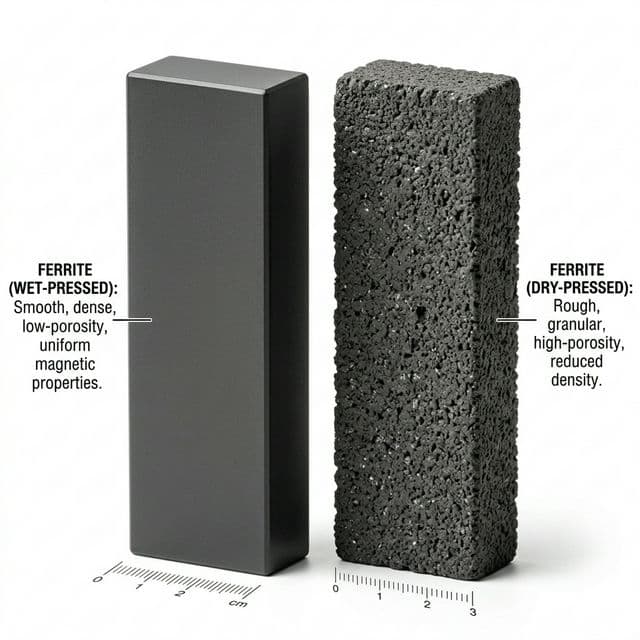
Anisotropic Ferrite vs Neodymium: 2026 Engineering Decision Guide
Data-backed comparison for anisotropic ferrite vs neodymium magnets across output density, thermal limits, supply concentration, and RFQ validation gates.
If your envelope is fixed and you need high force density, NdFeB is usually the default. If volume can increase and your program is constrained by supply concentration risk, coating complexity, or cost stability, anisotropic ferrite deserves first-pass qualification.
This page is written for engineering, sourcing, and quality teams that need a defensible decision path, not a one-line material slogan.
Updated Scope And Reader Questions
- Updated: 2026-04-28 (sources reviewed and date-stamped below).
- Core question 1: How large is the real magnetic-performance gap?
- Core question 2: Where do thermal and demagnetization boundaries become decision blockers?
- Core question 3: What does 2025-2026 supply policy volatility change in sourcing strategy?
- Core question 4: What acceptance tests should be in RFQ before material lock?
Stage1b Gap Audit -> What Was Added In This Iteration
| Gap before this round | Why it blocked decisions | Evidence-backed increment added (2026-04-28) |
|---|---|---|
| Acceptance boundary not explicit enough | Teams could over-trust nominal material tables | Added MMPA section 9.1 acceptance boundary: Br tolerance context and reference-magnet requirement |
| Demand pressure not linked to conversion bottleneck | Sourcing actions could over-focus on mine supply only | Added IEA 2026 demand and 2035 downstream-capacity gap table |
| Logistics risk lacked numeric threshold | Shipping checks might happen too late | Added 49 CFR 173.21(d) aircraft threshold in measurable form |
| Regional policy boundary not covered | EU-linked programs lacked concentration compliance context | Added CRMA 2030 benchmark and single-third-country concentration cap |
| Public data blank spots not explicit enough | Forecasts could hard-code unknown assumptions | Added known-unknown item with explicit "to be verified / no reliable public data" marker |
Executive Conclusion Cards (Conclusion -> Evidence -> Action)
| Conclusion | Evidence basis | Boundary condition | Action now |
|---|---|---|---|
| NdFeB remains the compact-force leader | MMPA R5-1 NdFeB grades list much higher (BH)max than Ceramic 5/8 | Material table values are not final product force values | Run geometry-specific simulation before final lock |
| Anisotropic ferrite is viable when volume can grow | Ceramic 5/8 ranges are lower, but can meet many non-miniaturized programs | Tight envelope programs will fail volume trade early | Gate project by available magnet volume first |
| Supply-risk profile is now a first-order design input | IEA 2026 shows high concentration and 2025 export-control episodes | Risk is scenario-based and policy-sensitive | Add dual-source and substitution path in RFQ |
| U.S. buyers still face import concentration on both rare earths and strontium chains | USGS 2026 chapters show high import reliance patterns | Concentration profile differs by mineral and stage | Split risk review by upstream chemistry, not by magnet label only |
| Shipping/compliance checks can fail late if ignored | 49 CFR 173.21(d) sets aircraft magnetic-field threshold | Threshold applies to package field, not just magnet grade | Add pre-shipment field test point to outgoing QC |
Core Evidence: Material Property Delta (MMPA Standard)
| Dimension | Anisotropic ferrite reference (Ceramic 5/8) | NdFeB reference (R5-1 table entries) | Decision impact |
|---|---|---|---|
| (BH)max | 3.40-3.50 MGOe | 24-50 MGOe | NdFeB typically supports much higher compact-force designs |
| Br | 3800-3850 G | 10,000-14,100 G | Ferrite often needs larger magnetic volume for same target |
| Hc | 2400-2950 Oe | 9600-13,000 Oe (table range) | NdFeB usually keeps stronger demag margin in compact circuits |
| Density | 4.9 g/cm3 (ceramic) | 7.4 g/cm3 (sintered NdFeB) | Ferrite can reduce magnet mass but not always full assembly mass |
Source context: MMPA 0100-00 Table III-1/III-4 and Table IV-1/IV-3.
Measurement Tolerance And Acceptance Boundary (MMPA 9.1)
| MMPA 9.1 point | Practical meaning for RFQ acceptance |
|---|---|
| For standard grades, tabulated values are normally for Br only with unit-property tolerance around +/-5% | Do not treat single-lot Br drift inside this window as immediate nonconformance without agreed protocol |
| Acceptance should be judged by comparison with a mutually agreed reference magnet tested under equivalent conditions | Freeze fixture, method, and reference sample before pilot-lot release to avoid buyer-supplier disputes |
If this boundary is missing in RFQ, "same grade" parts may still fail acceptance due to test-method mismatch rather than real material failure.
Thermal Boundaries: What Numbers Mean In Practice
| Thermal item | Anisotropic ferrite (MMPA ceramic table) | NdFeB (MMPA table) | Practical caution |
|---|---|---|---|
| Reversible coefficient of Br | -0.2%/°C | -0.090%/°C | Do not compare only one coefficient; evaluate full circuit and temperature window |
| Reversible coefficient of intrinsic coercive force | +0.2% to +0.5%/°C | Not shown as positive trend in NdFeB table | Ferrite can gain coercive robustness as temperature rises, but output baseline stays lower |
| Curie temperature | 450°C (typical in table) | 310°C | Curie is not equal to recommended operating limit |
| Max service temperature (table note) | 800°C structural note with remagnetization warning beyond 450°C | 150°C | Use these as material descriptors only; final operating window must be validated by part geometry and load line |
Decision rule: treat thermal numbers as screening gates, then confirm with application-level demagnetization tests.
Supply Concentration And Policy Risk (2025-2026)
| Signal | Data point | Why it matters for material choice |
|---|---|---|
| Global concentration of magnet rare-earth chain | China share in 2024: mining 60%, refining 91%, sintered permanent magnets 94% (IEA 2026) | NdFeB programs need explicit concentration-risk treatment in sourcing strategy |
| 2025 control events | Export controls expanded in 2025; suspension window and further dual-use tightening noted in 2026 (IEA) | Do not assume steady-state availability for strategic grades |
| Downstream value at risk | IEA scenario: up to USD 6.5 trillion/year downstream production exposure outside China under full control implementation | Material substitution path is now an economic-security tool, not only engineering backup |
| U.S. rare-earth import source mix | 2021-24 compounds/metals: China 71%, Malaysia 13%, Japan 5%, Estonia 5% (USGS 2026) | NdFeB inputs remain geopolitically concentrated |
| U.S. strontium dependence (ferrite chain context) | Net import reliance 100%; ferrite magnets and pyrotechnics each 14% of estimated U.S. end uses (USGS 2026) | Ferrite does not remove all mineral-risk exposure; it changes the risk profile |
Demand And Capacity Mismatch (IEA 2026)
| IEA signal | Date context | Why it changes execution |
|---|---|---|
| Rare earth demand has doubled since 2015 and grows by another one-third by 2030 | 2026 report baseline | Capacity planning must assume structural growth, not temporary spike |
| Outside China, announced mine projects by 2035 are >50 kt, but announced metals/alloys/magnets capacity is about 18 kt | 2035 announced pipeline snapshot in 2026 report | Downstream conversion (metallization/alloying/magnet making) becomes the bottleneck, not ore alone |
| Demand in diversified regions is expected to increase by around 50% by 2035 | 2026 projection | Secure conversion-capacity slots earlier for NdFeB-heavy programs |
| Permanent magnets account for about 95% of total rare earth consumption value | 2026 value-chain framing | Magnet path should be treated as a strategic spend category, not an interchangeable commodity |
| About USD 60 billion investment is needed over the next decade for diversified supply chains | 2026 investment estimate | Long-term contracts should include capacity reservation and trigger clauses |
Price And Procurement Signals To Monitor (USGS 2026 + IEA 2026)
| Indicator | 2024 | 2025e / latest official note | Procurement implication |
|---|---|---|---|
| Neodymium oxide average price (USD/kg) | 56 | 73 | Material-index clauses and re-open triggers should be explicit in long-lead RFQs |
| NdPr oxide average price (USD/kg) | 55 | 69 | Avoid quoting only unit part price without index date and formula |
| U.S. apparent consumption of compounds/metals (t REO eq.) | 9,010 | 27,000 | Volume shifts can amplify supply tightness during policy shocks |
| U.S. net import reliance (compounds/metals) | 61% | 67% | Track import-reliance drift in quarterly sourcing review |
| U.S. compounds/metals imports (t REO eq.) | 6,090 | 16,400 (+169%) | Build contingency for abrupt import-volume swings even when unit values soften |
| U.S. National Defense Stockpile FY2026 potential acquisitions (NdPr oxide, NdFeB block) | N/A | Information not available in USGS 2026 | Mark as to be verified / no reliable public data in 2026 sourcing forecast |
Regulatory And Logistics Boundaries (US + EU)
| Boundary | Official rule and date context | Decision impact |
|---|---|---|
| U.S. aircraft shipment magnet threshold | 49 CFR 173.21(d): forbidden on aircraft when package field exceeds 0.00525 gauss at 15 ft (4.6 m) | Add outgoing field-test record before air shipment booking |
| EU diversification benchmark | CRMA entered into force on 2024-05-23; by 2030 EU target is at least 10% extraction, 40% processing, 25% recycling | For EU programs, ask suppliers for stage-level origin and processing traceability |
| EU single-country concentration cap | CRMA 2030 benchmark: at each relevant stage, no more than 65% from a single third country | Keep second-source plan and concentration KPI in supplier scorecard |
Decision Method: From Screening To Release
Step 1: Envelope Gate
- If target cannot be met after realistic ferrite volume growth, keep NdFeB path primary.
- If envelope has margin, move ferrite to formal A/B qualification.
Step 2: Temperature And Demag Gate
- Use operating-temperature range and load-line analysis, not room-temperature datasheet alone.
- Apply MMPA section 9.1 principle: acceptance should be tied to load-line equivalent testing and a mutually agreed reference magnet.
Step 3: Supply-Risk Gate
- Review concentration exposure and policy-trigger response.
- Set explicit substitution fallback and inventory/lead-time playbook.
Step 4: Logistics/Compliance Gate
- Add aircraft-shipment field screening against 49 CFR 173.21(d) threshold when relevant.
- Use the measurable threshold (0.00525 gauss at 15 ft / 4.6 m) as the shipment-release gate for air routes.
Risk And Tradeoff Matrix
| Risk | Trigger | Typical impact | Mitigation |
|---|---|---|---|
| Force-density shortfall after ferrite switch | Compact envelope and aggressive output target | Redesign loop, launch delay | Keep dual-material prototype path until validation gate closes |
| Policy-driven NdFeB disruption | Export-control or licensing shock | Allocation risk and schedule variance | Add second-source geography and fallback BOM option |
| Downstream conversion bottleneck | Mining capacity expands faster than non-China metals/alloys/magnet capacity | Long lead times despite upstream availability | Reserve conversion capacity early and stage demand forecasts |
| Late logistics rejection | No package-field precheck for air route | Shipment hold/rework | Add outgoing magnetic-field screening step |
| False confidence from table values | Datasheet-only qualification | Field failures or derating surprise | Require pilot-lot validation under real duty cycle |
Cost Structure For Real Decision Quality
Use total program cost, not piece-price-only comparison:
- quoted magnet price by volume tier,
- assembly yield and scrap impact,
- coating/process complexity burden,
- logistics/expedite risk reserve,
- revalidation cycle cost if substitution fails late.
Known Unknowns (Do Not Fake Precision)
| Question | Public evidence status | How to close the gap |
|---|---|---|
| Open benchmark for lot-level ferrite yield by geometry class | No unified public benchmark | Collect pilot data by part family and set your own control limits |
| Public real-time anisotropic ferrite finished-magnet price index | Not available in open standardized form | Use supplier-index formulas plus quarterly contract review |
| One universal conversion rule from material (BH)max to final product torque/force | No universal rule | Use electromagnetic simulation plus fixture validation |
| U.S. FY2026 stockpile acquisition quantities for NdPr oxide and NdFeB block | Officially "information not available" in USGS 2026 | Keep this as to be verified / no reliable public data and avoid deterministic assumptions |
Practical Scenarios
| Scenario | Better first path | Why | Required proof before SOP |
|---|---|---|---|
| Compact actuator, no envelope growth allowed | NdFeB | Force density dominates | Thermal demag + corrosion/coating validation |
| Industrial motor with available space and high volume | Anisotropic ferrite candidate | Cost-stability and substitution resilience potential | Pilot torque map and lot-distribution stability |
| Dual-source strategy for policy-risk resilience | Parallel path (NdFeB + ferrite feasibility) | Preserves performance while building fallback | Release criteria for switch-over lead time and quality |
FAQ (Decision-Critical)
Action Checklist By Role
| Role | Next 2-week action | Deliverable |
|---|---|---|
| Engineering | Build A/B simulation + fixture plan (ferrite vs NdFeB) | Decision memo with fail gates |
| Sourcing | Add dual-source + price-index clauses | Updated RFQ package |
| Quality | Freeze measurement method and reference sample | Pilot validation protocol |
| Program manager | Integrate risk trigger table into launch plan | Stage-gate readiness review |
Bottom Line
Use anisotropic ferrite vs NdFeB as an architecture decision, not a single-material preference.
Recommended Action
Run a gated A/B path with envelope kill criteria, load-line acceptance testing, and policy-aware sourcing controls.
Caution
Do not approve substitution using room-temperature nominal data only; validate under real duty cycle and logistics constraints.
Evidence and Applicability Notes
Last reviewed: 2026-04-28
Sources Used
- MMPA 0100-00 material and testing tables (Ceramic and Rare Earth sections)
- USGS Mineral Commodity Summaries 2026 (Rare Earths; Strontium)
- IEA Rare Earth Elements 2026 report and executive summary
- European Commission Critical Raw Materials Act (CRMA) official pages
- U.S. DOE Neodymium Magnets Supply Chain Deep Dive (2022)
- 49 CFR 173.21(d) aircraft-shipment threshold for magnetized materials
Method
- Mapped reader decisions to measurable gates (envelope, thermal, supply, logistics).
- Used Tier-1 sources for core numeric claims and date-sensitive policy context.
- Added region-specific compliance boundaries (US shipment rule and EU concentration benchmark).
- Marked unknown public datasets explicitly instead of inferring fabricated precision.
Applicability Boundary
- Material-level tables are screening inputs, not final circuit guarantees.
- MMPA nominal values include tolerance and method dependencies; acceptance must be protocol-controlled.
- Policy-risk projections are scenario-based and should be refreshed quarterly.
- Final release requires project-specific pilot validation and cross-functional sign-off.
Related Internal Reading
- Ferrite vs Neodymium Magnets: B2B Selection Guide
- Anisotropic Ferrites Fit Checker + Canonical Decision Report
- Anisotropic Sintered Ferrite Fit Checker (Alias Canonical)
- Anisotropic Barium Ferrite Magnets Guide
- Wet Press vs Dry Press Ferrite: Process Selection
External References
- MMPA Standard No. 0100-00, Standard Specifications for Permanent Magnet Materials
- USGS Mineral Commodity Summaries 2026: Rare Earths
- USGS Mineral Commodity Summaries 2026: Strontium
- IEA Rare Earth Elements (2026)
- IEA Rare Earth Elements (2026) Executive Summary
- U.S. DOE Rare Earth Permanent Magnets Supply Chain Deep Dive (2022-02-24)
- 49 CFR 173.21(d) - Forbidden materials and packages
- FAA PackSafe: Magnets (last updated 2023-03-15)
- European Commission: European Critical Raw Materials Act
- European Commission (DG GROW): Strategic Projects under CRMA (entered into force 2024-05-23)
Author

Categories
More Posts
Preventing Micro-Cracks and Chipping in Ferrite Magnets: A Guide to Packaging and Logistics
Ferrite magnet packaging guide for OEM buyers: reduce chips and micro-cracks with RFQ specs, freight choices, AQL receiving checks, and source-backed limits.

Ferrite RFQ Checklist for OEM Buyers
A practical RFQ checklist that helps purchasing and engineering teams get faster, comparable ferrite magnet quotations.
Low-Temperature Demagnetization in Ferrite Magnets: An OEM Sourcing Guide
Custom ferrite magnets can lose coercivity in extreme cold. Learn how OEM buyers specify grades, Pc, and -40°C validation before sourcing.
Inquiry Email
Copy the email, or open your default email app to start an inquiry.