
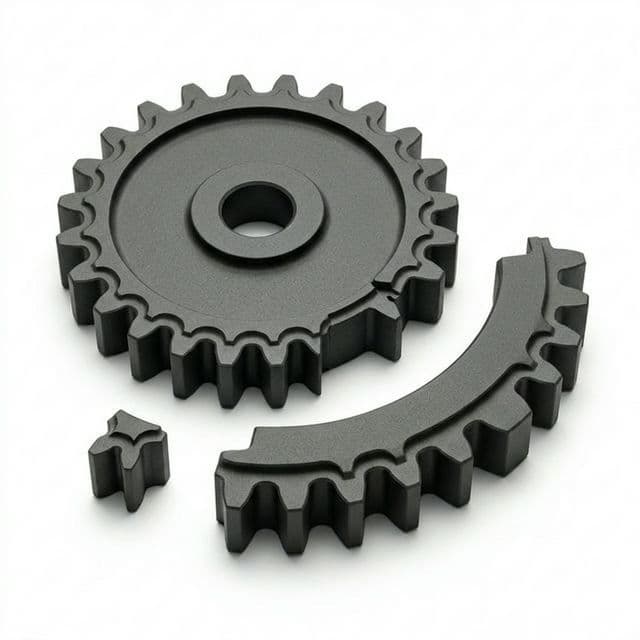
Injection Molded vs Sintered Ferrite Magnets: An OEM Buyer's Guide
Compare injection-molded vs sintered ferrite magnets for OEM sourcing: tooling cost, tolerances, heat limits, assembly yield, and RFQ review support now.
When specifying ferrite (ceramic) magnets for high-volume automotive sensors, BLDC motors, or consumer electronics, engineering and procurement teams inevitably face a critical architectural decision: should you choose traditional sintered ferrite or injection-molded ferrite?
This decision goes far beyond simple magnetic strength. It dictates your initial tooling investment, secondary machining requirements, assembly processes, and ultimately, your total cost of ownership (TCO) at scale. Both technologies utilize strontium or barium ferrite powder as their fundamental magnetic material, but the manufacturing processes differ radically, leading to distinct mechanical, thermal, and economic profiles.
This guide provides a deep-dive comparison to help OEM buyers and engineers match the right manufacturing process to their specific application requirements, ensuring optimal performance and cost-efficiency.
If you are preparing a custom ferrite magnet RFQ, start with the decision cues below, then use the Ferrite RFQ checklist and send the drawing context when tolerance, temperature, or assembly route is not settled.
Scope and limits, reviewed July 25, 2026: This guide is for global OEM programs comparing ferrite/ceramic magnet manufacturing routes. It does not cover NdFeB, SmCo, or lab-grade material optimization. Numerical ranges are planning ranges; final choice depends on grade, magnetization pattern, tool design, binder grade, and supplier process capability.
1. Composition and Manufacturing Process
To understand the differences in performance, we must first look at how these two types of magnets are manufactured.
Sintered Ferrite
Sintered ferrite is produced via a traditional powder metallurgy route. Strontium or barium ferrite powder is pressed in a die under immense pressure. In anisotropic grades, this pressing occurs in the presence of an aligning magnetic field. The "green" pressed compacts are then transferred to a kiln and sintered at temperatures often exceeding 1,100°C (2,000°F).
During sintering, the particles fuse together, creating a dense, hard, ceramic-like material consisting of roughly 99% pure magnetic phase. Because shrinkage occurs during this high-temperature firing, dimensional tolerances of the raw sintered part are relatively loose. Tight tolerances must be achieved through post-sintering diamond grinding, which adds cycle time and cost.
Injection Molded Ferrite (Plastoferrite)
Injection-molded ferrite is a type of bonded magnet. Instead of relying on thermal fusion, the ferrite powder is thoroughly compounded with a thermoplastic binder—typically Nylon 6, Nylon 12, or Polyphenylene Sulfide (PPS).
This compound is heated until the polymer becomes molten and is then injected into a precision mold cavity under high pressure, exactly like standard plastic injection molding. If an anisotropic structure is required, an electromagnetic field is applied to the mold cavity during the injection and cooling phase. The resulting part is a solid matrix of plastic holding the magnetic particles.
2. Magnetic Performance and Dilution
The fundamental trade-off of injection molding is magnetic strength.
Sintered ferrite magnets are fully dense. They offer the highest possible magnetic flux for a ferrite material. Typical Br (Residual Induction) for sintered anisotropic ferrite ranges from 3,800 to 4,300 Gauss.
Injection-molded magnets, however, suffer from "dilution." The thermoplastic binder takes up significant physical volume—often 30% to 40% by volume. Because the polymer is non-magnetic, the overall magnetic density of the part is reduced. Anisotropic injection-molded ferrites typically peak around 2,500 to 3,000 Gauss.
If your motor or sensor application demands the absolute maximum magnetic flux density within a heavily constrained spatial envelope, sintered ferrite (or transitioning to Neodymium) is often the only viable path.
3. Geometric Complexity and Precision
Where injection-molded ferrite loses in pure magnetic strength, it wins heavily in geometric flexibility and dimensional precision.
Sintered ceramics are brittle and prone to cracking or chipping. Pressing dies are generally limited to relatively simple geometries: blocks, discs, rings, and simple arc segments. Thin wall sections are incredibly difficult to press and sinter without warping or breaking. Furthermore, because of the firing shrinkage, standard sintered tolerances (without grinding) are typically ±2% of the dimension.
Injection molding allows for immense geometric freedom. You can design:
- Extremely thin walls (down to 1.0mm or less)
- Complex multi-pole shapes and intricate internal features
- Flanges, mounting holes, and locating pins integrated directly into the magnet
- Tight as-molded tolerances (often ±0.05mm or better) without any secondary grinding operations.
If the decision is driven by tolerance stack-up rather than shape freedom, compare this section with the ferrite magnet tolerance guide and custom-machined ferrite capabilities.
The Value of Insert Molding
One of the most powerful cost-saving advantages of injection-molded ferrite is insert molding (or overmolding). You can place a metal shaft, a stamped sensor housing, or a hub directly into the injection mold, and shoot the magnetic compound directly around it. This eliminates secondary assembly steps, gluing, and mechanical fasteners, significantly improving assembly line yield and lowering total part cost.
For designs where the magnet must carry a hub, shaft, or spline, review the ferrite magnet overmolding design guide and the injection-molded ferrite product formats before freezing the part envelope.
4. Mechanical Durability
Sintered ferrite is a ceramic. It is hard, brittle, and highly susceptible to chipping and cracking upon impact or during automated handling. Dropping a sintered ferrite magnet on a hard floor will almost certainly break it. Special care, specialized packaging, and controlled assembly lines are required to prevent damage.
Injection-molded ferrite takes on the mechanical characteristics of its polymer binder. It is much tougher, highly impact-resistant, and flexible (depending on the specific binder). It will not chip during automated bowl-feeding or high-speed robotic assembly, making it drastically easier to handle in mass production environments.
5. Thermal Characteristics and Boundaries
Temperature resistance is another critical divergence point.
Sintered Ferrite: Being a fired ceramic, the material itself can easily withstand high temperatures. Sintered ferrite magnets can typically operate up to 250°C (482°F) before irreversible demagnetization becomes an issue. They are immune to melting.
Injection Molded Ferrite: The maximum operating temperature is entirely dictated by the melting point and thermal deformation limits of the polymer binder.
- Nylon 6 / Nylon 12 Binders: Typically limited to continuous operating temperatures of 100°C to 120°C.
- PPS (Polyphenylene Sulfide) Binders: Offer higher thermal resistance, capable of operating up to 150°C to 180°C, but PPS compounds are more expensive and harder to process.
If your application involves an automotive under-the-hood environment reaching 200°C, injection-molded ferrite will soften and fail structurally. Sintered ferrite is mandatory in these extreme thermal scenarios.
6. Tooling Economics and Total Cost of Ownership
Tooling strategy is often the deciding factor between the two technologies, heavily influenced by your projected lifetime production volume.
Sintered Ferrite Tooling: Pressing dies for simple sintered shapes are relatively inexpensive. Because the raw powder is compressed into a basic form, the mold does not need to handle molten plastic dynamics. However, if your part requires tight tolerances, you will incur ongoing, per-part costs for diamond grinding. For low-to-medium volumes, sintered ferrite often has a lower barrier to entry.
Injection Molded Tooling: Injection molds are precision-machined from hardened tool steel. They must handle high injection pressures, manage complex cooling channels, and accommodate electromagnetic coils if anisotropic alignment is required. Consequently, injection molding tools are significantly more expensive upfront—often 3x to 5x the cost of a pressing die.
However, injection molding produces a "near-net-shape" part instantly. It eliminates post-sintering grinding, and via insert-molding, can eliminate entire assembly steps. For high-volume production (e.g., 500,000+ units annually), the savings in secondary operations and assembly labor rapidly amortize the higher mold cost, leading to a much lower Total Cost of Ownership (TCO) per system.
7. Comparative Feature Matrix
To summarize the engineering trade-offs, here is a structured comparison of the two technologies:
| Feature Dimension | Sintered Ferrite | Injection Molded Ferrite |
|---|---|---|
| Magnetic Strength (Br) | High (Up to ~4,300 G) | Moderate (Up to ~3,000 G) |
| Material Structure | 99% Ceramic | Magnetic Powder + Polymer Binder |
| Mechanical Nature | Brittle, chips easily | Tough, impact resistant, flexible |
| Temperature Tolerance | Excellent (Up to 250°C) | Binder limited (Nylon: 120°C, PPS: 160°C) |
| Geometric Complexity | Low (Blocks, discs, simple arcs) | High (Thin walls, gears, complex 3D shapes) |
| As-Produced Tolerances | Loose (±2%) | Very Tight (±0.05mm) |
| Post-Processing Required? | Yes, diamond grinding often needed | No, near-net shape as molded |
| Initial Tooling Cost | Lower | Higher (precision molds required) |
| Insert Molding Support | No | Yes (Excellent for part consolidation) |
8. Application Boundaries & Supplier Communication
Beyond the technical specifications, buyers must carefully manage the commercial and quality parameters with suppliers.
Specification Dimensions & Application Boundaries
- Sintered Ferrite: Ideal for unbounded or stationary applications (e.g., speakers, static sensors). Its boundary is high-vibration dynamic environments where cracking is likely. Specifications must clearly define grinding tolerances and acceptable chip limits.
- Injection Molded Ferrite: Ideal for dynamically complex or constrained environments (e.g., BLDC rotors, ABS sensors). Its boundary is purely thermal. Above 150°C, polymer failure is imminent.
Failure Risks
- Sintered: Catastrophic brittle failure during assembly line bowl-feeding; magnetic degradation if exposed to extreme cold (below -40°C).
- Injection Molded: Thermal deformation if the application temperature exceeds the binder's HDT (Heat Deflection Temperature); swelling from moisture absorption if Nylon binders are used in high-humidity environments.
Key Buyer Decision Points & Supplier Communication Fields
When issuing an RFQ, explicitly communicate these fields to your magnet supplier:
- Operating Environment: State maximum continuous temperature and peak temp duration.
- Assembly Method: Tell the supplier if the magnet is glued, mechanically pressed, or insert-molded.
- Handling Requirements: Specify if parts will be bulk-shipped, tray-packed, or fed into automated assembly robots.
- Tolerance Capabilities: Confirm the supplier's in-house capabilities for diamond grinding (sintered) or precision mold making (molded).
9. Sourcing and Engineering Checklist
When evaluating quotes or starting a new project design, engineering and procurement teams should run through this checklist to avoid costly late-stage redesigns:
- Define maximum ambient temperature. Is it above 150°C? If yes, sintered ferrite is likely mandatory.
- Calculate required magnetic flux. Can your design tolerate a 30% reduction in Br compared to sintered material? If not, injection molding may not work.
- Evaluate shape complexity. Does the magnet require mounting flanges, gears, or thin walls? If yes, injection molding is heavily favored.
- Assess total production volume. Are you producing enough units annually to amortize a $15,000 - $30,000 injection mold through assembly savings?
- Review assembly processes. Can you insert-mold the shaft or housing directly? This often pays for the injection mold by eliminating gluing and curing times.
- Identify handling risks. Will your automated assembly equipment crack a brittle ceramic magnet? If scrap rates are historically high, bonded/molded magnets solve this.
10. Frequently Asked Questions (FAQ)
Can injection molded ferrite be anisotropic?
Yes. During the injection process, an electromagnetic field can be applied to the mold to align the ferrite particles before the polymer binder solidifies. This requires specialized tooling and molding machines but yields significantly higher magnetic performance than isotropic molded ferrite.
Why do some injection molded magnets use PPS instead of Nylon?
Nylon absorbs moisture (hygroscopic) which can cause slight dimensional swelling, and it softens at lower temperatures. PPS (Polyphenylene Sulfide) absorbs almost zero moisture, offers excellent dimensional stability in harsh environments, and can withstand higher operating temperatures (up to 160°C-180°C). However, PPS is more abrasive and expensive to process.
Is it cheaper to buy sintered ferrite?
On a strict per-gram material basis, sintered ferrite is cheaper because it does not use expensive engineered plastics. However, if your design requires tight tolerances, the cost of diamond-grinding the sintered magnet may make the final part more expensive than a precision injection-molded alternative.
Can I change from sintered to injection-molded mid-production?
Not easily. Because injection-molded ferrite is magnetically weaker, you cannot usually swap a sintered magnet for a molded one of the exact same dimensions without losing motor torque or sensor range. The system typically requires redesigning to accommodate a slightly larger injection-molded magnet.
11. Summary and Next Steps
The choice between injection molded and sintered ferrite is a balance between raw magnetic power and total assembly efficiency. Sintered ferrite remains the king of low-cost, high-temperature, high-flux applications. Injection-molded ferrite, however, is increasingly dominant in precision sensors, complex rotors, and high-volume electronics where part consolidation and tight tolerances drive total costs down.
Conclusion: Align Manufacturing with Assembly Economics
Do not select a ferrite magnet based solely on material cost. Injection molding offers immense cost savings through tight tolerances and insert-molding, provided your application can accommodate the lower magnetic flux and temperature limits.
Recommended Action
Conduct a Total Cost of Ownership (TCO) analysis comparing a simple sintered magnet + grinding + assembly labor against a single-step, insert-molded plastoferrite component.
Caution
Never assume injection molded magnets can operate at the same elevated temperatures as sintered ceramics. Always verify the thermal limits of the specific polymer binder (Nylon vs. PPS).
Evidence and Applicability Notes
Last reviewed: 2026-07-25
Sources Used
- https://www.bomatec.com/en/products/magnets/sintered-ferrite-magnets
- https://www.bomatec.com/en/products/magnets/plastic-bonded-ferrite-magnets
- https://magnete.de/en/products/plastic-bonded-injectionmoulded-magnets/
Method
- Compared magnetic density dilution via polymer binders
- Evaluated tooling amortization paths based on high-volume production
- Analyzed thermal degradation boundaries of Nylon vs PPS
Applicability Boundary
- Specific tooling costs vary dramatically by geographic region and mold lifespan requirements
- Magnetic performance values (Br) are generalized for industry-standard strontium ferrite powders
- Insert-molding feasibility depends on the thermal mass of the insert and mold cavity design
For customized engineering support, tolerance evaluation, or tooling quotes on either sintered or injection-molded ferrite solutions, contact our technical sales team with your drawing, annual volume, temperature range, and assembly method.
Author

Categories
More Posts
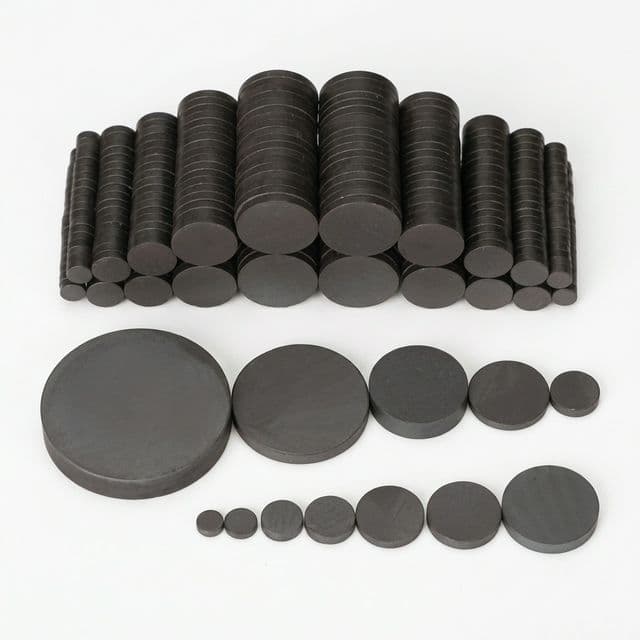
CEN/TS 18263:2026 Permanent Magnet Labeling: A Sourcing Guide for Ferrite Buyers
Learn how CEN/TS 18263:2026 affects custom ferrite magnet RFQs, supplier audits, labeling data, and EU DPP readiness before 2026 sourcing programs launch.

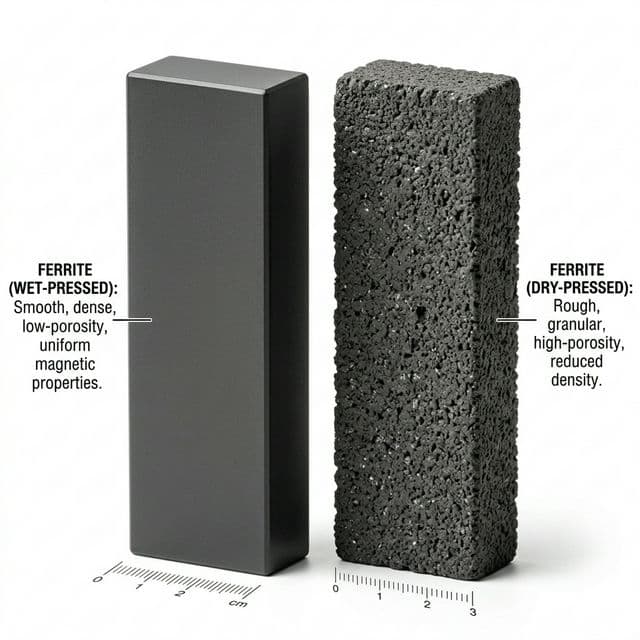
Wet Press vs Dry Press Ferrite: Process Selection for OEM Programs
How to choose wet-pressed or dry-pressed ferrite routes based on geometry, consistency targets, and total manufacturing economics.
Mid-2026 OEM Magnet Sourcing: Impact of the Magnets Value Chain Support Act & Tariff Updates
Decision brief for OEM engineers and sourcing managers on the 2026 tariff updates and the newly introduced Magnets Value Chain Support Act, and what it means for custom ferrite magnet procurement.
Inquiry Email
Copy the email, or open your default email app to start an inquiry.